







Question: Write out formulas for inputs. Suppose you purchase a 30-year, zero-coupon bond with a yield to marry of 6%. You hold the bond for five
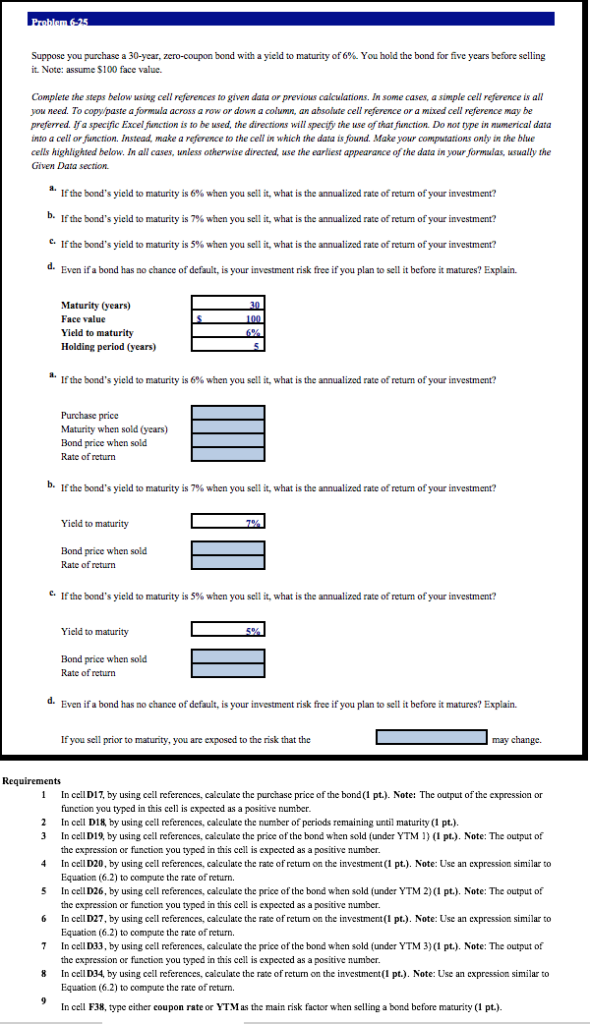
Write out formulas for inputs.
Suppose you purchase a 30-year, zero-coupon bond with a yield to marry of 6%. You hold the bond for five years before selling it. Note: assume S100 face value. Complete the steps below using cell references to given data or previous calculations. In some cases, a simple cell reference is all you need. To copypaste a formula across a row or down a column, an absoliute cell reference or a mixed cell reference may be preferred. ifa specific Excel fiunction is to be used, the directions will specify the use of that fiunction. Do not type in nmerical data into a cell or function. Instead, make a reference to the cell in which the data is found. Make your computations only in the blue cells highlighsed below. In all cases, unless otherwise directed, use the earliest appearance of the data in your formaulas, usually the Given Data section. Ifthe bond's yield to maturity is 6% when you sell it, what is the annualized rate of return of your investment? b. If the bond's yield to maturity is 7% when you sell it, what is the annualized rate of return of your investment? c. If the bond's yield to maturity is 5% when you sell it, what is the annualized rate of return of your investment? d. Even if a bond has no chance of default, is your investment risk free if you plan to sell it before it matures? Explain. Maturity (years) Face value Yield to maturity Holding period (years) If the bond's yield to maturity is 6% when you sell it, what is the annualized rate of return of your investment? Purchase price Maturity when sold (years) Bond price when sold Rate of return b. If the bond's yield to maturity is 7% when you sell it, what is the annualized rate of return of your investment? Yield to maturity Bond price when sold Rate of return c. If the bond's yield to maturity is 5% when you sell it, what is the annualized rate of return of your investment? Yield to maturity Bond price when sold Rate of return d. Even if a bond has no chance of default, is your investment risk free if you plan to sell it before it matures? Explain. If you sell prior to maturity, you are exposed to the risk that the may change. Requirements 1 In cell D17, by using cell references, calculare the purchase price of the bond (1 pt.). Note: The output of the expression or function you typed in this cel is expected as a positive number. 2 In cell DI by using cell references, calculate the number of periods remaining until maturity (1 pt.) 3 In cell D19, by using cell references, calculace the price of the bond when sold (under YTM) ( pt.). Note: The output of 4 In cel D20, by using cell references, calculate the rate of return on the investment (1 pt.) Note: Use an expression similar to 5 In cell D26, by using cell references, calculate the price of the bond when sold (under YTM 2)(1 pt.). Note: The output of 6 In cel D27, by using cell references, calculare the rate of return on the investment(1 pt.). Note: Use an expression similar to 7 In cell D33, by using cell references, calculate the price of the bond when sold (under YTM 3) ( pt.). Note: The output of 8 In cel D34, by using ceil references, calculare the rate of return on the investment(1 pt.). Note: Use an expression similar to the expression or function you typed in this cell is expected as a positive number. Equation (6.2) to compute the rate of return. the expression or function you typed in this cell is expected as a positive number. Equation (6.2) to compute the rate of return. the expression or function you typed in this cell is expected as a positive number. Equation (6.2) to compute the rate of return. In cell F38, type cither coupon rate or YTM as the main risk factor when selling a bond before maturity (I pt.)
Step by Step Solution
There are 3 Steps involved in it

Get step-by-step solutions from verified subject matter experts
 Study Help