







Question: Write programs in Arithlang 26 pt) Implement an interpreter for AbstractLang described as follows. You can modify from the ArithLang code. (a) This language contains
Write programs in Arithlang
26 pt) Implement an interpreter for AbstractLang described as follows. You can modify from the
ArithLang code.
(a) This language contains only three terminals, 0, p, n, u
(b) p represents positive numbers, n represents negative numbers and u represent unknown values
(c) There are three operators *, -, + that can be applied on the terminals, their syntactic rules are
similar to *, - and + in ArithLang, except that each operator only can take two operands
(d) The semantics of AbstractLang are defined by the following rules (the first column in the table
represents the first operand and the first row in the table represents the second operand of the
operation):
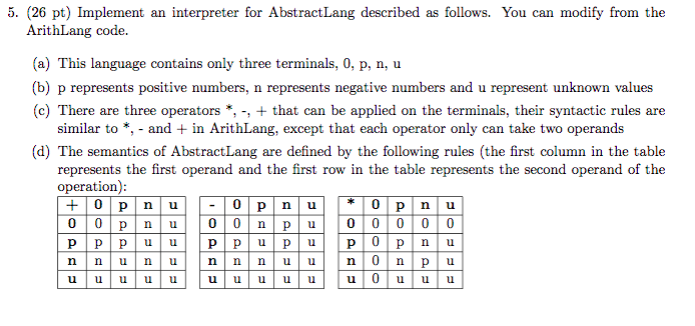
5. (26 pt) Implement an interpreter for AbstractLang described as follows. You can modify from the ArithLang code. (a) This language contains only three terminals, 0, p, n, u (b) p represents positive numbers, n represents negative numbers and u represent unknown values (c) There are three operators *, -, that can be applied on the terminals, their syntactic rules are similar to *, - and + in ArithLang, except that each operator only can take two operands (d) The semantics of AbstractLang are defined by the following rules (the first column in the table represents the first operand and the first row in the table represents the second operand of the operation) 5. (26 pt) Implement an interpreter for AbstractLang described as follows. You can modify from the ArithLang code. (a) This language contains only three terminals, 0, p, n, u (b) p represents positive numbers, n represents negative numbers and u represent unknown values (c) There are three operators *, -, that can be applied on the terminals, their syntactic rules are similar to *, - and + in ArithLang, except that each operator only can take two operands (d) The semantics of AbstractLang are defined by the following rules (the first column in the table represents the first operand and the first row in the table represents the second operand of the operation)
Step by Step Solution
There are 3 Steps involved in it

Get step-by-step solutions from verified subject matter experts
 Study Help