Question: write the disussion using critical thinking skills taht go beyond a undegrdautes way of thinking. use these for support: The Coaches Training Institute. (2011). Coaching
write the disussion using critical thinking skills taht go beyond a undegrdautes way of thinking. use these for support: The Coaches Training Institute. (2011). Coaching vs. therapy: What are the differences and when do you refer? Download Coaching vs. therapy: What are the differences and when do you refer?https://coriehurst.com/wp-content/uploads/2017/07/Coaching-vs-Therapy.pdfThe Coaches Training Institute. (n.d.). Coaching vs. therapy: What are the differences and when do you refer? https://coriehurst.com/wp-content/uploads/2017/07/Coaching-vs-Therapy.pdf?. Used with permission of The Coaches Training Institute.Giberson, T., & Miklos, S. (2012). CoachingLinks to an external site.. TIP: The Industrial-Organizational Psychologist, 49(3), 53.Haynes, C. (2015). Special issues in organization developmentLinks to an external site.. In W. J. Rothwell (Ed.), Organization development fundamentals: Managing strategic change. ATD Press.Jovanovic, T. (2024, March 7). Coaching vs. mentoring vs. training: Differences & similaritiesLinks to an external site.. Trafft. https://trafft.com/mentoring-vs-coaching/McKinsey & Company. (2023). The state of organizations 2023Links to an external site.. https://www.mckinsey.com/~/media/mckinsey/business%20functions/people%20and%20organizational%20performance/our%20insights/the%20state%20of%20organizations%202023/the-state-of-organizations-2023.pdfMyers, A. C., & Bachkirova, T. (2018). Towards a process-based typology of workplace coachi
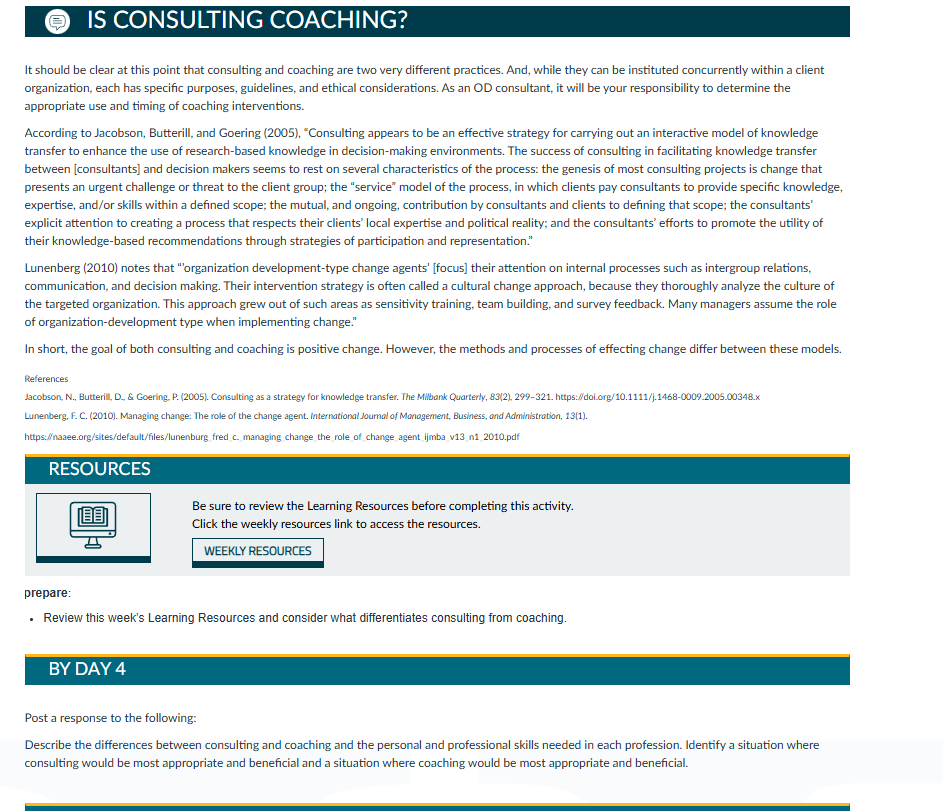
|S CONSULTING COACHING? lt should be clear at this point that consulting and coaching are two very different practices. And, while they can be instituted concurrently within a client organization, each has specific purposes, guidelines, and ethical considerations. As an OD consultant, it will be your responsibility to determine the appropriate use and timing of coaching interventions. According to Jacobson, Butterill, and Goering (2005), \"Consulting appears to be an effective strategy for carrying out an interactive model of knowledge transfer to enhance the use of research-based knowledge in decision-making environments. The success of consulting in facilitating knowledge transfer between [consultants] and decision makers seems to rest on several characteristics of the process: the genesis of most consulting projects is change that Presents an urgent challenge or threat to the client group; the \"service\" model of the process, in which clients pay consultants to provide specific knowledge, expertise, and/or skills within a defined scope: the mutual, and ongoing, contribution by consultants and clients to defining that scope; the consultants' explicit attention to creating a process that respects their clients' local expertise and political reality: and the consultants' efforts to promote the utility of their knowledge-based recommendations through strategies of participation and representation\" Lunenberg (2010) notes that \"organization development-type change agents' [focus] their attention on internal processes such as intergroup relations, communication, and decision making. Their intervention strategy is often called a cultural change approach, because they thoroughly analyze the culture of the targeted organization. This approach grew out of such areas as sensitivity training, team building, and survey feedback. Many managers assume the role of organization-development type when implementing change." In short, the goal of both consulting and coaching is positive change. However, the methods and processes of effecting change differ between these models. References Jacobson, W., ButterillL DL & Goering. P. (2005). Consulting as a strategy for knowledge transfer. The Milbank Quarterly, $312), 297-321. hitps:'dolore!10.1111/).1448-0009_2005.00348. Lunenberg, F.C. (2020). Managing change: The role of the change agent. international Journal of Managerent, Business, and Admwalstrabien, 13[1). hittps:Winaaee.ore 'sites/default/fles/lunenburg fred co managing change the role of change agent |jmba v13 m1 2010.pdf RESOURCES Be sure to review the Learning Resources before completing this activity. (Click the weekly resources link to access the resources. WEEKLY RESOURCES Review this week's Learning Resources and consider what differentiates consulting irom coaching. BY DAY 4 Post a response to the following: prepare: Describe the differences between consulting and coaching and the personal and professional skills needed in each profession. Identify a situation where consulting would be most appropriate and beneficial and a situation where coaching would be most appropriate and beneficial