







Question: Write the function removeN() which removes N elements from the array starting at a given position. We are currently working on Arrays and Algorithms and
Write the function removeN() which removes "N" elements from the array starting at a given position.
We are currently working on Arrays and Algorithms and I would appreciate some help with the function and below the picture is the support file.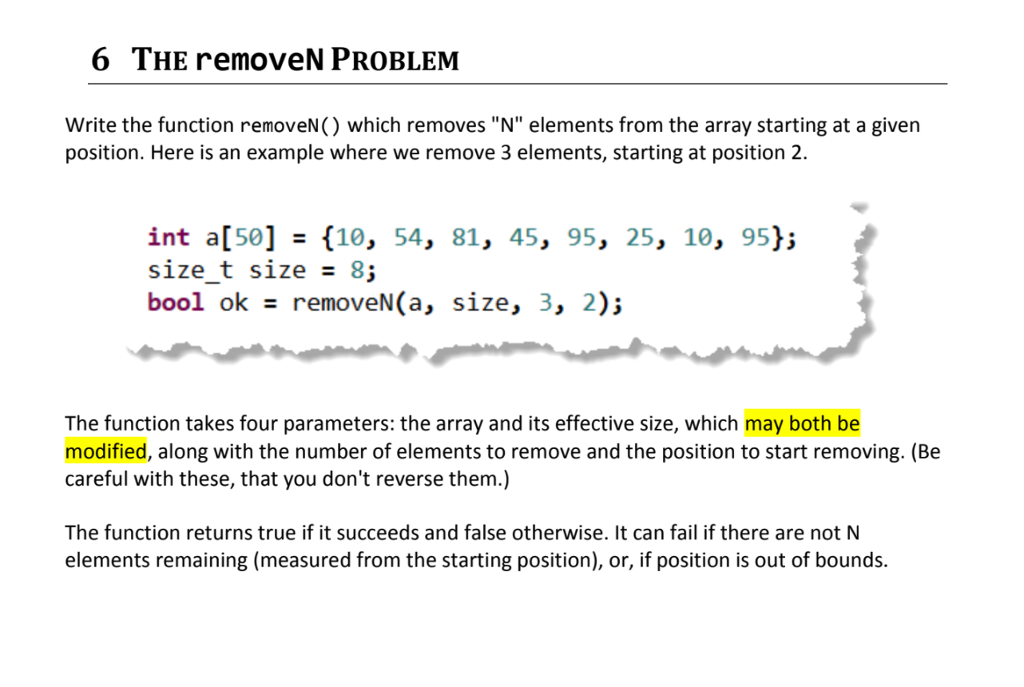
/**
CS 150 PARTIALLY FILLED ARRAYS
Follow the instructions on your handout to complete the
requested function. You may not use any library functions
or include any headers, except for
*/
#include
///////////////// WRITE YOUR FUNCTION BELOW THIS LINE ///////////////////////
// function here
///////////////// WRITE YOUR FUNCTION ABOVE THIS LINE ///////////////////////
// These are OK after the function
#include
#include
#include
using namespace std;
string toString(const int a[], size_t size);
void studentTests()
{
cout
cout
cout
{
const int CAP = 30;
int a[CAP] = {10, 54, 81, 45, 95, 25, 10, 95};
size_t size = 8;
cout
cout "
bool ok = removeN(a, size, 3, 2);
cout " "
cout [10, 54, 25, 10, 95], return->true"
}
{
const int CAP = 30;
int a[CAP] = {20, 10, 95};
size_t size = 3;
cout
cout "
bool ok = removeN(a, size, 2, 1);
cout " "
cout [20], return->true"
}
{
const int CAP = 30;
int a[CAP] = {20, 10, 95};
size_t size = 3;
cout
cout "
bool ok = removeN(a, size, 3, 1);
cout " "
cout [20, 10, 95], return->false"
}
cout
cout
}
string toString(const int a[], size_t size)
{
ostringstream out;
out
if (size > 0)
{
out
for (size_t i = 1; i
out
}
out
return out.str();
}
int main()
{
studentTests();
}
6 THE removeN PROBLEM Write the function removeN() which removes "N" elements from the array starting at a given position. Here is an example where we remove 3 elements, starting at position 2. int a[50] 10, 54, 81, 45, 95, 25, 10, 95}; size size - 8; bool ok removeN(a, size, 3, 2); t The function takes four parameters: the array and its effective size, which may both be modified, along with the number of elements to remove and the position to start removing. (Be careful with these, that you don't reverse them.) The function returns true if it succeeds and false otherwise. It can fail if there are not N elements remaining (measured from the starting position), or, if position is out of bounds
Step by Step Solution
There are 3 Steps involved in it

Get step-by-step solutions from verified subject matter experts
 Study Help