







Question: Write the quadratic equation in standard form and then identify the vertex and x-intercepts. 9. f(x) = x-8x+16 11. f(x)=3x+21x-54 10. f(x)=(x+2x-3) 12. f(x)=6x+x-5
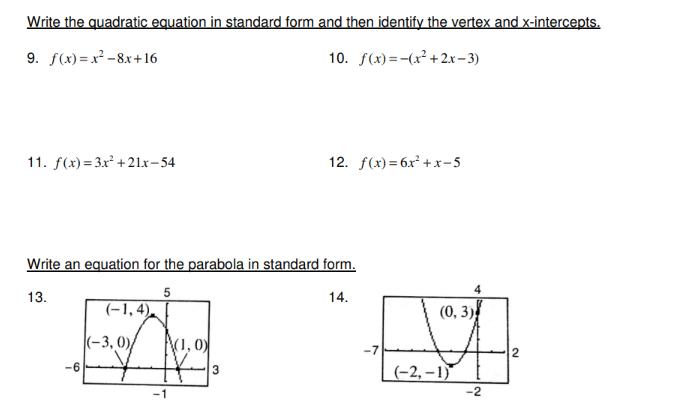




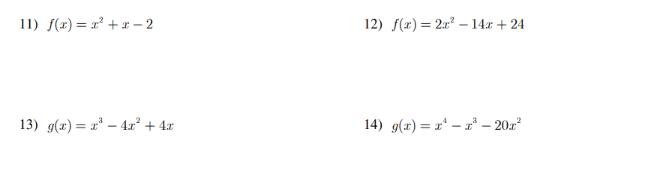
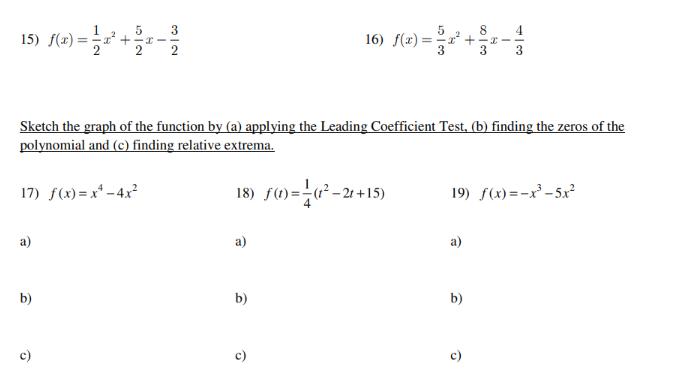

Write the quadratic equation in standard form and then identify the vertex and x-intercepts. 9. f(x) = x-8x+16 11. f(x)=3x+21x-54 10. f(x)=(x+2x-3) 12. f(x)=6x+x-5 Write an equation for the parabola in standard form. 13. 5 (-1,4) (-3, 0)/ (1, 0) -6 3 -1 14. (0,3) 4 (-2,-1) -2 2 5 3 15. Vertex: (-2, 5) and Point: (0, 9) 16. Vertex: and Point: (-2, 4) Solve by factoring. 18.) x-15x+56.x=0 19.) x=16 20.) x-x=0 21.) x-4x+3=0 Solve by using the quadratic formula and state the nature of the roots. 22.) 4x-8x+3=0 23.) 2x2-x+1=0 24.) x-7x+9=0 Use the Leading Coefficient Test to determine the end behavior of the polynomial function. 1) f(x)=2x-3x+1 1 2) f(x) = x+5x 3 3) g(x)=5-7x-3x 4) h(x)=1-2" 5) f(x)= 6-2x+4x2-5x 6) f(x)= 3 3x-2x+5 4 7) M() == ( -5 +3) 8) f(x)=7(x+5x-7x+1) Find all the real zeros of the polynomial function. Determine the multiplicity of each zero. 9) h(x) = x-6x+9 10) h(x) = x+10x + 25 11) f(x) = x+x-2 12) f(x) = 2x2 14x+24 - 13) g(x)=x-4x + 4x 14) g(x)=x-x-201 15) f(x)= 5 I 3 16) f(x) = x+ 0000 88 I 47 Sketch the graph of the function by (a) applying the Leading Coefficient Test, (b) finding the zeros of the polynomial and (c) finding relative extrema. 17) f(x) = x-4x a) 18) f(1) = (1-2+1 19) f(x)=-x-5x a) a) b) b) b) -3 -2 -1 y 10 9 8 3 -15 -10 -5 7 2 6 51 4 3 2 -2 3 4-3-2-1 1 1 2 3 -5 -10 15 -20 -25 5 10 15 Use the Intermediate Value Theorem and a graphing calculator to (a) find the intervals of length 1 in which the polynomial function is guaranteed to have a zero, (b) find the approximate zeros of the function, (c) find the approximate relative extrema. 20) f(x)=x-3x +3 21) f(x)=3x+4x-3 22) f(x)=0.11x-2.07x+9.81x-6.88 a) a) a) b) b) b) 6
Step by Step Solution
There are 3 Steps involved in it

Get step-by-step solutions from verified subject matter experts
 Study Help