Question: Write two paragraphs for Chapter 12 (Maximum seven grammatically correct complete sentences in each paragraph). One summarizing the chapter and one what you learned in
Writetwo paragraphs for Chapter 12 (Maximum seven grammatically correct complete sentences in each paragraph). One summarizing the chapter and one what you learned in each chapter. It should be your reflection of the material you read. Which new concepts did you learn, what surprised you the most and how will you apply these new concepts in your personal and work life.
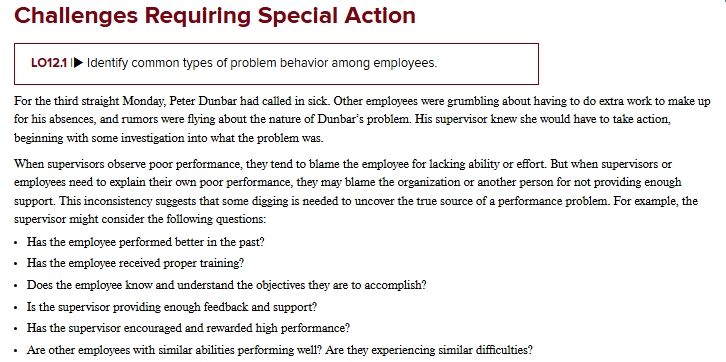
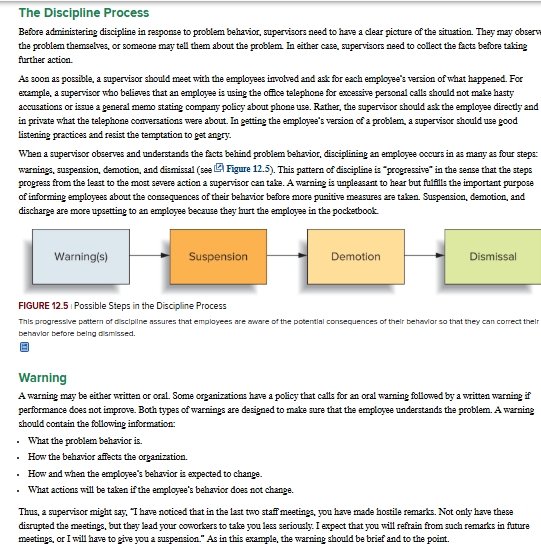
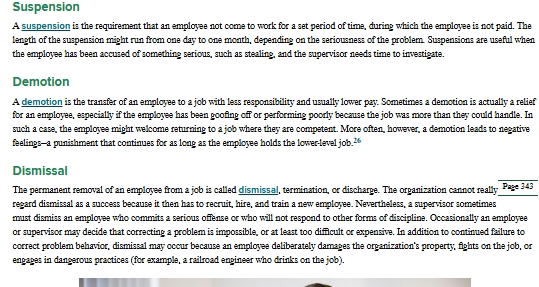
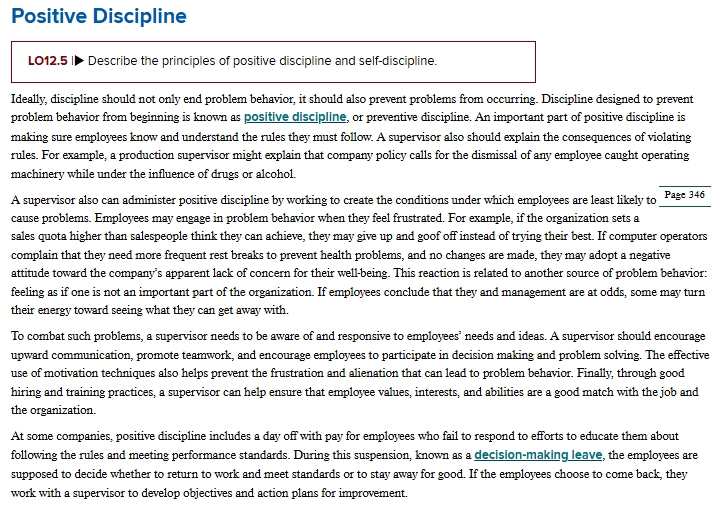
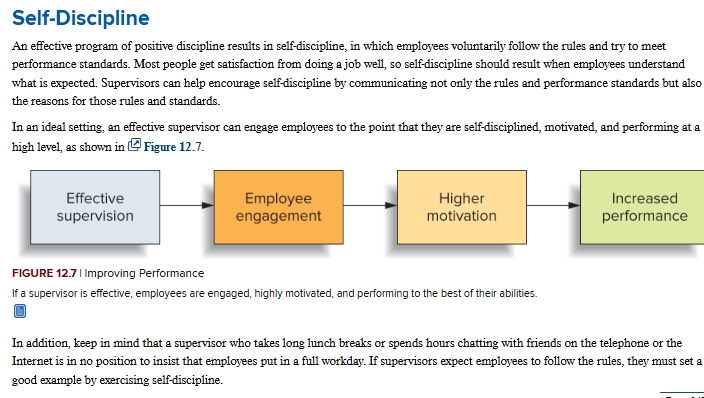
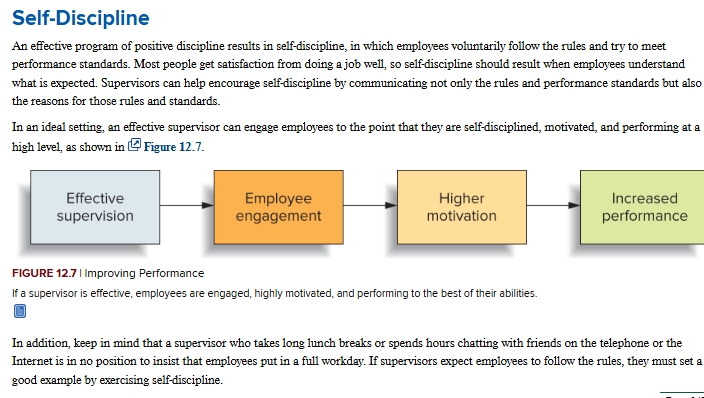
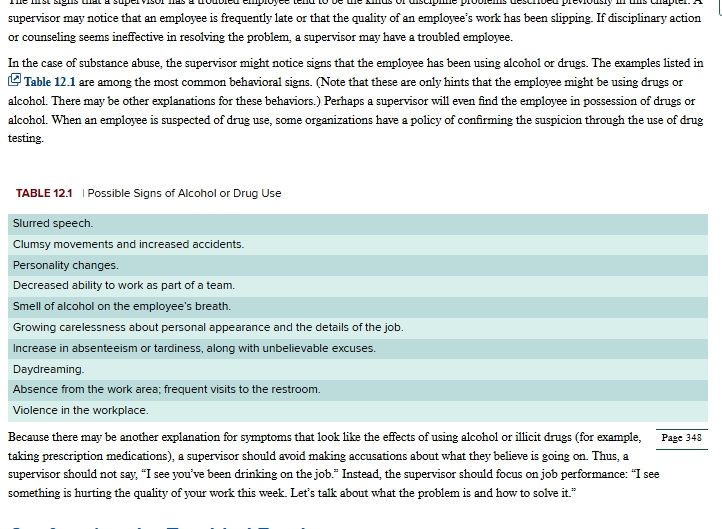
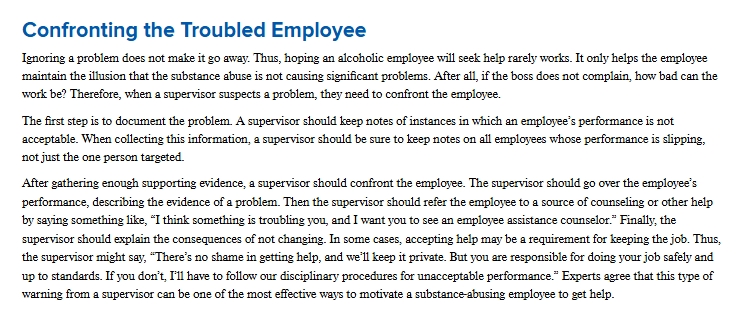
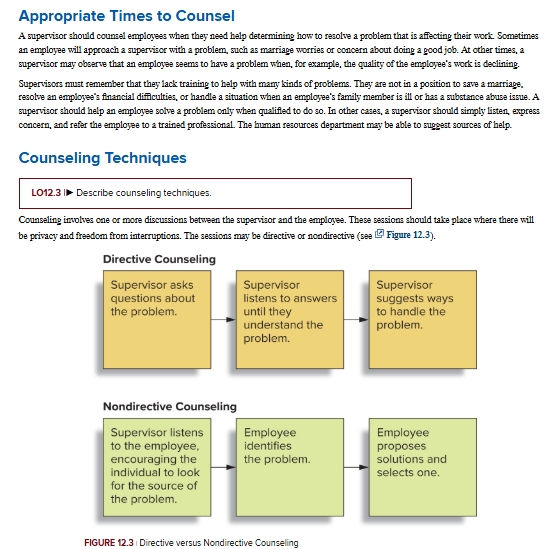
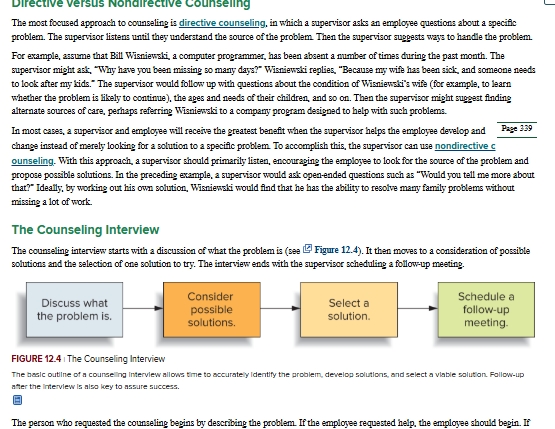
Challenges Requiring Special Action LO12.1 |> Identify common types of problem behavior among employees. For the third straight Monday, Peter Dunbar had called in sick. Other employees were grumbling about having to do extra work to make up for his absences, and rumors were flying about the nature of Dunbar's problem. His supervisor knew she would have to take action, beginning with some investigation into what the problem was. When supervisors observe poor performance, they tend to blame the employee for lacking ability or effort. But when supervisors or employees need to explain their own poor performance, they may blame the organization or another person for not providing enough support. This inconsistency suggests that some digging is needed to uncover the true source of a performance problem. For example, the supervisor might consider the following questions: . Has the employee performed better in the past? . Has the employee received proper training? . Does the employee know and understand the objectives they are to accomplish? . Is the supervisor providing enough feedback and support? . Has the supervisor encouraged and rewarded high performance? . Are other employees with similar abilities performing well? Are they experiencing similar difficulties?The Discipline Process Before administering discipline in response to problem behavior, supervisors need to have a clear picture of the situation. They may observ the problem themselves, or someone may tell them about the problem In either case, supervisors need to collect the facts before taking further action. As soon as possible, a supervisor should meet with the employees involved and ask for each employee's version of what happened. For example, a supervisor who believes that an employee is using the office telephone for excessive personal calls should not make hasty accusations of issue a general memo stating company policy about phone use. Rather, the supervisor should ask the employee directly and in private what the telephone conversations were about. In getting the employee's version of a problem, a supervisor should use good Listening practices and resist the temptation to get angry. When a supervisor observes and understands the facts behind problem behavior, disciplining an employee occurs in as many as four steps: warnings, suspension, demotion, and dismissal (see ' Figure 12.5). This pattern of discipline is "progressive" in the sense that the steps progress from the least to the most severe action a supervisor can take. A warning is unpleasant to hear but fulfills the important purpose of informing employees about the consequences of their behavior before more punitive measures are taken. Suspension, demotion, and discharge are more upsetting to an employee because they hurt the employee in the pocketbook Warning(s) Suspension Demotion Dismissal FIGURE 12.5 i Possible Steps in the Discipline Process This progressive pattern of discipline assures that employees are aware of the potential consequences of their behavior so that they can correct their behavior before being dismissed. Warning A warning may be either written or oral. Some organizations have a policy that calls for an oral warning followed by a written warning if performance does not improve. Both types of warnings are designed to make sure that the employee understands the problem. A warning should contain the following information: What the problem behavior is. How the behavior affects the organization. How and when the employee's behavior is expected to change. What actions will be taken if the employee's behavior does not change. Thus, a supervisor might say, "I have noticed that in the last two staff meetings, you have made hostile remarks. Not only have these disrupted the meetings, but they lead your coworkers to take you less seriously. I expect that you will refrain from such remarks in future meetings, or I will have to give you a suspension." As in this example, the warning should be brief and to the point.Suspension A suspension is the requirement that an employee not come to work for a set period of time, during which the employee is not paid. The length of the suspension might run from one day to one month, depending on the seriousness of the problem Suspensions are useful when the employee has been accused of something serious, such as stealing, and the supervisor needs time to investigate. Demotion A demotion is the transfer of an employee to a job with less responsibility and usually lower pay. Sometimes a demotion is actually a relief for an employee, especially if the employee has been goofing off or performing poorly because the job was more than they could handle. In such a case, the employee might welcome returning to a job where they are competent. More often, however, a demotion leads to negative feelings-a punishment that continues for as long as the employee holds the lower-level job."* Dismissal The permanent removal of an employee from a job is called dismissal, termination, or discharge. The organization cannot really Pas: 343 regard dismissal as a success because it then has to recruit, hire, and train a new employee. Nevertheless, a supervisor sometimes most dismiss an employee who commits a serious offense or who will not respond to other forms of discipline. Occasionally an employee or supervisor may decide that correcting a problem is impossible, or at least too difficult or expensive. In addition to continued failure to correct problem behavior, dismissal may occur because an employee deliberately damages the organization's property, fights on the job, or engages in dangerous practices (for example, a railroad engineer who drinks on the job).Positive Discipline LO12.5 |> Describe the principles of positive discipline and self-discipline. Ideally, discipline should not only end problem behavior, it should also prevent problems from occurring. Discipline designed to prevent problem behavior from beginning is known as positive discipline, or preventive discipline. An important part of positive discipline is making sure employees know and understand the rules they must follow. A supervisor also should explain the consequences of violating rules. For example, a production supervisor might explain that company policy calls for the dismissal of any employee caught operating machinery while under the influence of drugs or alcohol. A supervisor also can administer positive discipline by working to create the conditions under which employees are least likely to Page 346 cause problems. Employees may engage in problem behavior when they feel frustrated. For example, if the organization sets a sales quota higher than salespeople think they can achieve, they may give up and goof off instead of trying their best. If computer operators complain that they need more frequent rest breaks to prevent health problems, and no changes are made, they may adopt a negative attitude toward the company's apparent lack of concern for their well-being. This reaction is related to another source of problem behavior: feeling as if one is not an important part of the organization. If employees conclude that they and management are at odds, some may turn their energy toward seeing what they can get away with. To combat such problems, a supervisor needs to be aware of and responsive to employees' needs and ideas. A supervisor should encourage upward communication, promote teamwork, and encourage employees to participate in decision making and problem solving. The effective use of motivation techniques also helps prevent the frustration and alienation that can lead to problem behavior. Finally, through good hiring and training practices, a supervisor can help ensure that employee values, interests, and abilities are a good match with the job and the organization. At some companies, positive discipline includes a day off with pay for employees who fail to respond to efforts to educate them about following the rules and meeting performance standards. During this suspension, known as a decision-making leave, the employees are supposed to decide whether to return to work and meet standards or to stay away for good. If the employees choose to come back, they work with a supervisor to develop objectives and action plans for improvement.Self-Discipline An effective program of positive discipline results in self-discipline, in which employees voluntarily follow the rules and try to meet performance standards. Most people get satisfaction from doing a job well, so self-discipline should result when employees understand what is expected. Supervisors can help encourage self-discipline by communicating not only the rules and performance standards but also the reasons for those rules and standards. In an ideal setting, an effective supervisor can engage employees to the point that they are self-disciplined, motivated, and performing at a high level, as shown in & Figure 12.7. Effective Employee Higher Increased supervision engagement motivation performance FIGURE 12.7 | Improving Performance If a supervisor is effective, employees are engaged, highly motivated, and performing to the best of their abilities. In addition, keep in mind that a supervisor who takes long lunch breaks or spends hours chatting with friends on the telephone or the Internet is in no position to insist that employees put in a full workday. If supervisors expect employees to follow the rules, they must set a good example by exercising self-discipline.Self-Discipline An effective program of positive discipline results in self-discipline, in which employees voluntarily follow the rules and try to meet performance standards. Most people get satisfaction from doing a job well, so self-discipline should result when employees understand what is expected. Supervisors can help encourage self-discipline by communicating not only the rules and performance standards but also the reasons for those rules and standards. In an ideal setting, an effective supervisor can engage employees to the point that they are self-disciplined, motivated, and performing at a high level, as shown in & Figure 12.7. Effective Employee Higher Increased supervision engagement motivation performance FIGURE 12.7 | Improving Performance If a supervisor is effective, employees are engaged, highly motivated, and performing to the best of their abilities. In addition, keep in mind that a supervisor who takes long lunch breaks or spends hours chatting with friends on the telephone or the Internet is in no position to insist that employees put in a full workday. If supervisors expect employees to follow the rules, they must set a good example by exercising self-discipline.supervisor may notice that an employee is frequently late or that the quality of an employee's work has been slipping. If disciplinary action or counseling seems ineffective in resolving the problem, a supervisor may have a troubled employee. In the case of substance abuse, the supervisor might notice signs that the employee has been using alcohol or drugs. The examples listed in L Table 12.1 are among the most common behavioral signs. (Note that these are only hints that the employee might be using drugs or alcohol. There may be other explanations for these behaviors.) Perhaps a supervisor will even find the employee in possession of drugs or alcohol. When an employee is suspected of drug use, some organizations have a policy of confirming the suspicion through the use of drug testing. TABLE 12.1 | Possible Signs of Alcohol or Drug Use Slurred speech. Clumsy movements and increased accidents. Personality changes. Decreased ability to work as part of a team. Smell of alcohol on the employee's breath. Growing carelessness about personal appearance and the details of the job. Increase in absenteeism or tardiness, along with unbelievable excuses. Daydreaming. Absence from the work area; frequent visits to the restroom. Violence in the workplace. Because there may be another explanation for symptoms that look like the effects of using alcohol or illicit drugs (for example, Page 348 taking prescription medications), a supervisor should avoid making accusations about what they believe is going on. Thus, a supervisor should not say, "I see you've been drinking on the job." Instead, the supervisor should focus on job performance: "I see something is hurting the quality of your work this week. Let's talk about what the problem is and how to solve it."Confronting the Troubled Employee Ignoring a problem does not make it go away. Thus, hoping an alcoholic employee will seek help rarely works. It only helps the employee maintain the illusion that the substance abuse is not causing significant problems. After all, if the boss does not complain, how bad can the work be? Therefore, when a supervisor suspects a problem, they need to confront the employee. The first step is to document the problem. A supervisor should keep notes of instances in which an employee's performance is not acceptable. When collecting this information, a supervisor should be sure to keep notes on all employees whose performance is slipping, not just the one person targeted. After gathering enough supporting evidence, a supervisor should confront the employee. The supervisor should go over the employee's performance, describing the evidence of a problem. Then the supervisor should refer the employee to a source of counseling or other help by saying something like, "I think something is troubling you, and I want you to see an employee assistance counselor." Finally, the supervisor should explain the consequences of not changing. In some cases, accepting help may be a requirement for keeping the job. Thus, the supervisor might say, "There's no shame in getting help, and we'll keep it private. But you are responsible for doing your job safely and up to standards. If you don't, I'll have to follow our disciplinary procedures for unacceptable performance." Experts agree that this type of warning from a supervisor can be one of the most effective ways to motivate a substance abusing employee to get help.Aid in and Evaluation of Recovery LO127 | Specify how supervisors can direct troubled employees in getting help and then follow up on the recovery efforts. Most organizations have developed procedures for providing help to troubled employees. When a supervisor believes that problems are occurring because an employee is troubled, the organization's procedures need to be investizated. In most cases, the place to start is with the human resources department. The type of treatment program tends to depend on the size of the organization. Many small organizations refer troubled employees to a counseling service. Another policy is simply to tell the employee to get help of lose the job. A supervisor should be careful in pursuins the latter approach. If possible, the ultimate objective should be the employee's rehabilitation, not dismissal. Not only is rehabilitation more compassionate, but it also tends to be less costly than hiring and training a new employee, and it is less likely to violate laws prohibiting employment discrimination. providing counseling and related help to employees whose personal problems affect their performance.*! It may be simply a referral service, or it may be fully staffed with social workers, psychologists, nurses, career counselors, financial advisers, and other professionals. These programs are voluntary (employees do not have to participate unless they want to) and confidential (participation 1s a private matter). Services of EAPs include recovery from substance abuse, financial and career counselins, referrals for child care and elder care, AIDS education and counseling, and helping employees work with others of a different cultural backeroond. [ Figure 17.8 identifies the benefits that organizations have experienced as a result of using EAPs. A supervisor who 1s concerned about troubled employees micht investigate such benefits and encourage the organization to consider offering an EAP Some employees would be unlikely to seek out help without the push of a referral from their supervisor. Sources of Support LO12.8 1)> Discuss the role of the supervisor's manager and the human resources department in helping the supervisor with employee challenges. Supervising problem employees is a delicate matter. Supervisors must be careful to motivate and correct rather than to generate hostility and resentment. At the same time, supervisors must be careful to follow organizational procedures, union requirements, and laws regarding fair employment practices. Fortunately, supervisors can get support from their superiors, the organization's human resources department, and outside experts. When an employee fails to respond to initial counseling attempts, a supervisor should try discussing the problem with their manager. The manager may be able to offer insights into how to handle the problem. In addition, some steps, such as suspension or dismissal, may require that the supervisor get authorization from a higher-level manager. It is also wise to consult with the human resources department, which has information about company policies on discipline and Page 350 how to document it. Human resources personnel can advise a supervisor on how to proceed without breaking laws, violating a contract with the union, or putting the organization at risk in case of a lawsuit. In addition, personnel specialists have expertise that can make them good sources of ideas on what to say or what corrective measures to propose. Sometimes just talking about a strategy helps a supervisor to think of new ways to approach the problem. In small organizations with no human resource staff, a supervisor and their manager may agree that the problem requires the help of outside experts. They may contract with a consultant, a labor attorney, or a human relations specialist who provides services on a temporary basis. The fee paid to such an expert may seem high but can be far less than the cost of defending a wrongful-termination lawsuit. The local office of the Small Business Administration (SBA) also may be able to provide help. The SBA assistance may include a referral to an executive in one of its programs for providing small businesses with free advice. In summary, when an employee's problems or problem behavior threatens to disrupt the workplace, a supervisor should not despair. The effective use of counseling and discipline can solve many of these problems. When they do not, a variety of people inside and outside the organization stand ready to help.Absenteeism and Tardiness An employee who misses work, even part of a day, is expensive for an employer. The company frequently must pay for those unproductive hoursfor example, by providing sick pay to an employee who calls in sick. In addition, the other employees may be less productive when they have to cover for someone who 1s absent o1 tardy. A recent survey found that unscheduled absenteeism costs employers as much as "$3600 per year for each hourly worker and $2,650 for each salaried employee.) Of course, employees who really are sick should take time off. Recent research indicates that injuries, illness, and medical Page 333 appointments are the most common causes for missing work? Psychological health stressors such as depression and anxiety are not significantly associated with absenteeiam. Rather, employees seeking mental health treatment for psychological health stressors were more likely to show up for work even when a sickness absence was justified. In other words, employees seelins mental health treatment were more likely to work under suboptimal conditions. Whatever the cause of absenteeism, problems arise when absences are unexcused or recur with suspicious regulanty. In addition, missing work is often a sign of a deeper problem, such as a family crisis, anger about somethines at work, or plans to leave the organization. Effective action against tardiness and absenteeism targets the cause of this problem behavior. Unscheduled absences are more frequent at organizations where morale is poor. The most common reasons eiven for taking unscheduled time off are personal iliness and family isswes_ Employers can help employees manage these needs through programs such as paid tmeoif banks, meanings employees are allowed a given number of paid days off, which they can use when they are sick, have family needs, of want to take a vacation. If an employee takes days off for doctors' appotmtments of famuly crises, fewer days remain for vacationing. Walmart recently announced that it will pay employees monetary bonuses for sood attendance records. In addition, supervisors can reduce absenteeism by creating a positive work environment in Which morale is high. Insubordination and Uncooperativeness When poor performance results from not understanding how to do a job, the solution is relatively simple. A supervisor must make sure that instructions are communicated clearly and that the employee is receiving the proper training. But sometimes employees perform poorly or break rules because they choose to do so. Such an employee may simply be uncooperative, or the employee may engage in insubordinatio n, the deliberate refusal to do what a supervisor or other superior asks. Many kinds of negative behavior fall into these categories. An employee may have a generally poor attitude-criticizing, complaining, and showing a dislike for a supervisor and the organization. The employee might get into arguments over many kinds of issues. An employee may make an art form out of doing as little as possible. The employee might spend most of the day socializing, joking around, or just moving slowly. Another employee might regularly fail to follow rules-"forgetting" to wear safety equipment or sign out at lunchtime. Some employees even blame the supervisor or organization when reprimanded. When the supervisor objects to a problem behavior ("Please don't use your cell phone to make personal calls during work hours"), the employee twists the situation into something the supervisor is supposed to fix ("Well, how am I supposed to manage my kitchen renovation if I can't take contractors' calls at work?"). This type of behavior can go on endlessly unless the supervisor defines specific limits and requires the employee to figure out a way to stay within those limits or be disciplined.4Glow Images Direct, LLC Although these problems are serious, it 1s important for supervisors to see the difference between employees who do not do their work properly because they choose not to and employees who do not do their work because they need help. One manager who has this skill is Mike Speckman, vice president of sales for in Silica, a company that sells semiconductors. Speckman once had a salesperson who was disorganized and spent almost every minute on existing customers, rather than cultivating the new ones that could help the company ero: Where some supervisors might have seen a lost cause, Speckman saw an employee with a desire to learn. He decided to travel with the salesperson on calls to prospective customers. On the first call, Speckman led the conversation to show how the work was to be done. On the second call, he and the salesperson worked as a team. On the third call, the salesperson took the lead, and Speckman was there just ti watch and provide support. The coaching save the salesperson the necessary confidence to become successful? Pase 3: Alcohol and Drug Abuse The abuse of alcohol and drugs by workers is costly in several ways. According to the National Safety Council (NSC), \"Workers with substance use disorders ... miss nearly 90 percent more days than their peers, averasine nearly three weeks at (14.8 days) a year") And employees who abuse alcohol and dues are far less productive than their coworkers who stay sober. The NSC reports that workers who abuse alcohol cost the economy $74 billion in lost productivity each year, and abuse of prescription drugs including opioids costs anywhe from $26 to $53 billion.' Unfortunately, substance abuse, inchoding abuse of marijuana, is mot uncommon at work. The situation for manjuana has recently becom more complicated because, while it is still legal under federal law, which acknowledges no accepted medical use, 21 states have made marijuana use legal by adults, and 38 states allow it for medical use.? Marijuana is the most popular illegal abused drug, and about one in five young adults (15 to 25) say they are regular users. Employees who fo to work while hich, however, have 55 percent more accidents at 85 percent more injuries than others, and they are absent more frequently? The Americans with Disabilities Act (ADA), which prohibits discrimination on the basis of physical or mental disability, treats substance abuse arising from an addiction as a disability. Therefore, substance abuse may not be legal erounds for fining an employee. The supervise should encourage the employee to get help, even if doing so requires adjusting the employee's work schedule or permitting the employee t take a disability leave to cet treatment. In addition, actions taken with regard to the employee should focus on work performance, not on the substance abuse itself. For example, a supervisor micht warn, \"If catch you picking fishts with your coworkers again, I will have to suspend you.\" This warning addresses the employee's job-related behavior. (For more on the ADA and other laws azainst employment ee qlee Ge MLS Workplace Violence Millions of incidents of workplace violence, thousands of injuries, and hundreds of fatalities are reported each year. The National Institute for Occupational Safety and Health (NIOSH) classifies workplace violence into four categories: violence motivated by criminal intent, customer client violence, worker-on-worker violence, and violence between people in a personal relationship. In the last category, victims are overwhelmingly women. " According to the Bureau of Labor Statistics, homicide deaths at work were declining through 2015 but still account for several hundred deaths on the job every year. An even 500 workplace homicides occurred in 2016, 458 in 2017, 453 in 2018. and 454 in 2019.12 Several factors contribute to workplace violence. Some occupations, such as driving a taxi or working in law enforcement, are more dangerous than others. Workers who abuse alcohol or drugs or who have psychological problems may be more likely to engage in violence at work. Employees who are under stress, either at work or away, may explode in violence. While other employees handle stress without becoming violent, problems are particularly likely if employees feel they are treated unfairly, fail to communicate their problems effectively. and feel frustrated and unable to do anything about their situation. Together, these circumstances suggest that supervisors may sometimes be able to head off or at least prepare to handle violence by paying close attention to their employees, fostering good communication (see 4 Chapter 10), and treating employees fairly (see " Chapters 2 and (4 4).14 Another factor associated with workplace violence is domestic violence. If an employee is being abused by a spouse, parent, or Page 335 other third party, the abuser may carry violent behavior to the workplace. The employee might receive threatening phone calls or even disruptive visits from the abuser. Domestic violence is behind millions of days of absences each year, and millions more in lost productivity. The problem is widespread, with more than one-fourth of women saying they are or have been victims of domestic violence. IS To address these business losses and out of concern for abused workers and their colleagues, some organizations, including Unilever and University of Buffalo, offer information and help for employees who are victimized at work or at home. " These efforts may include secure parking spaces, flexible hours, and referrals to employee assistance programs for counseling." Whatever the cause, supervisors should be prepared for the possibility of workplace violence." They should be aware of warning signs such as an employee who appears to be under the influence of drugs or alcohol, does not control angry outbursts, has a history of intimidating others, talks about or shows off weapons, and jokes about workplace violence. If an employee complains of feeling threatened by another employee or an outsider, the supervisor should take these concerns seriously. The supervisor also should work with the organization's human resource department to develop and practice plans for moving to safety in the event of a violent incident. The supervisor should turn to the human resource department for assistance if a problem employee seems threatening and does not respond to the basic measures described in this chapter. In that case, or if an employee is coping with domestic violence, the necessary measures may require efforts beyond what the supervisor can provide. In the aftermath of workplace violence, heightened fear, anger, and other emotions may continue to affect employees' ability to cope with their jobs and lives. Supervisors can help the group by providing opportunities to talk over the experience but not pressuring anyone to speak up. If members of the supervisor's staff were injured or killed in a workplace incident, it may be helpful for the supervisor to express concern with a visit or note to the injured workers or the workers' survivors. The supervisor should help the group return gradually to a normal routine. As much as possible, the supervisor should try to project a calm image and allow breaks at times when employees seem overwhelmed. Of course, the supervisor also may feel affected by a violent incident If so. the supervisor should allow time for resting and talking over the situation with a counselor or other trusted person."Appropriate Times to Counsel A supervisor should counsel employees when they need help determining how to resolve a problem that is affecting their work. Sometimes an employee will approach a supervisor with a problem, such as marriage worries or concern about doing a good job. At other times, a supervisor may observe that an employee seems to have a problem when, for example, the quality of the employee's work is declining. Supervisors must remember that they lack training to help with many kinds of problems. They are not in a position to save a marriage, resolve an employee's financial difficulties, or handle a situation when an employee's family member is ill or has a substance abuse issue. A supervisor should help an employee solve a problem only when qualified to do so. In other cases, a supervisor should simply listen, express concern, and refer the employee to a trained professional. The human resources department may be able to suggest sources of help. Counseling Techniques L012.3 I)> Describe counseling techniques. Counseling involves one or more discussions between the supervisor and the employee. These sessions should take place where there will be privacy and freedom from interruptions. The sessions may be directive or nondirective (see [ Figure 12.3). Directive Counseling Supervisor asks Supervisor Supervisor questions about listens to answers suggests ways the problem. until they to handle the understand the problem. problem. Nondirective Counseling Supervisor listens Employee Employee to the employee, identifies proposes encouraging the the problem. solutions and Individual to look selects one. for the source of the problem. FIGURE 12.3 / Directive versus Nondirective CounselingDirective versus Nondirective Counseling The most focused approach to counseling is directive counseling, in which a supervisor asks an employee questions about a specific problem. The supervisor listens until they understand the source of the problem. Then the supervisor suggests ways to handle the problem. For example, assume that Bill Wisniewski, a computer programmer, has been absent a number of times during the past month. The supervisor might ask, "Why have you been missing so many days?" Wisniewski replies, "Because my wife has been sick, and someone needs to look after my kids." The supervisor would follow up with questions about the condition of Wisniewski's wife (for example, to learn whether the problem is likely to continue ), the apes and needs of their children, and so on. Then the supervisor might suggest finding alternate sources of care, perhaps referring Wisniewski to a company program designed to help with such problems. In most cases, a supervisor and employee will receive the greatest benefit when the supervisor helps the employee develop and Page 309 change instead of merely looking for a solution to a specific problem To accomplish this, the supervisor can use nondirective c ounseling. With this approach, a supervisor should primarily listen, encouraging the employee to look for the source of the problem and propose possible solutions. In the preceding example, a supervisor would ask open-ended questions such as "Would you tell me more about that?" Ideally, by working out his own solution, Wisniewski would find that he has the ability to resolve many family problems without missing a lot of work. The Counseling Interview The counseling interview starts with a discussion of what the problem is (see " Figure 12.4). It then moves to a consideration of possible solutions and the selection of one solution to try. The interview ends with the supervisor scheduling a follow-up meeting. Discuss what Consider Select a Schedule a the problem is. possible follow-up solutions. solution. meeting- FIGURE 12.4 i The Counseling Interview The basic outline of a counseling Interview allows time to accurately Identify the problem, develop solutions, and select a viable solution. Follow-up aMer the Interview Is also key to assure success. The person who requested the counseling begins by describing the problem If the employee requested help, the employee should begin. If
Step by Step Solution
There are 3 Steps involved in it
1 Expert Approved Answer
Step: 1 Unlock
Question Has Been Solved by an Expert!
Get step-by-step solutions from verified subject matter experts
Step: 2 Unlock
Step: 3 Unlock
Students Have Also Explored These Related General Management Questions!









 Study Help