Question: Write two paragraphs for Chapter 14 (Maximum seven grammatically correct complete sentences in each paragraph). One summarizing the chapter and one what you learned in
Writetwo paragraphs for Chapter 14 (Maximum seven grammatically correct complete sentences in each paragraph). One summarizing the chapter and one what you learned in each chapter. It should be your reflection of the material you read. Which new concepts did you learn, what surprised you the most and how will you apply these new concepts in your personal and work life.
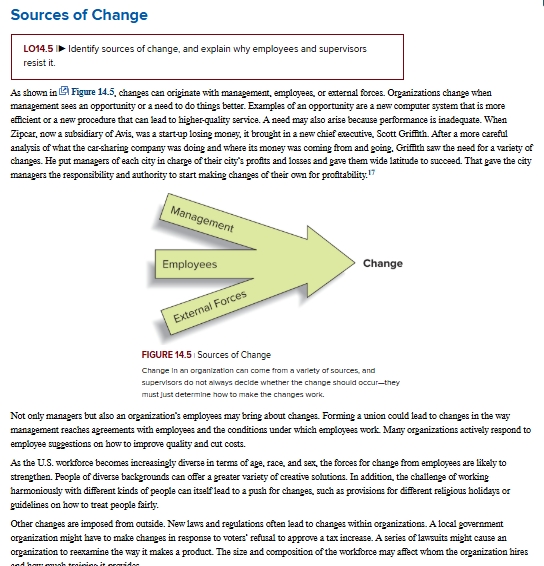
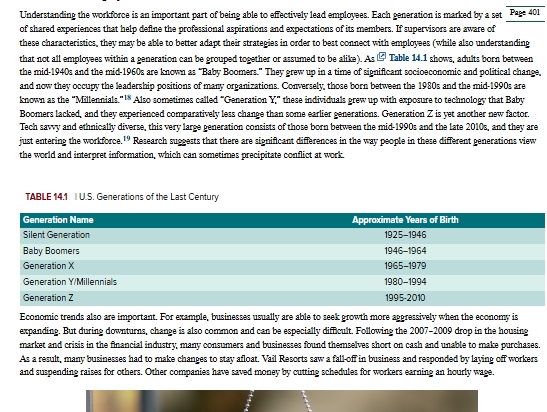
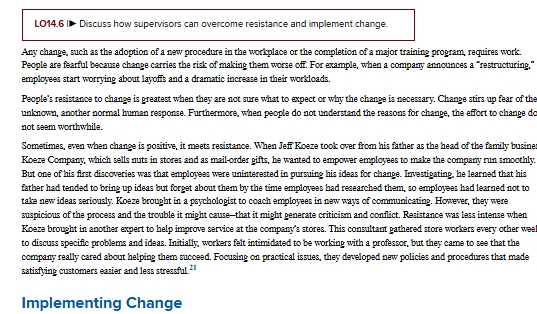
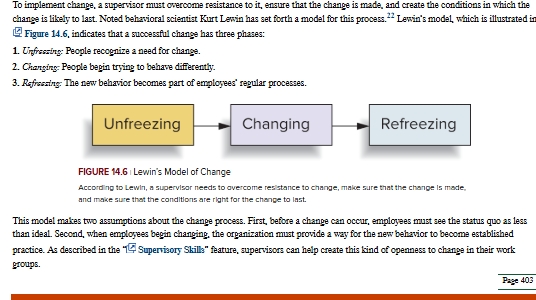
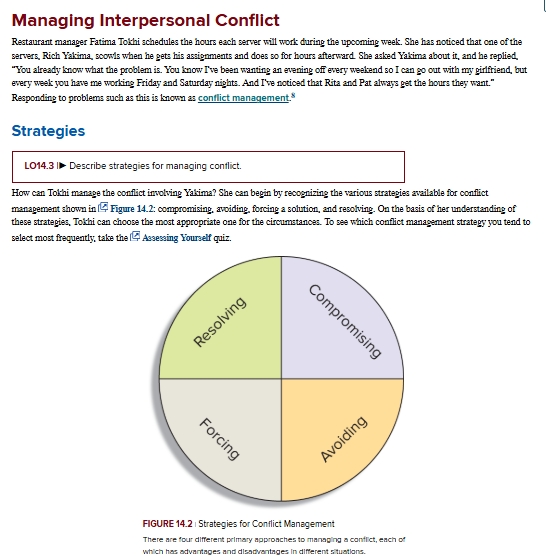
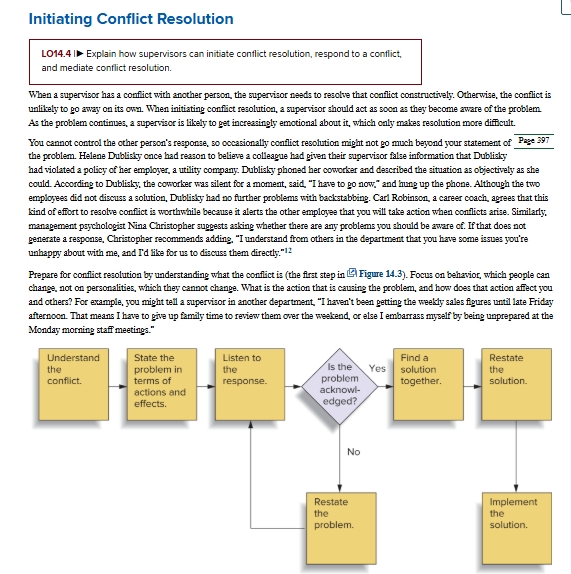
Conflict In the context of this book, conflict refers to the struggle that results from incompatible or opposing needs, feelings, thoughts, Page 39 or demands within a person or between two or more people. If supervisor Janelle Speers-March sees that an employee she likes is taking home office supplies, her feelings for the employee come into conflict with her belief that stealing is wrong. If her feelings and beli are both strong, she will have difficulty resolving the issue. Likewise, if two employees disagree over how to fill out time sheets for sick day there is a conflict between the employees. In this case, the organization should have a clear procedure to make the conflict easy to resolve Positive and Negative Aspects of Conflict LO14.1 ) List positive and negative aspects of conflict. Sometimes conflict is a positive force that can bring about necessary changes. Imagine that a business that develops computerized information systems has hired a new systems analyst. Omar Shah. Shah gets all the boring and routine jobs-filling. running errands, proofreading documentation. If he acts cheerful, the other employees will assume there is no conflict (although he may feel one internally Of course, this situation is not good for Shah; he feels insulted, is bored every day, and is missing out on the experience he needs to devel his career. This arrangement is also bad for the employer, who is paying for a systems analyst but not benefiting from his talents. Furthermore, if Shah quits, the company will have to bear the expense of repeating the hiring process. However, if Shah complains to his supervisor about his limited role, the conflict will surface, and the resolution may leave everyone, including Shah, better off. Thus, when conflict serves as a signal that a problem exists, it can stimulate a creative response. Ongoing conflict also has negative consequences. People who are engaged in disputes are under stress, which takes a physical toll. In addition, people who are busy arguing and trying to persuade others to take their sides are not involved in more productive activities. Finally, depending on the source of the conflict, the people involved may be angry at management or the organization, so they may vent their anger in ways that are destructive to the organization, such as taking extra time off or sabotaging equipment. The consequences of conflict may depend partially on the way that it is resolved. If people treat a conflict as an opportunity for constructive problem solving and change, the outcomes may well be positive. If people routinely see conflict as a need for someone to win at someone else's expense, or for a manager to impose control, the conflict is more likely to have negative consequences. Most notably when conflict is viewed as a win-lose proposition, the loser will experience frustration: that is, defeat in the effort to achie desired goals. An employee who has a request for a flextime arrangement turned down experiences frustration. So does an employee who can't convince a prospective customer to return his phone calls. Most of us can handle a little frustration philosophically, with words such as, "Oh, well, I can't always have my own way" or "No one can have it all." However, repeated frustration tends to generate anger. A frustrated employee may engage in destructive behavior such as sabotage, aggression, insubordination, and absenteeism ( Chapter 12 covers the supervision of employees who engage in such behaviors.) To help supervisors head off problems arising from frustration, this chapter emphasizes forms of conflict resolution aimed at finding a solution that is satisfactory to all parties. Page 3Responding to a conflict Sometimes a supervisor is a party to a conflict that is bothering someone else. When the other person makes the supervisor aware of the conflict, it is up to the supervisor to respond in a way that makes a solution possible. If an employee says, "You always give me the dirty assignments," it is not helpful to get angry or defensive. Understand the Problem The constructive way to respond to a conflict is first to listen to the other person and try to understand what the problem is really about If the other person is emotional, let that person vent those feelings, then get down to discussing the problem. Try to interpret the problem in the terms you would use to express the problem yourself. Avoid statements of blame, and find out what specific actions the other person is referring to. For example, when an employee says, "You always give me the dirty assignments," you can ask the employee to give specific acamples and then describe their feelings about the behavior. Mark Preiser took this important first step when he was a partner with Walter F. Cameron Advertising in Hauppauge, New York An account manager at his agency had committed to delivering a job by a particular deadline, but on the day of the deadline, the artist who was to prepare the visuals called in sick. The furious account manager was on the phone, shouting. He doubted that the artist was sick. Instead, he suspected the weather: The day was snowy, and the artist often missed work on snowy days. Preiser joined the conversation and learned that the artist was afraid. He had been in a serious car accident on a snowy day, and ever since, driving in the snow had terrified him. Preiser worked with the account manager and artist to arrange for the artist to be able to take work home whenever a snowstorm was in the weather forecast.13 Understanding the problem can be complicated if one of the people involved has a "hidden agenda"-a central concern that is left unstated. Typically, a person with a hidden agenda is angry or upset about something but directs those feelings toward some other issue. For example, a colleague in another department explodes, "What's wrong with you? The numbers in your report are off by a mile!" Your colleague is not really angry because you made a mistake. He is nervous because he has to make a presentation to the board of directors, and he wonders if the incorrect members are your way to mislead him so that he looks uninformed and you get the promotion he wants. Or maybe your colleague simply has had a frustrating day, and your mistake is the last straw. If another person's feelings seem to be out of proportion to the problem they are describing, look for a hidden agenda. Finding one can save you from trying to resolve the wrong conflict. In addition, when you are upset about something yourself, it is usually more constructive to describe the problem directly than to leave others guessing at your hidden agenda. Work on a SolutionWhen you understand the problem, build an environment of working together on a solution. To do this, agree with some aspect of what the other person has said. In the previous example, you might say, "You've really disliked your last three assignments." Then you and the other person should be ready to begin identifying possible solutions. The final step is to agree on what the solution will be and how you will carry it out. LI Figure 14.4 summarizes this approach Listen to Interpret Agree with Find a Agree on Implement the the problem something solution how to the complaint. in terms of the other together. carry out solution, actions and person the solution. effects. said FIGURE 14.4 i Responding to a Conflict Responding to and resolving a conflict requires both good listening and communication skills as well as a willingness to work together toward a resolution. Mediating Conflict Resolution Sometimes a supervisor is not personally involved in a conflict, but the parties ask the supervisor to help resolve it. If the parties to the conflict are peers of the supervisor, getting involved can be risky. and the supervisor might be wiser to tactfully refer the peers to a higher- level manager. If the parties to the conflict are the supervisor's employees, then mediating the conflict is part of the supervisor's job and an important way to keep the department functioning as it should. To mediate a conflict, a supervisor should follow these steps: Page 399 1. Begin by establishing a constructive environment. If the employees are calling one another names, have them foous on the issue instead of such destructive behavior 2. Ask each person to explain what the problem is. Get each person to be specific and to respond to the others' charges. 3. When all parties understand what the problem is, have them state individually what they want to accomplish or what will satisfy them. 4. Restate in your own words what each person's position is. Ask the employees if you have understood them correctly. 5. Have all participants suggest as many solutions as they can. Begin to focus on the future. 6. Encourage the employees to select a solution that benefits all of them. They may want to combine or modify some of the ideas suggested. 7. Summarize what has been discussed and agreed on. Make sure all participants know what they are supposed to do in carrying out the solution and ask for their cooperation. Throughout this process, continue your efforts to maintain a constructive environment. Keep the emphasis off personalities and blame; keep it on your mutual desire to find a solution.Change in the Workplace Conflict is both a cause and a consequence of change. When people experience a conflict, they manage it by making changes to the situation of their attitudes. For instance, faced with conflicts between the demands of work and family, employees increasingly have tried to balance the two rather than choose one over the other. Their efforts have forced organizations to consider the adoption of policies and values that are more family friendly. When change occurs-in the workplace and elsewhere-conflict accompanies the need to let go of familiar behaviors and attitudes. The greater desire to balance work and home life is only one of many sources of change in the workplace today. External sources of change include innovations in technology, diversity in the workforce, shifts in global economic power, demographic shifts among workers, and depletion of resources and climate change." The first of those forces, technology has made communication faster and more flexible and has changed job requirements. Especially for workers in high-tech fields, training and retraining are essential for keeping up with industry developments. With stiff international competition, supervisors and higher-level managers endure continuing pressure to cut costs. As the price of health insurance rises year after year, some companies are trying to cut costs by persuading employees to make changes even outside work. Many employers realize that having healthy employees will reduce the cost of health insurance. Healthy people will most likely select lower-cost insurance plans. To encourage health in the workplace. companies have begun wellness programs for workers that offer seminars about developing skills to improve health, getting preventive health screenings, and reducing exposure to hazards at work Because of these and many other changes, an organization's success (its profitability, in the case of a business) depends on how Page 400 we'll it adapts to changes in its environment. For example, an organization must respond when a new competitor enters the marketplace or a new law limits how it may operate. Change is a fact of organizational life, so supervisors do not decide whether organizations should change but how to make the changes work. They can do this better if they recognize the various factors that can affect the success of a change The change agent: The person trying to bring about the change should have skills in implementing change and solving the related problems, as well as expertise in the area affected. Deferednation of what to change: Any changes should make the organization more effective in delivering high quality. The kind of change to be made: The change can involve process and equipment; policies, procedures, and job structure; and people-related variables such as attitudes and communication asills. Individual affected Some people are more open to change than others. Also, people will see some changes as beneficial to them but other changes as harmful. Evaluation of change: An evaluation can indicate whether it is necessary to modify the change process or make further changes. Supervisors are the organization's primary link to operative employees, so they must understand how employees are likely to respond to changes, be able to communicate information about the changes to employees, and help employees respond positively.Sources of Change LO14.5 )> Identify sources of change, and explain why employees and supervisors resist it. As shown in L' Figure 14.5, changes can originate with management, employees, or external forces. Organizations change when management sees an opportunity or a need to do things better. Examples of an opportunity are a new computer system that is more efficient or a new procedure that can lead to higher-quality service. A need may also arise because performance is inadequate. When Zipcar, now a subsidiary of Avis, was a start-up losing money, it brought in a new chief executive. Scott Griffith. After a more careful analysis of what the car-sharing company was doing and where its money was coming from and going, Griffith saw the need for a variety of changes. He put managers of each city in charge of their city's profits and losses and gave them wide latitude to succeed. That gave the city managers the responsibility and authority to start making changes of their own for profitability. IT Management Employees Change External Forces FIGURE 14.5 i Sources of Change Change In an organization can come from a variety of sources, and supervisors do not always decide whether the change should occur-they must Just determine how to make the changes work. Not only managers but also an organization's employees may bring about changes. Forming a union could lead to changes in the way management reaches agreements with employees and the conditions under which employees work Many organizations actively respond to employee suggestions on how to improve quality and cut costs. As the U.S. workforce becomes increasingly diverse in terms of ape, race, and sex, the forces for change from employees are likely to strengthen. People of diverse backgrounds can offer a greater variety of creative solutions. In addition, the challenge of working harmoniously with different kinds of people can itself lead to a push for changes, such as provisions for different religious holidays or guidelines on how to treat people fairly. Other changes are imposed from outside. New laws and regulations often lead to changes within organizations. A local government organization might have to make changes in response to voters' refusal to approve a tax increase. A series of lawsuits might cause an organization to reexamine the way it makes a product. The size and composition of the workforce may affect whom the organization hiresUnderstanding the workforce is an important part of being able to effectively lead employees. Each generation is marked by a set Page 401 of shared experiences that help define the professional aspirations and expectations of its members. If supervisors are aware of these characteristics, they may be able to better adapt their strategies in order to best connect with employees (while also understanding that not all employees within a generation can be grouped together or assumed to be alike). As L Table 14.1 shows, adults born between the mid-1940s and the mid-1960s are known as "Baby Boomers." They grew up in a time of significant socioeconomic and political change. and now they occupy the leadership positions of many organizations. Conversely, those born between the 1980s and the mid-1990s are known as the "Millennials." "Also sometimes called "Generation Y." these individuals grew up with exposure to technology that Baby Boomers lacked, and they experienced comparatively less change than some earlier generations. Generation Z is yet another new factor. Tech savvy and ethnically diverse, this very large generation consists of those born between the mid-1990s and the late 2010s, and they are just entering the workforce."" Research suggests that there are significant differences in the way people in these different generations view the world and interpret information, which can sometimes precipitate conflict at work. TABLE 14.1 IU.S. Generations of the Last Century Generation Name Approximate Years of Birth Silent Generation 1925-1946 Baby Boomers 1946-1964 Generation X 1965-1979 Generation Y/Millennials 1980-1994 Generation Z 1995-2010 Economic trends also are important. For example, businesses usually are able to seek growth more aggressively when the economy is expanding. But during downturns, change is also common and can be especially difficult. Following the 2007-2009 drop in the housing market and crisis in the financial industry, many consumers and businesses found themselves short on cash and unable to make purchases. As a result, many businesses had to make changes to stay afloat. Vail Resorts saw a fall-off in business and responded by laying off workers and suspending raises for others. Other companies have saved money by cutting schedules for workers earning an hourly wage.LO14.6 |> Discuss how supervisors can overcome resistance and implement change. Any change, such as the adoption of a new procedure in the workplace or the completion of a major training program, requires work. People are fearful because change carries the risk of making them worse off. For example, when a company announces a "restructuring," employees start worrying about layoffs and a dramatic increase in their workloads. People's resistance to change is greatest when they are not sure what to expect or why the change is necessary. Change stirs up fear of the uniknown, another normal human response. Furthermore, when people do not understand the reasons for change, the effort to change do not seem worthwhile. Sometimes, even when change is positive, it meets resistance. When Jeff Koeze took over from his father as the head of the family busine Koeze Company, which sells nuts in stores and as mail-order gifts, he wanted to empower employees to make the company run smoothly. But one of his first discoveries was that employees were uninterested in pursuing his ideas for change. Investigating. he learned that his father had tended to bring up ideas but forget about them by the time employees had researched them, so employees had learned not to take new ideas seriously. Koeze brought in a psychologist to coach employees in new ways of communicating. However, they were suspicious of the process and the trouble it might cause-that it might generate criticism and conflict. Resistance was less intense when Koeze brought in another expert to help improve service at the company's stores. This consultant gathered store workers every other wee to discuss specific problems and ideas. Initially, workers felt intimidated to be working with a professor, but they came to see that the company really cared about helping them succeed. Focusing on practical issues, they developed new policies and procedures that made satisfying customers easier and less stressful - Implementing ChangeTo implement change, a supervisor must overcome resistance to it, ensure that the change is made, and create the conditions in which the change is likely to last. Noted behavioral scientist Kurt Lewin has set forth a model for this process. " Lewin's model, which is illustrated in 4 Figure 14.6, indicates that a successful change has three phases: 1. Or freezing People recognize a need for change. 2. Changing People begin trying to behave differently. 3. Refreezing: The new behavior becomes part of employees' regular processes. Unfreezing Changing Refreezing FIGURE 14.6 Lewin's Model of Change According to Lewin, a supervisor needs to overcome resistance to change, make sure that the change Is made, and make sure that the conditions are right for the change to last. This model makes two assumptions about the change process. First, before a change can occur, employees must see the status quo as less than ideal. Second, when employees begin changing, the organization must provide a way for the new behavior to become established practice. As described in the "1 Supervisory Skills" feature, supervisors can help create this kind of openness to change in their work groups. Page 403players, most owners worried that they could not succeed under the new arrangement because the teams in the biggest markets would take all the best players. Tagliabue focused on showing owners why the change was actually in their best interests. Eventually, he convinced enough of them that a majority voted to accept the change. ' In essence, then, unfreezing means overcoming resistance to change. Many changes require not only performing new tasks, but also adopting new attitudes, such as a willingness to assume decision-making responsibility and a strong commitment to sustainability. Employees may have difficulty changing their attitudes, especially if they are unsure about management's sincerity. Therefore, supervisors leading a change may need to adjust their own attitudes first-finding something in the change to be enthusiastic about-so that they can be perinely enthusiastic with their employees." Also, management needs to address employee resistance arising from fears about the change. The organization relies heavily on supervisors-as management's Link to operative employees-to carry out this responsibility, for which they need good communication skills (see ( Chapter 10). The following guidelines may help as well-: Find out as much as you can about the reasons for the change, and explain those reasons to employees. Especially describe the Page 404 benefits of the change that employees will appreciate-say, reduced strain on the planet's resources, happier customers to deal with, a sizable bonus at the end of the quarter, or a safer, healthier workforce. If you can, roll out the change gradually. Identify the people who are most openminded about the change, and have them be the pioneers. Praise their successes, and enable them to help you promote the benefits of the change to their coworkers. Be honest with employees. If you do not know the answers to any questions or concerns, promise to investigate and share what you learn. People tend to be less fearful when they believe they will be treated fairly and with honesty. If the change will involve layoffs, do not try to hide that or any other bad news. Employees will guess it anyway. Rather than being reassured by the absence of bad news, they will lose trust and become more fearful and resistant Listen to employees' questions and ideas about the change. Nervous employees will pepper you with questions and concerns, but these could actually lead to better ways of communicating and implementing the change. When possible, involve employees in making decisions about how to implement the change. In listening to and answering questions, remember that some employees will not think of questions until some time has passed. Therefore, provide opportunities for employees to ask questions on an ongoing basis, not just at the time a change is announced. Sometimes, though rarely, change is so sudden that unfreezing in an orderly way just isn't possible. When the COVID-19 pandemic struck in 2020, millions of employees and managers able to do so were asked to work at home on short notice for an indefinite period of time. As people struggled to adjust to the abrupt change to remote work, some had more difficulty than others. Cisco held a companywide videoconference to answer employee questions and introduce several mental health practitioners who offered guidance about dealing with stress. "Nobody prepares for this, " said CEO Chuck Robbins, who hosted the meeting from his home. Changing When employees appreciate the need for a change and have received any necessary training. they are ready to begin altering their behavior. The key to implementing change is to build on successes. A supervisor should determine those aspects of the change over which they have control, then seek to carry them out successfully. A supervisor should point out each success the group achieves along the way. Asemployees see the change achieving desirable results, they are more likely to go along with it and even embrace it. Demonstrating practical success was important when Fokker Aerotron began applying the tools of lean manufacturing to its administrative departments. The company, which maintains and repairs parts for the aerospace industry, already could show that in its operations, lean methods had halved turnaround time and dramatically boosted on-time delivery rates. But some employees were skeptical about whether lean process improvement would be relevant for office work. Fokker Aerotron began by targeting the invoicing process (preparing bills and submitting them to customers for payment). A team of employees and managers met to review the existing process to identify where waste was occurring, what was causing the waste, and how the process could be improved. At first, few employees spoke up, but as they began to see how they poured effort into unproductive activities, they became more enthusiastic and creative. The purchasing supervisor, for example, was surprised when she realized that the invoicing process took more than three days and involved 80 steps, requiring 1,080 feet of travel for the invoice, including 12 trips to the printer. Applying lean principles shrank this effort to a one-day process with half as many steps. No one was sorry to cut out the 30 percent of paperwork identified as unnecessary. Measuring the dramatically reduced waste of this one process showed employees that lean makes business sense and inspired them to apply lean in other administrative areas.7 Fokker Aerotron started its program to eliminate waste in administrative processes without waiting to fully convince its people Page 405 the program was worthwhile. As in this example, building on successes generally entails starting with basic changes in behavior. rather than beginning with an effort to change values. Values, by their nature, are more resistant to change. To induce changes in behavior, the change effort should include tangible or intangible rewards for the desired behavior. As employees experience positive outcomes, their attitudes become more positive, and their values may shift as well. A supervisor who has control over scheduling a change should establish reasonable deadlines. As employees meet each deadline, the supervisor can point out their on-time achievements. For example, imagine that an accounting department is installing a new computer system. Instead of focusing simply on whether everyone is using the system properly, a supervisor can establish dates for setting up various pieces of equipment and learning to operate different parts of the system. Then the supervisor can note that the terminals arrived on time, that everyone learned how to log on and enter their password in a single training session, and so on A supervisor also might have control over which people are directly involved in the change or the order in which people get involved. The supervisor of the accounting department might recognize that some employees are already enthusiastic about the new system or are flexible and open to change. These people should learn the system first; then they can spread their enthusiasm around and help other employees when it is their turn to learn. Similarly. if a group of employees works well together and enjoys one another's company, a sensible approach is to keep these employees together. For example, the change of adding another shift might proceed more smoothly if informal groups are not split into different shifts. In contrast, when a change involves bringing together two groups of employees from different organizations, locations, or shifts, a supervisor might build cooperation by teaming up employees from each group. Refreezing The change process is complete only when employees make the new behavior part of their routine. However, because new procedures are less comfortable than the old and familiar ones, employees may revert to their old practices when the initial pressure for change eases. In organizations that do not manage change effectively. managers may assume a change effort has succeeded simply because employees modified their behavior according to instructions. But if employees merely fulfill the basic requirements of a change without adjusting theirattitudes, and if the organization has not arranged to reinforce and reward the change, backsliding is likely. That is just what happened to a hospital unit's attempt to start a self-directed work team. The employees of the hospital unit at first seemed to embrace that change when they said good-bye to a 15-year supervisor who had controlled with a strong hand. They agreed to operate as a team and chose a leader with a more lowkey personality. Team members quickly stepped in and handled the administrative work their former supervisor had performed, and their new supervisor had no problem delegating. But as time passed, the team members began expecting their leader to handle more and more of the administrative duties, and the team leader allowed the old ways to return.* Backsliding is a natural response among employees, but it can become a problem unless a supervisor acts to get everyone back on track. A supervisor should remind employees about what they have achieved so far and what is expected of them in the future (see the principles of motivation described in ' Chapter 11). An important part of refreezing is for employees to be rewarded for behavior that shows they have made the desired change. Proposing Change In many situations, a supervisor wants to make a change but needs to ask higher-level management for authority to implement it A supervisor aloo is wise to ask their manager about changes that are controversial, difficult to implement, or of major importance. These situations require a supervisor to make a proposal to higher-level management. To propose a change effectively, the supervisor should bepin by analyzing it How will it help the organization better achieve its Page 406 goals? Will it improve quality or productivity? What steps are required to carry it out? How much will it cost? Who will carry itLO14.2 \\> Define types of conflict. Before a supervisor can respond effectively to a conflict, they need to understand the real nature of that conflict. Who is involved? What is the source of the conflict? A supervisor is likely to respond differently to a conflict that results from a clash of opinions than to one stemming from frustration over limited resources. As defined, conflict may arise within an individual (intrapersonal) or between individuals or groups. The basic types of conflict involving more than one person are called interpersonal, structural, and strategic. as illustrated in " Figure 14.1. Intrapersonal Interpersonal Structural Strategic FIGURE 141 i Types of Conflict There are several different types of conflict that can come Into play In the workplace. Intrapersonal Conflict An intrapersonal conflict arises when a person has trouble selecting from among goals. Choosing one of two possible poals is easy if one is good and the other bad. For example, would you rather earn $1 a year as a drug dealer or $1 million a year as the microbiologist who discovered a cure for cancer?' Of course, we rarely are faced with such unrealistically easy choices. Most choices fall into three categories: 1. A choice between two good possibilities (for example, buying a home or taking an exciting job that requires travel year-round). 2. A choice between two mixed possibilities (for example, accepting a promotion that requires moving away from your family or keeping your current but unexciting job to be near your family). 3. A choice between two bad possibilities (for example, you can reorganize your department in a way that requires laying off two employees or a way that eliminates your own position). Because these choices are not obvious, they result in conflict. Supervisors should consider whether they or their organization are contributing unnecessarily to intrapersonal conflicts. For example, do they reward unethical behavior or pressure employees to behave unethically? If so, they are setting up conflicts between employees' values and their desire to be rewarded. Listening to others with an open mind can help supervisors correct actions that add to conflict. Michael Feiner saw this principle when he was a PepsiCo executive. Feiner learned that one of his employees had bypassed the chain of command to ack higher-level management to increase salaries in the employee's group. Feiner was upset at what he perceived to be an action that undermined him as the supervisor, soout? What training will be required? Only when the answers to these questions confirm that the change is beneficial and feasible is the supervisor in a valid position to continue with the proposal. Recall that the change process begins with convincing others of the need for a change (unfreezing in Lewin's model). Some organizations actively cultivate suggestions for improvement, making it relatively easy for a supervisor to sell a change. In other organizations, management may view change more cautiously. Thus, it is often important for a supervisor to begin by helping management see the situation that gives rise to the need for a change. A supervisor may have to do this before even mentioning the idea of changing something. Once a supervisor's groundwork has prepared management for the proposal, a supervisor should have one ready to submit. Except for simple changes, a supervisor should make proposals in writing. The beginning of a proposal should contain a brief summary of what the change is and why it is desirable. Then the supervisor can provide details about the procedure for change and the costs and benefits involved. (For more suggestions about upward communication and reports, see L' Chapter 10: for puidelines on maintaining good relations With your manager, see ( $ Chapter 2.)Organizational Politics and Power Implementing change and resolving conflicts are easier for a person who has a relatively strong position in the organization. Thus, supervisors can most effectively manage conflict and change if they are able to improve their positions within an organization. Together, the activities through which people do this are called organizational politics. "Improving one's position is not in itself good or bad therefore, politics also is not innately good or bad. Political skills are important, however. They help a supervisor obtain the cooperation and support of others in the organization. As illustrated in ( Figure 14.7. one recent article reported that managers spend a full day out of every five-day workweek on matters related to organizational politics, including the politically motivated activities of their employees. 20% for politics FIGURE 147 i Share of Time Spent by Managers on Organizational Politics An article reported that managers spend on average one full day out of every five dealing with organizational politics. Source: M. T. Wobleweld, "The Impact of Power and Follties In Organizational Productivity," Chron, November 14, 2013, http::/smalbusiness.chron.com/mpact- power-politics-organizational-productivity-33942.html. The usual way that people use politics to improve their positions is by gaining power. Power is the ability to influence people to behave in a certain way. For instance, one supervisor says, "I wish everyone would be at work on time," yet employees continue to come in late. Another supervisor gets employees so excited about their contribution to the company that they consistently arrive at work on time and perform above what is required of them. The second supervisor has more power than the first.Sources of Power Editorial supervisor Stan Bakker has a decade-long track record of turning manuscripts into bestsellers. When he tells one of the editors on his staff how to handle a particular author or manuscript the editor invariably follows Bakker's directions. Why? Partially because he is the boss and partially because the editors respect his expertise. Thus, Bakker's power comes both from his position in the company and from his personal characteristics. Power that comes from a person's formal role in an organization is known as position power. Every supervisor has some Page 407 position power over the employees they supervise. Higher-level managers, in turn, have a greater degree of position power." In contrast, personal power is the power that arises from an individual's personal characteristics. | Because a person does not need to be a manager in an organization to have personal power there, employees sometimes view a coworker as an informal leader of their group. If a supervisor announces a reorganization, one employee may successfully urge everyone to rally around the new plan-or may undermine morale by making fun of the changes. The informal leader in a group could be someone that other employees see as having expertise or being fun to work with. Supervisors cannot eliminate personal power in subordinates, but they should be aware of it so they can use it to their advantage. A supervisor can watch for problems that might arise when the supervisor and an informal leader have conflicting goals. Perhaps more important, a supervisor can seek ways to get an informal leader on their side; for example. a supervisor might announce a decision to the informal leader first or discuss plans with that person.Types of Power LO14.7 ID> Describe the types of power supervisors can have. Because power comes from their personal characteristics as well as their position in the organization, supervisors can have a variety of types of power. A supervisor who has less position power than they would like might consider the following types of power to see wheth some can be developed These types are summarized in " Table 14.2. TABLE 14.2 | Types of Power Power Type Arises from Legitimate The position a person holds Referent The emotions a person inspires Expert A person's knowledge or skills Coercive Fear related to the use of force Reward Giving people something they want Connection A person's relationship to someone powerful Information Possession of valuable information Legitimate power comes from the position a person holds. Thus, a supervisor has legitimate power to delegate tasks to employees. To exercise legitimate power effectively, a supervisor needs to be sure employees understand what they are directed to do and are able to do Referent power comes from the emotions a person inspires. Some supervisors seem to light up the room when they enter, they have a winning personality that includes enthusiasm, energy, and genuine enjoyment of the job. People like working for such a supervisor and often perform beyond the call of duty because they want the supervisor to like them. A person with referent power is often called "charismatic." Export power arises from a person's knowledge or skills. Employees respect a supervisor who knows the employees' jobs better than they Their respect leads them to follow the supervisor's instructions. For example, the head of a company's research and development team might be a scientist who is well regarded in the field. Researchers could be expected to ask for and rely on this supervisor's advice. Coercive power arises from fear related to the use of force. A supervisor who says. "Be on time tomorrow, or you're fired!" is using Pagecoercive power. This type of power may get results in the short fun, but in the long fun, employees come to resent and may Try to get around this supervisor. A supervisor who often relies on coercive power should consider whether doing so comes at the expanse of developing other, more appropriate types of power. Reward power arises from giving people something they want. The reward given by a supervisor might be a raise, recognition, or assignmen to a desired shift. A supervisor who plans to rely on reward power to lead employees had better be sure that they are able to give out rewards consistently. Often supervisors are limited in this regard. Company policy may put a ceiling on the size of raises to be granted, or there may be only a few assignments that really thrill employees. Connection power is the power that stems from a person's relationship to someone powerful. Imagine some supervisors are running buddie and one of them gets promoted to the job of manager of purchasing. The other supervisors now have connection power stemming from their relationship to the new manager.Political Strategies LO14.8 \\ Identify common strategies for organizational politics. A person's political strategies are the methods the person uses to acquire and keep power within the organization. Depending on the particular strategies a person chooses and the way those strategies are used, they may be ethical or unethical. The following strategies commonly are used in organizations : . Building melanomakips: Politically skillful supervisors build positive, appropriate relationships with people at their level of the organization, above their level, and below. They socialize, listen, and learn about the interests and goals of the people around them. . Making a good ingmeanion: Not only the supervisor but also the organization can benefit when the supervisor's desire and ability to contribute are well known. Therefore, political behavior includes communications that help a person be known in a positive way. Examples include offering ideas, sharing progress reports, announcing accomplishments, and asking to take on more responsibility. Gaining a good reputation from the start is far easier than trying to salvage a reputation if others try to damage it. . Helping onewa: Acts that go beyond job responsibilities to make other people's work easier or more rewarding will cement relationship and contribute to a positive reputation. People want to be associated with a supervisor who is known for being helpful. For example, supervisor can pay attention to employees' ambitions and be quick to recommend them for promotions and special assignments. Signaling confidence: People are more likely to accept that someone is acquiring and using power if the person seems confident in the role. Ways to project confidence include speaking firmly and carrying one's body erect, with good posture. Of course, it is essential to stay educated about the company's poals and culture and the supervisor's own area of work, so statements made assertively are also accurate and insightful. For examples of using political strategies ethically, see the "L Supervision and Ethics" feature. PageBecause these choices are not obvious, they result in conflict. Supervisors should consider whether they or their organization are contributing unnecessarily to intrapersonal conflicts. For example, do they reward unethical behavior or pressure employees to behave unethically? If so, they are setting up conflicts between employees' values and their desire to be rewarded. Listening to others with an open mind can help supervisors correct actions that add to conflict. Michael Feiner saw this principle when he was a PepsiCo executive. Feiner learned that one of his employees had bypassed the chain of command to ask higher-level management to increase salaries in the employee's group. Feiner was upset at what he perceived to be an action that undermined him as the supervisor, so he angrily confronted his employee. The employee explained that he went to higher-level managers because he had repeatedly brought his proposal to Feiner and Feiner had rejected the salary increases without listening to the employee's arguments in favor of them. Feiner recognized that by neglecting to listen to the proposal, he had allowed the conflict to persist.Listening to others and admitting your mistakes can be difficult, requiring self-discipline and maturity. In Feiner's example, however, the effort made him a more effective manager.Conflict between individuals is called interpersonal conflict. Supervisors may be involved in interpersonal conflicts with their manager, an employee, a peer, or even a customer. In addition, they may have to manage conflicts between two or more of their employees. Interpersonal conflicts may arise from differing opinions, misunderstandings of a situation, or differences in values or beliefs. Sometimes two people just rub each other the wrong way. Differences are especially likely to arise in a diverse workforce, where there may be more variety in employees' values and opinions. Supervisors should take a lead role in managing these differences so they do not become a source of negative conflict. For example, the "[ Supervision and Diversity" feature describes some ways to manage conflict between age groups at work ( For more ideas, see the discussion of diversity in [ Chapter 5, the ideas for leading employees in L Chapter 2, and the section on managing interpersonal conflict later in this chapter.) Interpersonal conflicts are especially difficult when one or more people lack "emotional intelligence," or the ability to manage emotions and interpersonal relationships. People with emotional intelligence have a combination of self-awareness (recognizing their emotions and how they affect others), self-regulation (ability to control emotions and maintain integrity), self-motivation (striving to meet goals and improve themselves), social awareness (empathy, concern for others, and understanding of how people operate in groups), and social skills such as leadership, cooperation, and communication.*In 2020, Microsoft's cofounder Bill Gates won praise for the emotional intelligence he displayed in a blog post about the developing COVID-19 outbreak. Said Gates, "I hope it's not that bad, but we should assume that it will be until we know otherwise." As one writer pointed out, Gates's safety-first calm and empathy contrasted sharply with the reactions of some other business leaders. Gates followed up by committing the Bill & Melinda Gates Foundation to give more than $100 million toward the global response to the virus." Team leaders and team members alike can learn to recognize that when emotions are riding high they can best channel their energy into communicating, solving problems, and meeting shared goals-hallmarks of an emotionally intelligent team- rather than blaming and complaining." Page 393they ask for, and production wants to make what it can produce easily and well. Structural conflict often arises when various groups in the organization share resources, such as the services of a word-processing or maintenance department. Each group wants its jobs handled first, but the support department obviously cannot help everyone first. Some of the most unpleasant structural conflicts occur when the "shared resource" is one employee who reports to two different managers. Some organizations are structured so that employees report to a functional manager and a project manager, or perhaps a supervisor's manager ignores the chain of command and gives directions to the supervisor's employees. For example, Hayley Lewis worked as the head of communications in a government agency. She reported to a line manager, the assistant chief executive, the chief executive, and the political leaders of the organization. Lewis reports, "I felt like I was being pulled in every which direction, desperately trying to keep on top of the ever-growing list of demands that came from each. My to-do list meant that I often had very little time to spend with my team and in particular, those who reported directly into me. And I had no energy when I went home." She found a way to use clear communication and better setting of both boundaries and expectations to clarify the situation. 'Lewis persevered to resolve the structural conflict, but many employees under that amount of pressure just quit. When structural conflict arises between two groups of employees reporting to a supervisor or between a supervisor's group and Page 394 another group, the supervisor may be able to help minimize or resolve it by providing opportunities for the two groups to communicate and get to know each others' viewpoints, having them collaborate on achieving a mutually desirable goal, and giving each group training or experience in what the other group does. If some employees involved in a structural conflict report to another supervisor, managing the conflict requires the cooperation of the two supervisors. Engaging in that cooperation may require the appropriate use of political tactics, discussed in the last section of this chapter. Because supervisors do not establish an organization's structure, they have a limited impact on the sources of structural conflict. However, they do need to be able to recognize it. Knowing that a conflict is structural frees a supervisor from taking the issue personally and alerts them to situations that require extra diplomacy. A supervisor also may be able to understand the other party's point of view and communicate it to their employees. Strategic Conflict Most of the conflicts described so far arise unintentionally when people and groups try to work together. However, sometimes management or an individual intentionally will bring about a conflict to achieve an objective. This is referred to as a strategic conflict. For instance, a sales department might hold a contest for the highest sales volume and the most impressive example of delighting a customer. Or, aManaging Interpersonal Conflict Restaurant manager Fatima Tokhi schedules the hours each server will work during the upcoming week. She has noticed that one of the servers, Rich Yakima, soowls when he gets his assignments and does so for hours afterward She asked Yakima about it, and he replied, "You already know what the problem is. You know I've been wanting an evening off every weekend so I can go out with my girlfriend, but every week you have me working Friday and Saturday nights. And I've noticed that Rita and Pat always get the hours they want. Responding to problems such as this is known as conflict management.* Strategies LO14.3 I Describe strategies for managing conflict. How can Tokhi manage the conflict involving Yakima?' She can begin by recognizing the various strategies available for conflict management shown in |4 Figure 14.2: compromising, avoiding. forcing a solution, and resolving. On the basis of her understanding of these strategies, Tokhi can choose the most appropriate one for the circumstances. To see which conflict management strategy you tend to select most frequently, take the 4 Assessing Yourself quiz. Resolving Compromisin Forcing Avoiding FIGURE 14.2 1 Strategies for Conflict Management There are four different primary approaches to managing a conflict, each of which has advantages and disadvantages In different situations.Compromising One conflict management strategy is to reach a compromise, which means the parties to the conflict settle on a solution that gives both of them part of what they wanted. No party gets exactly what was wanted, but neither loses entirely either. Both parties presumably experience a degree of frustration-but at a level, they are willing to live with. People who choose to compromise are assuming they cannot reach a solution completely acceptable to everyone, but they would Page 395 rather not force someone to accept a completely disagreeable choice. In that sense, compromise does not really solve the underlying problem; it works best when the problem is relatively minor and time is limited. Avoiding Conflict is unpleasant, so people sometimes try to manage conflict by avoiding it. For example, if sales supervisor Jeanette Delacroix finds the people in the human resources department stuffy and inflexible, she can avoid dealing with that department. When contact with human resources is absolutely necessary. she can delegate the responsibility to a member of the sales force. This strategy makes sense if you assume that all conflict is bad. If you successfully avoid all conflicts, life looks serene on the surface. Fear of ruining a close relationship is one of the reasons people in family-owned businesses sometimes try to avoid resolving their conflicts." However, people do disagree, and sometimes people with opposing viewpoints have important ideas to share. Avoiding those conflicts does not make them go away, nor does it make opposing points of view any less valid or significant. Therefore, it is important to be selective in avoiding conflicts. These strategies are most useful for conflicts that are not serious and for which a solution would be more difficult than the problem justifies. This point is especially important with regard to today's diverse workforce. A person's point of view often seems puzzling, irritating, or downright incorrect to someone of another race, age, or sex. It takes extra work to understand people who are different from us. However, a supervisor must give equal attention to the views of all employees, not only those the supervisor understands best Pretending that everyone is looking at a situation the same way does not make it so. It can even foster a belief among some employees that the supervisor is discriminating against them. At the same time, people in many mon-Western cultures believe it is best to avoid conflicts, placing a higher value on harmony than on "telling it like it is." People with these values are less likely than employees from Western cultures to complain to their supervisor or to deliver bad news. Thus, a supervisor may not realize there is a problem, such as a dispute between employees or a possibility that a task will be completed late. A supervisor must tactfully ensure that employees know that the supervisor wants to be aware of any problems in order to help resolve them.Forcing Because ignoring or avoiding a problem does not make it go away, a supervisor may want to try a more direct approach to ending a conflict. One possibility is to force a solution. This means that a person or group with power decides what the outcome will be. For example, if machinist Pete Desai complains to his supervisor that he never gets overtime assignments, the supervisor can respond. "I make the assignments, and your job is to do what you're told. This weekend it's going to be Sue and Jaime, so make the best of it." Or if two supervisors present conflicting proposals for allocating space among their departments, a committee of higher-level managers could select one proposal, allowing no room for discussion. In an organization with self-managed work teams, another twist on forcing a solution is more likely. The team may decide that instead of reaching a consensus on some issue, it will simply vote on what to do. The majority makes the decision. Or the team leader may make the overall decision and let the group work out the details. During Timothy Riordan's management career in Ohio city governments, he once was trying to lead his employees in a project to reduce the time needed to process payments of citizens' taxes and water bills from three days to two days. The team was stuck on how to make employees work faster. Then Riordan forced a decision: The processing time would shrink from three days to completion on the day received. The forced decision shifted everyone's thinking. One supervisor exclaimed, "Well, we're going to have to do things differently around here." And the team began to restructure the whole process to make it more efficient !1 Forcing a solution is a relatively fast way to manage a conflict, and it may be the best approach in an emergency. Reaching Page 396 consensus, for example, tends to be difficult and time-consuming, whereas a team can vote on an issue quickly. However, forcing a solution can cause frustration. In organizations seeking teamwork and employee empowerment, forcing a solution works against those objectives by shutting off input from employees with a minority viewpoint. The bad feelings that accompany frustration and exclusion from decision making may lead to future conflict. Resolving The most direct-and sometimes the most difficult-way to manage conflict is to confront the problem and solve it This is the conflict management strategy called conflict resolution. Confronting the problem requires listening to both sides and attempting to understand rather than to place blame. Next, the parties should identify the areas on which they agree and the ways they can both benefit from possible solutions. Both parties should examine their own feelings and take their time at reaching a solution. (LI Chapter S provides further guidelines for problem solving.) Confronting and solving a problem makes a different assumption about the conflict than other strategies for conflict management, which tend to assume that the parties have a win-lows corMier. In other words, the outcome of the conflict will be that one person wins (that is, achieves the desired outcome), and the other person must lose. In contrast, conflict resolution assumes that many conflicts are win-win corylists, in which the resolution can leave both parties better off. Frustration is avoided, and both sides feel like winners.Initiating Conflict Resolution LO14.4 IP Explain how supervisors can initiate conflict resolution, respond to a conflict. and mediate conflict resolution. When a supervisor has a conflict with another person, the supervisor needs to resolve that conflict constructively. Otherwise, the conflict is unlikely to go away on its own. When initiating conflict resolution, a supervisor should act as soon as they become aware of the problem As the problem continues, a supervisor is likely to get increasingly emotional about it, which only makes resolution more difficult. You cannot control the other person's response, so occasionally conflict resolution might not go much beyond your statement of Page 397 the problem. Helene Dublisky once had reason to believe a colleague had given their supervisor false information that Dublisky had violated a policy of her employer, a utility company. Dublisky phoned her coworker and described the situation as objectively as she could. According to Dublisky, the coworker was silent for a moment, said. "I have to go now." and hung up the phone. Although the two employees did not discuss a solution, Dublisky had no further problems with backstabbing. Carl Robinson, a career coach, agrees that this kind of effort to resolve conflict is worthwhile because it alerts the other employee that you will take action when conflicts arise. Similarly, management psychologist Nina Christopher suppests asking whether there are any problems you should be aware of. If that does not generate a response, Christopher recommends adding. "I understand from others in the department that you have some issues you're unhappy about with me. and I'd like for us to discuss them directly."12 Prepare for conflict resolution by understanding what the conflict is (the first step in Figure 14.3). Focus on behavior, which people can change, not on personalities, which they cannot change. What is the action that is causing the problem, and how does that action affect you and others? For example, you might tell a supervisor in another department. "I haven't been getting the weekly sales figures until late Friday afternoon. That means I have to give up family time to review them over the weekend, or else I embarrass myself by being unprepared at the Monday morning staff meetings." Understand State the Listen to Find a Restate the problem in the Is the Yes solution the conflict. terms of response. problem together. solution. actions and acknowl effects. edged? No Restate Implement the the problem. solution
Step by Step Solution
There are 3 Steps involved in it
1 Expert Approved Answer
Step: 1 Unlock
Question Has Been Solved by an Expert!
Get step-by-step solutions from verified subject matter experts
Step: 2 Unlock
Step: 3 Unlock
Students Have Also Explored These Related General Management Questions!









 Study Help