Question: Write two paragraphs for chapter 16 (at least five grammatically correct complete sentences for each chapter). One summarizing the chapter and one what you learned
Writetwo paragraphs for chapter 16 (at least five grammatically correct complete sentences for each chapter). One summarizing the chapter and one what you learned in each chapter. It should be your reflection of the material you read. Which new concepts did you learn, what surprised you the most and how will you apply these new concepts in your personal and work life.
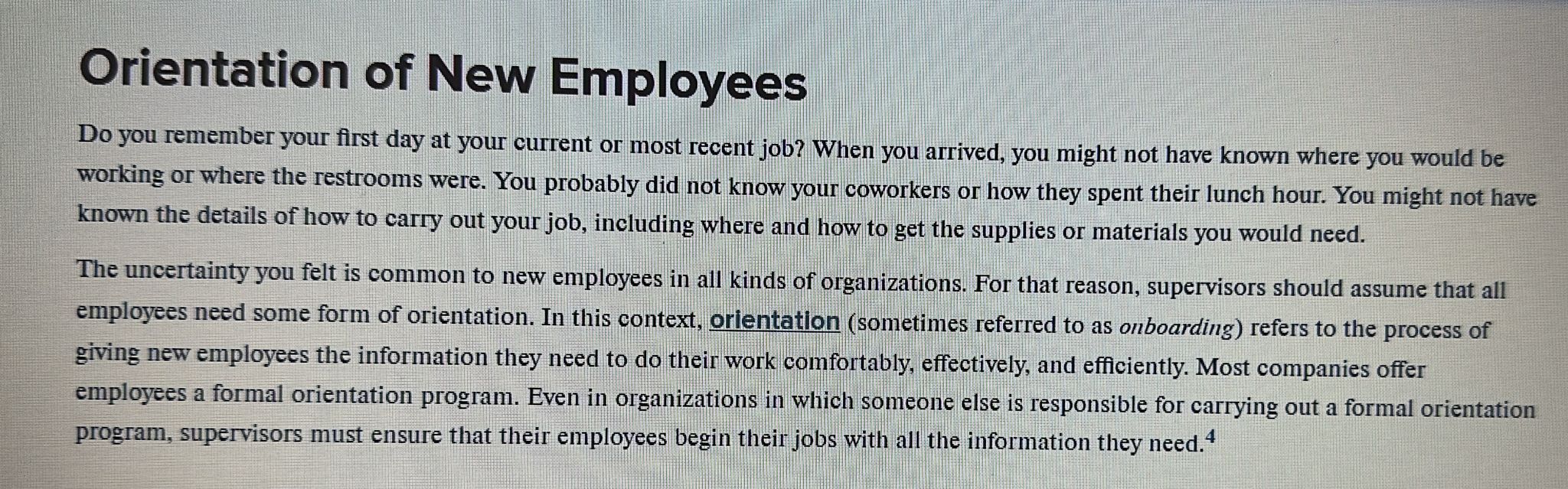
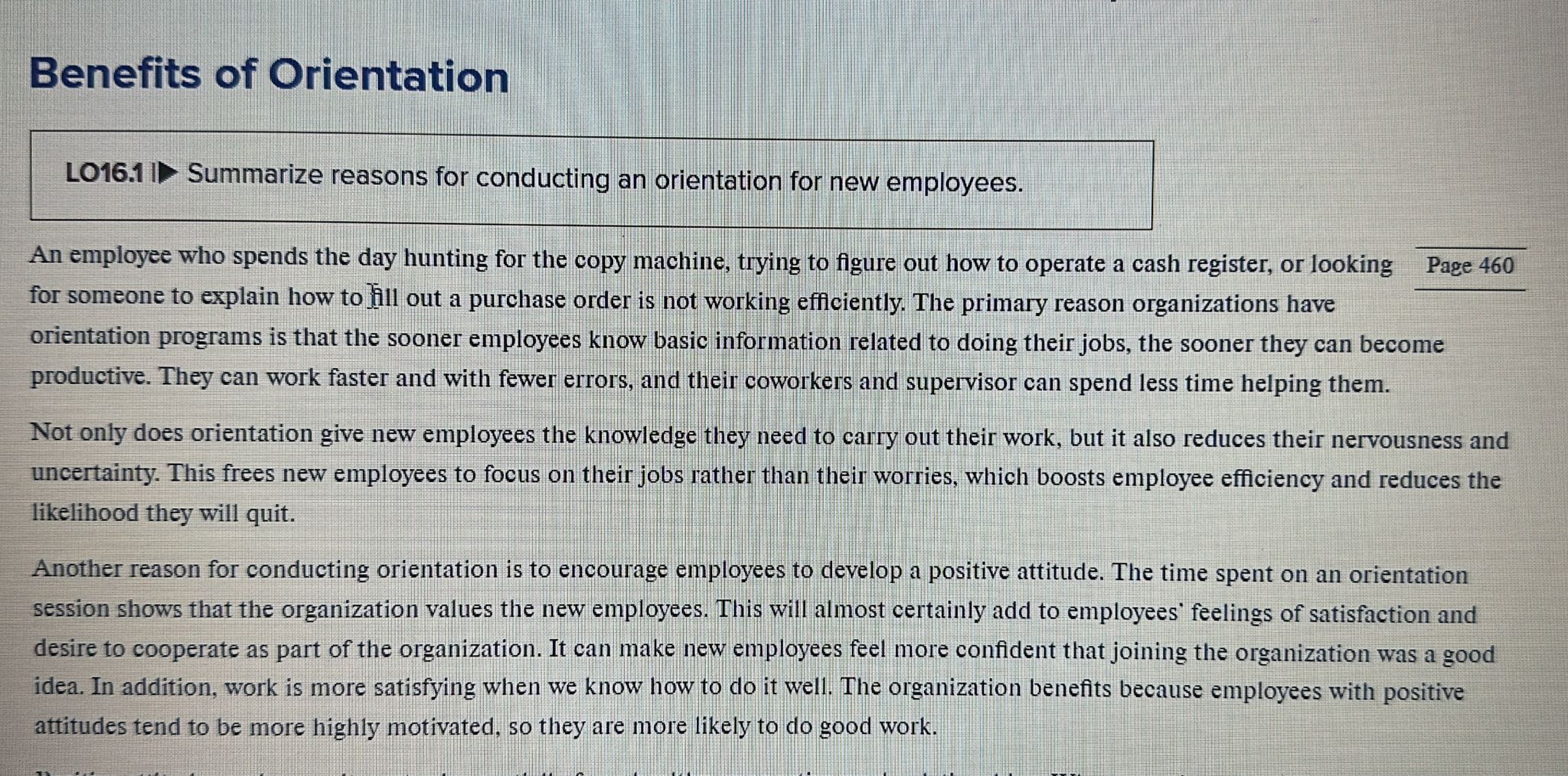
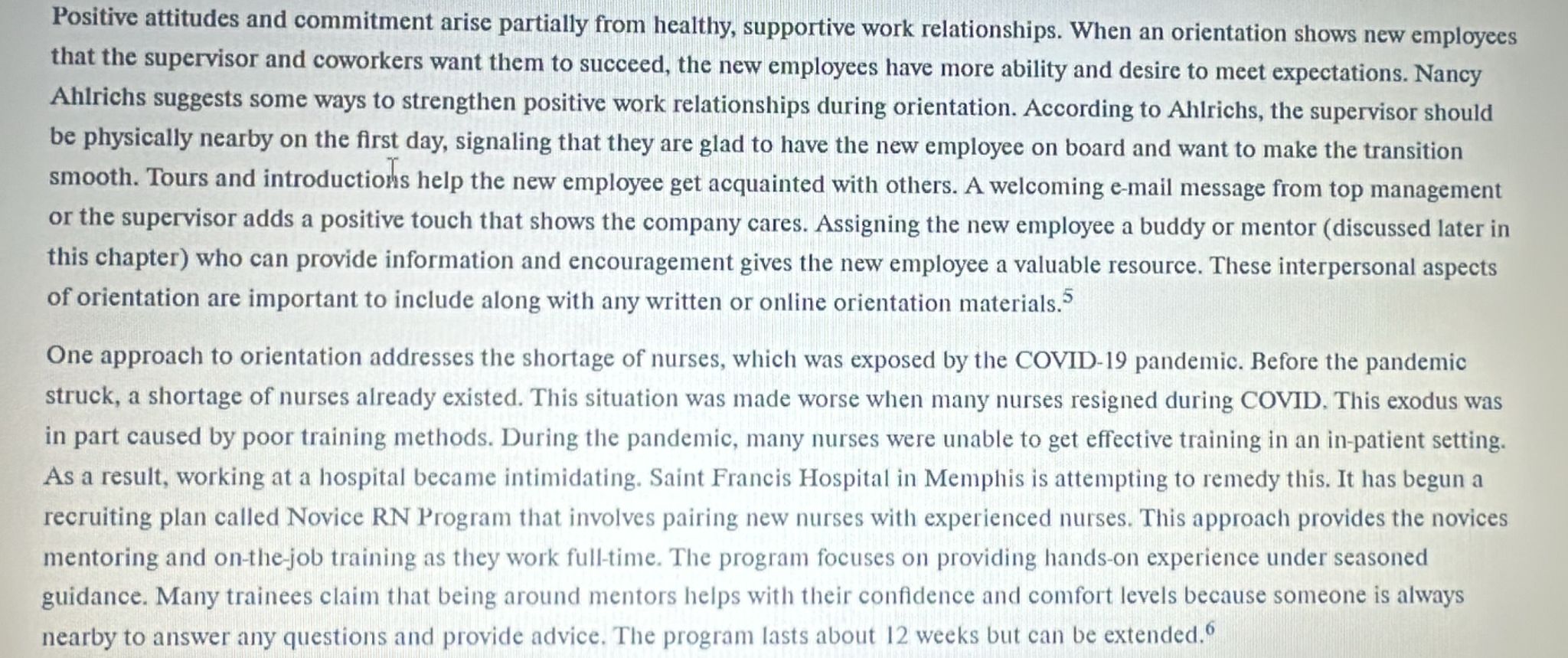
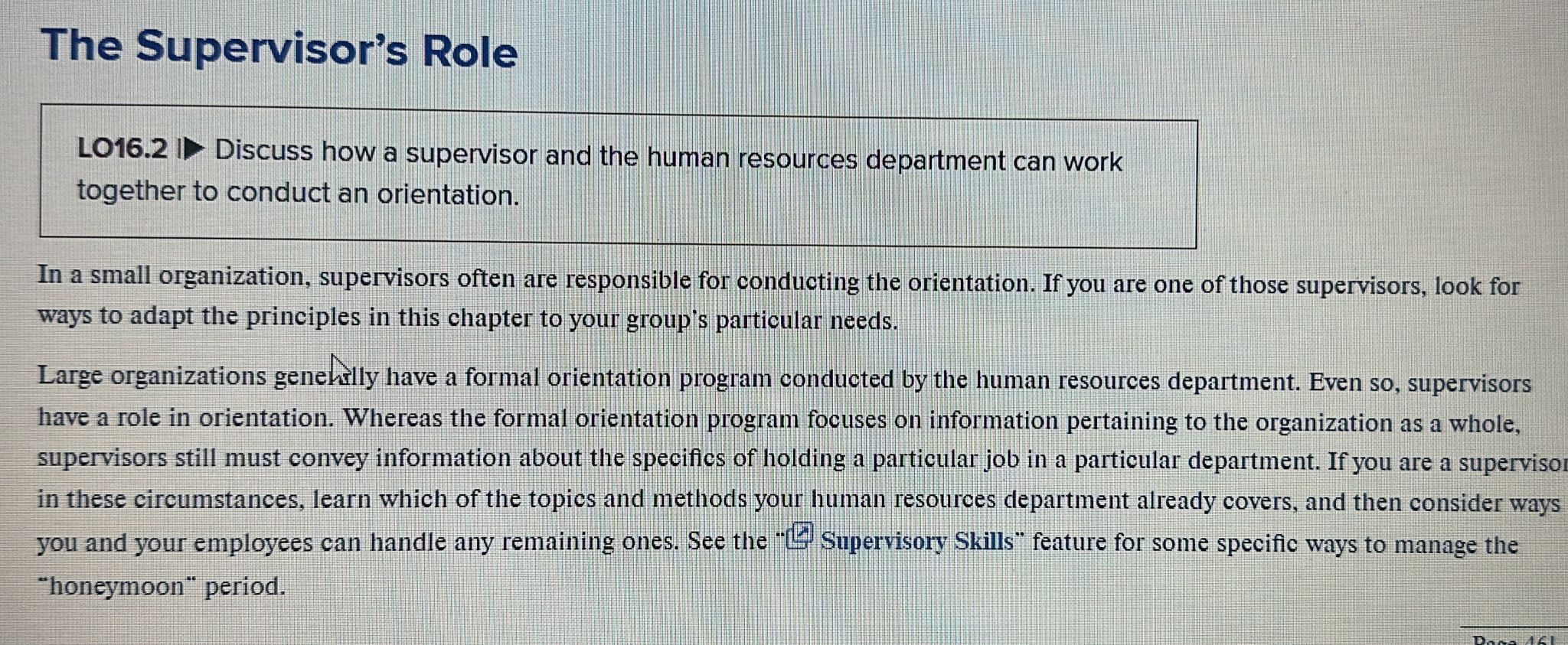
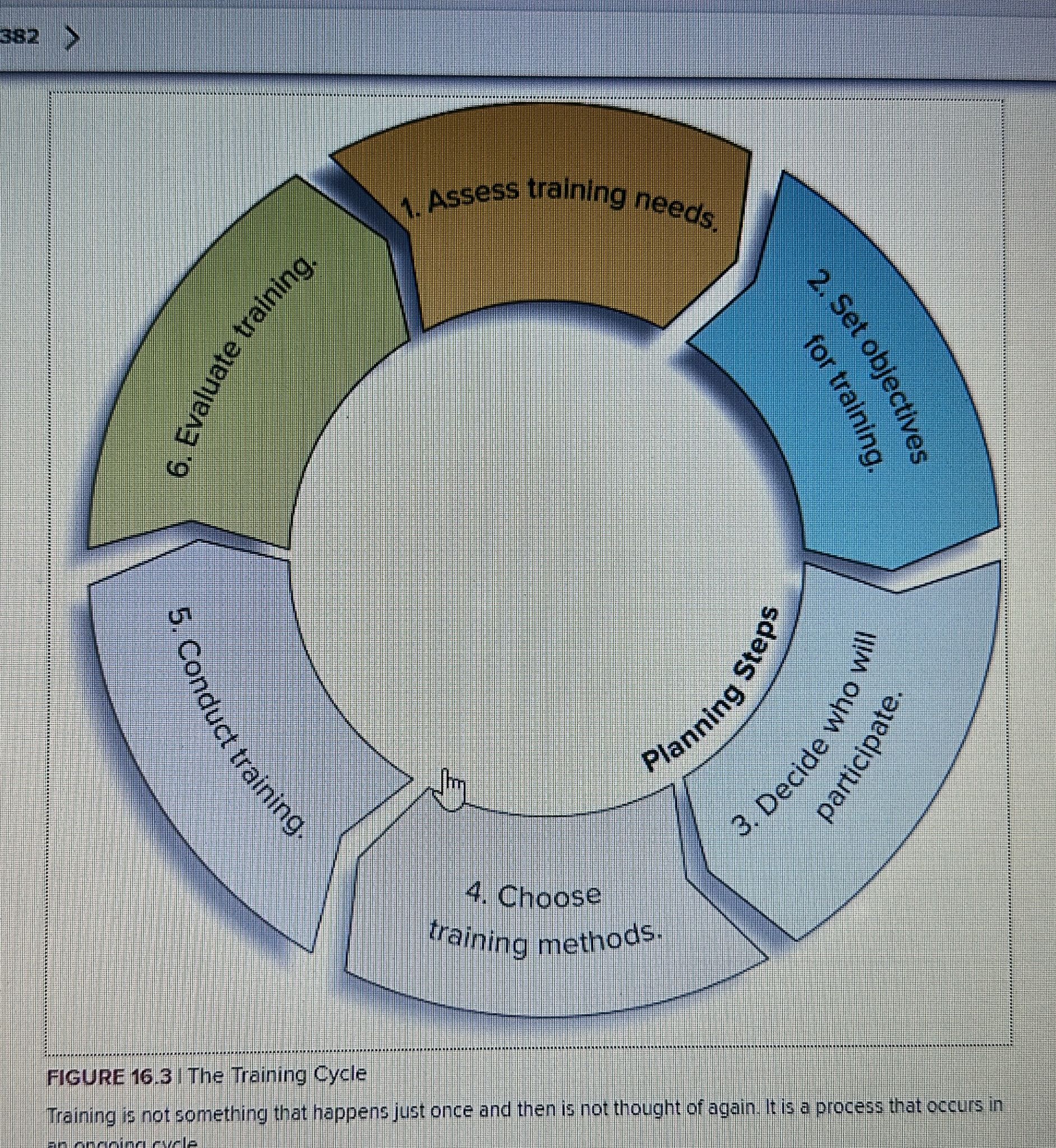
Orientation of New Employees Do you remember your first day at your current or most recent job? When you arrived, you might not have known where you would be working or where the restrooms were. You probably did not know your coworkers or how they spent their lunch hour. You might not have known the details of how to carry out your job, including where and how to get the supplies or materials you would need. The uncertainty you felt is common to new employees in all kinds of organizations. For that reason, supervisors should assume that all employees need some form of orientation. In this context, orientation (sometimes referred to as onboarding) refers to the process of giving new employees the information they need to do their work comfortably, effectively, and efficiently. Most companies offer employees a formal orientation program. Even in organizations in which someone else is responsible for carrying out a formal orientation program, supervisors must ensure that their employees begin their jobs with all the information they need.*Benefits of Orientation LO16.1 1> Summarize reasons for conducting an orientation for new employees. An employee who spends the day hunting for the copy machine, trying to figure out how to operate a cash register, or looking Page 460 for someone to explain how to fill out a purchase order is not working efficiently. The primary reason organizations have orientation programs is that the sooner employees know basic information related to doing their jobs, the sooner they can become productive. They can work faster and with fewer errors, and their coworkers and supervisor can spend less time helping them. Not only does orientation give new employees the knowledge they need to carry out their work, but it also reduces their nervousness and uncertainty. This frees new employees to focus on their jobs rather than their worries, which boosts employee efficiency and reduces the likelihood they will quit. Another reason for conducting orientation is to encourage employees to develop a positive attitude. The time spent on an orientation session shows that the organization values the new employees. This will almost certainly add to employees' feelings of satisfaction and desire to cooperate as part of the organization. It can make new employees feel more confident that joining the organization was a good idea. In addition, work is more satisfying when we know how to do it well. The organization benefits because employees with positive attitudes tend to be more highly motivated, so they are more likely to do good work.Positive attitudes and commitment arise partially from healthy, supportive work relationships. When an orientation shows new employees that the supervisor and coworkers want them to succeed, the new employees have more ability and desire to meet expectations. Nancy Ahlrichs suggests some ways to strengthen positive work relationships during orientation. According to Ahlrichs, the supervisor should be physically nearby on the first day, signaling that they are glad to have the new employee on board and want to make the transition smooth. Tours and introductions help the new employee get acquainted with others. A welcoming e-mail message from top management or the supervisor adds a positive touch that shows the company cares. Assigning the new employee a buddy or mentor (discussed later in this chapter) who can provide information and encouragement gives the new employee a valuable resource. These interpersonal aspects of orientation are important to include along with any written or online orientation materials. One approach to orientation addresses the shortage of nurses, which was exposed by the COVID-19 pandemic. Before the pandemic struck, a shortage of nurses already existed. This situation was made worse when many nurses resigned during COVID. This exodus was in part caused by poor training methods. During the pandemic, many nurses were unable to get effective training in an in-patient setting. As a result, working at a hospital became intimidating. Saint Francis Hospital in Memphis is attempting to remedy this. It has begun a recruiting plan called Novice RN Program that involves pairing new nurses with experienced nurses. This approach provides the novices mentoring and on-the-job training as they work full-time. The program focuses on providing hands-on experience under seasoned guidance. Many trainees claim that being around mentors helps with their confidence and comfort levels because someone is always nearby to answer any questions and provide advice. The program lasts about 12 weeks but can be extended.The Supervisor's Role LO16.2 | Discuss how a supervisor and the human resources department can work together to conduct an orientation. In a small organization, supervisors often are responsible for conducting the orientation. If you are one of those supervisors, look for ways to adapt the principles in this chapter to your group's particular needs. Large organizations genelilly have a formal orientation program conducted by the human resources department. Even so, supervisors have a role in orientation. Whereas the formal orientation program focuses on information pertaining to the organization as a whole, supervisors still must convey information about the specifics of holding a particular job in a particular department. If you are a superviso in these circumstances, learn which of the topics and methods your human resources department already covers, and then consider ways you and your employees can handle any remaining ones. See the "( Supervisory Skills" feature for some specific ways to manage the "honeymoon" period.Orientation Methods LO16.3 I Identify methods for conducting an orientation. The methods a supervisor uses will depend on the organization's policies and resources. For example, a large organization with a human resources department may provide a handbook of information for new employees and spell out orientation procedures to follow. It may also offer web-based programs to acquaint new hires with a large amount of information at once. These programs can be efficient, but ideally, orientation should also include face-to-face interaction, which provides an opportunity for learners to ask questions and interact with other new employees. ' A small organization may expect individual supervisors to develop their own orientation methods. Some common methods include using an employee handbook, conducting a tour of the facilities, and encouraging the involvement of coworkers. Employee Handbook If the organization publishes an employee handbook, a new employee should be introduced to this document during the orientation. An employee handbook describes an organization's conditions of employment (for example, attendance, behavior on the job, and performance of duties), policies regarding employees (for example, time off, hours of work, and benefits), administrative procedures (for example, filling out time sheets and travel expense reports), and related matters. A supervisor should show a new employee what topics are covered in the handbook and explain how to use it to find answers to questions. For example, an employee might use the handbook to learn how long they must work to qualify for three weeks' vacation.Tour of Facilities Another important orientation method is to give the employee a tour. The tour might start with the employee's own work area, which should already be prepared with the supplies, tools, or equipment the employee will need. The supervisor then shows the employee the locations of physical facilities they will need to know about-including restrooms, water fountain, coffee station, fax, and photocopier- and also where to get supplies, parts, or other materials needed to do the job. During the tour, the supervisor should introduce the new employee to the people with whom they will be working. Friendly, positive words during introductions can help make the new employee part of the team. In introducing a new nurse to colleagues in the hospital, a supervisor might say, "This is Janet Strahn. She's one of the top graduates from Northern, and I know we're all going to appreciate her help." In introducing a new maintenance mechanic to a machine operator in the department, a supervisor might say, "Pedro is the guy you'll need if your machine goes down." In both examples, the supervisor is emphasizing the importance of the new employee to the department.A new employee's coworkers have an important role to play in orientation. Their behavior goes a long way toward making the new employee feel either welcome or like an outsider. Therefore, a supervisor should ask all employees to help welcome newcomers. The supervisor can even consider selecting one trusted team member to act as an informal mentor and information source for the new person's first few days or weeks." If the organization tries to build team spirit through activities such as clubs and sports teams, a supervisor should see that they are well publicized so that new employees can participate easily. A supervisor may encourage coworkers to invite a new employee to join them on breaks and at lunch. On the employee's first day, a supervisor can help a new employee feel welcome by inviting them to lunch. Page 464 Follow-Up In addition to the initial information provision, an orientation should involve follow-up. A supervisor should check with new employees at the end of the first day and the first week to make sure they understand what they are supposed to be doing and know where to get what they need. At all times, a supervisor should encourage employees to ask questions. Of course, a supervisor should not stop following up after one week. Regularly checking on the performance and progress of employees is part of a supervisor's control responsibilities.The Training Cycle The process of providing training occurs in a cycle of steps ( see ( Figure 16.3). The first step is to assess needs for training. As described in the next section, assessment of training needs is part of a supervisor's job. In addition, higher-level management or the human resources department may identify a need for various kinds of training. The next three steps involve planning the training. Then someone conducts the training as planned. Finally, the training should be evaluated.1. Assess training needs. 6. Evaluate training. 2. Set objectives for training anning Steps 5. Conduct training. 3. Decide who will participate. 4. Choose training methods FIGURE 16.3 | The Training Cycle Training is not something that happens just once and then is not thought of again. It is a process that occurs inPlanning Steps A supervisor or other person proposing the training begins the planning stage by setting objectives for it. These objectives are based on a comparison of the current level and the desired level of performance and skills. In other words, they specify progress from the current level to the desired level. The training objectives should meet the criteria for effective objectives (sec [ Chapter 6). Thus, they should be written, measurable, clear, specific, and challenging but achievable. Training objectives also should support the organization's goals by helping develop the kind of employees who can make the organization more competitive. At United Technologies Corporation (UTC), business challenges forced the company to focus on reducing its workforce and making the remaining employees more efficient. Despite the difficult climate that follows cutbacks, UTC had to ensure that the remaining employees knew they were valued and appreciated the need to apply their skills more productively than ever. To meet that goal, UTC established a training program for its frontline supervisors, comprising more than 10,000 supervisors whose employees make products as diverse as helicopters, elevators, and fuel cells. The training program emphasized supervisory skills such as constructively discussing performance with employees." A supervisor also decides who will participate in the training program. For example, training pertaining to how to prevent and Page 465 avoid sexual harassment applies to all employees, so everyone in the department would participate. But training on how to operate a new piece of equipment would include only those who might use that equipment. This decision may take into account the interests and motivation levels of employees, as well as their skills. For example, an employee who is cager to advance in the organization will want to participate in many training activities to developa variety of skills. An employee who is interested primarily in job security will probably want just cnough training to keep up to date on how to perform the job. The last step in planning training is to choose the training methods. Some training methods are described subsequently in this chapter. If selecting a training method is part of a supervisor's role, they may wish to consult with the human resources department or a training expert to learn which techniques will best meet the objectives of the training.Implementation Once the training has been planned, someone must conduct it in a timely manner. In some cases, the trainer may be a supervisor. A department's employees may be qualified to conduct some kinds of training, such as demonstrating how to use a computer system. In other cases, a professional trainer is more appropriate. The choice depends on the expertise of a supervisor or employee, the content and type of training, and the time and money available for training. A supervisor with a big budget and little expertise in a particular area of training is most likely to use an in-house or outside expert. Training topics most often tackled by a supervisor are those about the specific job or department instead of company policies and values, interpreting the company's performance, or working effectively as a team. When a supervisor is conducting the training, they can benefit from applying principles of learning.One of these principles is that adults generally get the most out of training if they are taught a little at a time over a long period, especially if the training is seeking to change behavior rather than merely add to the learner's store of knowledge. Thus, shutting down for a day of training would be less effective than scheduling a half hour every week or so. Another principle is that adults want to see how the training content applies to their everyday problems and needs. Generally, they bring significant experience to the training sessions, and the training program should acknowledge and draw upon what they alreday know. Expert trainers also advise that sessions should combine a variety of methods because individuals have different learning styles, they approach a subject and retain information in varying ways. Training methods should include visual and spoken information, as well as a chance to involve employees in trying what they learn, perhaps through role-plays, simulations, or games. At the very least, training should engage employees in asking and answering questions. The methods should be appropriate for presenting the theory and instruction (procedures, methods, rules, and so forth) of the subject matter, as well as for presenting models of how to carry out the new skill and experiences with trying the new skill. At Kimberly-Clark, for example, employees had trouble learning about the company's supply chain (all the steps to get a product to consumers) from slide presentations and meetings. When training expanded to include simulation games and video presentations, employees began to understand the process and why it affected the company's performance.Page 467 Assessment of Training Needs LO16.5 1> Explain how supervisors can decide when employees need training. Whether or not supervisors conduct much of their employees' formal training, they are still responsible for recognizing needs for training. With input from the employees, supervisors should determine the areas of training that employees will need and schedule the times for them to receive it. Needs assessment should be an ongoing, not an occasional, concern of supervisors. Change is such a dominant force today that organizations depend on a workforce that continually learns and develops to give them a competitive edge A supervisor has several ways to identify training needs. First, a supervisor can observe problems in the department that suggest a need for training. For example, if a restaurant's customers are complaining about the quality of service, the manager might conclude that some or all of the staff needs training in how to satisfy customers. Or if forms sent from one department to another frequently contain a similar type of error, the department's supervisor should investigate why the people filling out the forms are making this type of mistake. Although frequent questions from employees are not necessarily a "problem," they do indicate that employees may need training in some areas. Certain areas of change also signal a need for training, and a supervisor should pay attention to them and consider what new knowledge and skills employees will need to keep abreast. If an organization encourages employee empowerment and teamwork, employees will need to know how to make decisions, evaluate team efforts, and listen to team members. When new technology (from a competitor, supplier, or elsewhere) affects an organization or the individuals in it, employees will need to learn about that technology and gain skills in applying it. If a department or its customer base is becoming more diverse, employees will need to learn how to respect, communicate with, and achieve objectives with people of different cultures.es to help find the underlying issue. Mandatory Training A supervisor is not the only one to decide when training is required. Government regulations, union work rules, or company policy may dictate training in certain circumstances. If the state mandates a number of continuing education classes for teachers, if the union requires an apprenticeship of so many months for pipe fitters, or if the company's top managers decide that everyone should take a class in total quality management, the supervisor's job is to make sure that their employees get the required training. The supervisor does so primarily through decisions related to scheduling and motivation. Page 468 Learning Environment Along with planning for formal training sessions, supervisors can help organizations meet the need for training by fostering a climate that values learning. This kind of climate has been called a "learning environment." Daniel R. Tobin, a business consultant and coach, has said that if team members "aren't learning from each other or aren't learning together, they're not really part of a team." Rather, they are "just a bunch of people that happen to work for the same boss." Tobin encourages supervisors to create a learning environment by meeting with employees before and after any training program the employees attend. In these meetings, the supervisor and employee discuss what lessons from the program will be most important to focus on and how the lessons learned can be applied at work. Another way to foster a learning environment is to set a good example. Supervisors should develop their own knowledge and skills through a variety of means, from reading to attending seminars. Also, supervisors should share information generously with employees. They can enable employees to learn from one another by encouraging them to exchange what they have learned through their education, training activities, and experience. When employees request time and other resources for training, a supervisor should view the training as an investment to be evaluated, not merely a distraction from the "real work" of the organization.an investment to be evaluated, not merely a distraction from the real work" of the organization. Retraining Employees Like one's muscles and memory, work-related skills are subject to atrophy, which is a condition where employees lose the ability to perform work-related functions over time. The loss of employee skills due to atrophy is a potential impediment to the competitiveness of an organization. To combat this, ongoing training in the basic skills required of employees is necessary in many companies. Customers can also provide great insight into the training needs of employees. As the needs of customers change, the demands they make of a company and its employees can drive and direct the kinds of training required. Finally, changing technologies may require companies to adapt and invest in additional training for employees. Companies wishing to stay competitive must conduct training needs assessments to help identify areas of deficiency in the existing workforce. These assessments ascertain if there are skills that some employees lack or that they are not as proficient at as they could be. As illustrated in & Figure 16.5, the degree of skills atrophy, changing customer needs, changing technologies, and the results of training needs assessment all impact the frequency with which retraining of employees is needed.Lifelong Learning Lifelong learning refers to the ongoing acquisition and enhancement of knowledge, skills, and abilities by individuals. Compared with episodic learning periods, including college, lifelong learning reflects the pursuit of bettering oneself on a consistent basis. There are a number of reasons that individuals engage in lifelong learning, but companies can benefit greatly from encouraging the ongoing pursuit of knowledge by their employees. Notably, lifelong learning provides employees with additional knowledge, skills, and abilities that can enable them to better connect with customers, engage in creative decision making and problem solving, and identify ways of improving work. One potential drawback to providing employees with ongoing training and learning opportunities is that employees could take their newly gained knowledge, skills, and abilities and leverage them with other firms. Thus, instead of encouraging training that may cause good employees to leave, it is important that the firm encourage training for roles inside the company. In a broader context, lifelong learning makes a labor force more productive, meaning astute local, regional, and national governments should encourage the practice of lifelong learning by their citizens. 18 Page 469Types of Training LO16.6 |> Define major types of training. A variety of types of training are available for employees (see ( Figure 16.6). Most organizations use a variety of training methods. At Regions Financial, a banking company based in Birmingham, Alabama, candidates for management jobs rotate through a variety of banking positions and participate in classroom training, computer-based instruction, and on-the-job training guided by a mentor. Verizon Wireless gives each of its customer service representatives 96 hours of training, including simulations, classroom instruction, and on-the- job learning. 19 On-the-job Apprenticeship Cross-training Im Vestibule training training Classroom Computer- Role-playing Basic skills training training based instructionOn-the-Job Training In many cases, the easiest way to learn how to perform a job is to try it. Teaching a job while trainer and trainee do the job at the work site is called on-the-job training. The trainer-typically a coworker or supervisor-shows the employee how to do the job, and then the employee tries it. 20 An employee who learns in this way benefits from being able to try the skills and techniques being taught. The results tell Page 470 immediately whether the employee understands what the trainer is trying to teach. However, on-the-job training carries the risk that an inexperienced employee will make costly and even dangerous mistakes. Thus, this type of training is most suitable when the tasks to be learned are relatively simple or the costs of an error are low. For more complex or risky tasks, it may be wiser to use other forms of training before or instead of on-the-job training. Apprenticeship Many tradespeople learn their trades through an apprenticeship, This involves working alongside an experienced person, who shows the apprentice how to do the various tasks involved in the trade. Thus, an apprenticeship is a long-term form of on-the-job training. (Many apprenticeship programs also require that apprentices complete classroom training. ) Most apprenticeships are in the building trades, such as carpentry and pipe fitting.Cross-Training As you learned in 4 Chapter 11, an increasing number of organizations are using job rotation, meaning that employees take turns performing various jobs. Job rotation requires that employees learn to perform more than one job. Teaching employees another job so that they can fill in as needed is known as cross-training. Employees who have completed cross-training can enjoy more variety in their work, and their supervisor has more flexibility in making assignments. The resulting flexibility also makes cross-training necessary for many forms of teamwork.Vestibule Training While on-the-job training is effective, it is not appropriate as initial training for jobs that have no room for errors, such as piloting or nursing. In those cases, people learn principles or techniques before doing the actual job. A type of training that allows employees to practice using equipment off the job is called vestibule training. Employees undergoing vestibule training use procedures and equipment set up in a special vestibule school. For example, a large retail store might set up a training room containing cash registers, or an airline might use a simulated cabin for training flight attendants. Vestibule training is appropriate when the organization hires people who do not already know how to use its equipment. Employees learn to operate the equipment without the pressure of accidents occurring, customers getting impatient, or other employees depending on a minimum amount of output. The expense of vestibule training or other off-the-job training is higher because employees are not producing goods or services for the organization while they undergo the training. However, if the organization hired only people who already had all the necessary skills, it would probably have to pay more and might have difficulty finding enough qualified candidates.Some firms have already put themselves on the leading edge of integrating technology into workforce training. One innovation is to use the technology of videogames to make learning more interesting and enjoyable, a technique known as gamification. Cold Stone Creamery has a custom online game that simulates one of its stores. Players learn portion control by scooping ice cream as the timer runs out; when it does, they see whether they served too much. Almost 3 of every 10 Cold Stone employees downloaded this learning game voluntarily because they find it so entertaining. Canon trains repair technicians with a game in which they drag and drop parts onto an image of a copier. If they send the part to the wrong place, a light flashes and a buzzer goes off. Canon compared the performance of trainees using the game with the performance of trainees who learned from manuals; the gamers' scores were noticeably higher.2 Computer-based instruction is becoming more engaging and widespread because of the growing affordability of interactive m Page 473 ultimedia. This software brings together sound, video, graphics, animation, and text. The best interactive multimedia programs adjust the course content on the basis of the student's responses to questions. Training that incorporates artificial intelligence, augmented reality, and virtual reality creates highly realistic scenarios to which employees can be trained to respond. Younger employees are especially attuned to these learning methods and show improved retention and memory after use. In addition to technical skills, virtual reality training has the potential to teach "soft skills" as well. Fidelity Investments, for example, is using virtual reality simulations in experiential training to encourage its employees to respond with empathy to customers in financial need.29 Even small companies can benefit from computer-based training. Thumbtack.com, an Internet business that links consumers with local service providers, finds online learning especially useful for training its growing staff in the Philippines. Employees at the company's San Francisco headquarters put together an online training program based on a dozen documents plus several videos that show company policies and operations. Newly hired employees at any location can review the documents and visit YouTube to watch the videos on their own. Then supervisors guide the employees as they begin their new jobs. In addition, the company gives all its employees access to databases containing answers to questions frequently asked by employees, so they can continue learning beyond the orientation period.Page 474 Role-Playing To teach skills in working with other people, an organization may use role-playing. This method involves assigning roles to participants, who then act out the way they would handle a specific situation. Some of the exercises in this book use role-playing. A technique that enhances the usefulness of role-playing is to videotape the session and play it back so participants can see how they looked and sounded. Role-playing gives people a chance to practice the way they react to others, making it especially useful for training in human relations skills such as communicating, resolving conflicts, and working with people of other races or cultures.32 People who have acted out a particular role-for example, the role of supervisor-generally have more sympathy for that person's point of view. The major potential drawback of role-playing is that, to be most useful, it requires a trainer with expertise in conducting it. Role-playing, like other kinds of training, now has online forms. Role-playing on the Internet may use games and simulations. The best ones are designed to closely mimic real-world challenges, and they engage the learner with their sophisticated graphics and plot lines. By training with simulation technologies, employees can practice how they would handle difficult situations, and if they make a mistake, the consequences to the company are minimal. For example, a call center employee can practice handling calls from angry (pretend) customers, and if the employee fails to soothe the customers, no accounts are actually lost. Oil companies use the virtual world of Second Life to create graphical images of oil platforms. Employees visit the virtual oil platforms to practice how they should respond if a fire breaks out. 53Basic Skills Training An often-heard complaint among employers today is that it is increasingly difficult to find enough employees with the basic skills necessary to perform the job. An increasing number of employers are responding to this problem by conducting their own training in basic skills. Organizations that offer such programs not only improve the skills of their workers but also attract and keep employees who are highly motivated. However, basic skills education offers some challenges to the employer. One is that employees may resist attending because they are embarrassed or afraid the organization will punish them if it finds out they do not have basic skills. To address this challenge, an organization should name the program carefully, calling it something like "workplace education" or "skills enhancement." Supervisors and other managers should reassure employees that participating in the program does not place their jobs in danger. In addition, experts recommend rewarding employees for participating in a basic skills program. Certification Training Another option for training and development is to outsource it to certifying organizations. In some industries, such as accounting, civil engineering, or securities and investments, individuals must obtain an appropriate license in order to practice, and these licenses are given on a competitive basis. However, an increasing number of organizations offer additional certifications that specify an individual as an expert in a given domain. For example, the Society for Human Resource Management (SHRM) is a global organization that certifies individuals as experts in human resource management practices. Like most of its counterparts, SHRM requires ongoing education to maintain certification. However, the possession of these certifications can help companies bolster their expertise in doing work and raise their image in the eyes of customers.In a business context, coaching involves similar activities. According to the Harvard Business Review, "An effective manager-as- Page 475 coach asks questions instead of providing answers, supports employees instead of judging them, and facilitates their development instead of dictating what has to be done. "54 As coach, a supervisor engages in regular observation, teaching, and encouragement to help employees develop so that they in turn can help the team succeed. Much of this coaching is done informally to back up the more formal training process. In this role, a supervisor observes employees' performances daily and provides feedback. To encourage employees, a supervisor should praise them when they meet or exceed expectations. A supervisor should consider whether good performance is evidence that the employees can be given key responsibilities or have strengths that should be further developed. When an employee makes a mistake, the supervisor should work with the employee, focusing on the problem rather than any perceived deficiencies in the employee's character. Together, the supervisor and employee should decide how to correct the problem-perhaps through more training, a revised assignment, or more reliable access to resources. A supervisor and employee should work on only one problem at a time, with the supervisor continually looking for signs of employee progress. L Figure 16.7 summarizes the process of coaching.teamwork. Mentoring In some cases, a supervisor may focus coaching efforts on one employee. This practice is called mentoring, or providing guidance, advice, and encouragement through an ongoing one-on-one work relationship. Mentoring seems to play an important role in employee retention, as "career mentoring . . . psychologically influences the employer's affection towards employees and their perceived costs of separation."A supervisor should not use a mentoring relationship as an excuse for failure to encourage all employees in the work group. However, mentoring may be an appropriate wayly support the training of an employee who has especially great potential, needs extra attention to contribute fully, or has been assigned to the supervisor for that purpose. Some organizations use mentoring of minority and female employees to help them learn to navigate in a setting where communication styles, values, expectations, and so on may differ from those with which they are familiar. As a supervisor, you, too, may have a mentor. For ideas to help you become a better mentor see the "[ Supervisor as Leader" feature.Evaluation of Training LO16.8 1> Discuss how a supervisor can evaluate the effectiveness of training. A supervisor is often in the best position to determine whether training is working. The most basic way to evaluate training is to measure whether the training is resolving the problem. Are new employees learning their jobs? Is the defect rate falling? Do employees use the new computer system properly? Are customers now praising the service instead of complaining about it? Looking for answers to such questions is central to the control process, described in L Chapter 6
Step by Step Solution
There are 3 Steps involved in it
1 Expert Approved Answer
Step: 1 Unlock
Question Has Been Solved by an Expert!
Get step-by-step solutions from verified subject matter experts
Step: 2 Unlock
Step: 3 Unlock
Students Have Also Explored These Related General Management Questions!











 Study Help