Question: write two to three sentences identifying the source as either 'primary or 'secondary' and explain your reasoning. 2. Document B: Juan Pau Rubis, The Worlds
write two to three sentences identifying the source as either 'primary or 'secondary' and explain your reasoning.
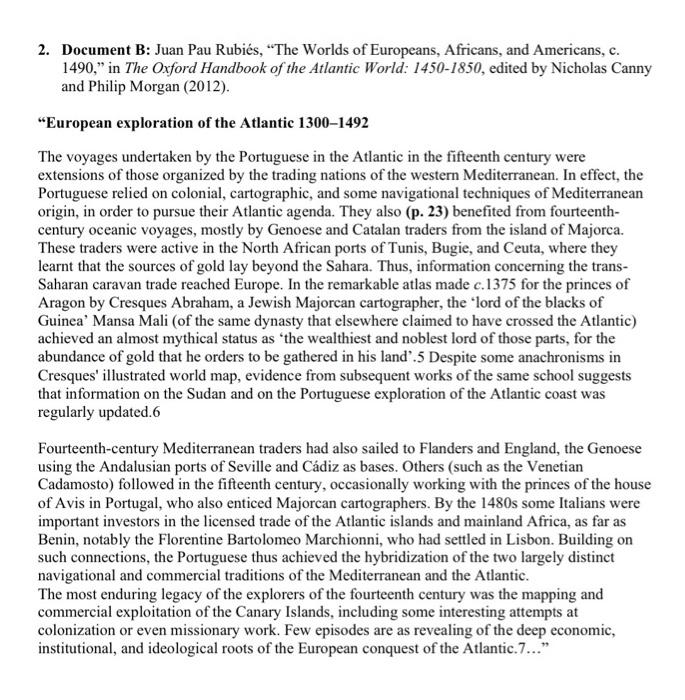
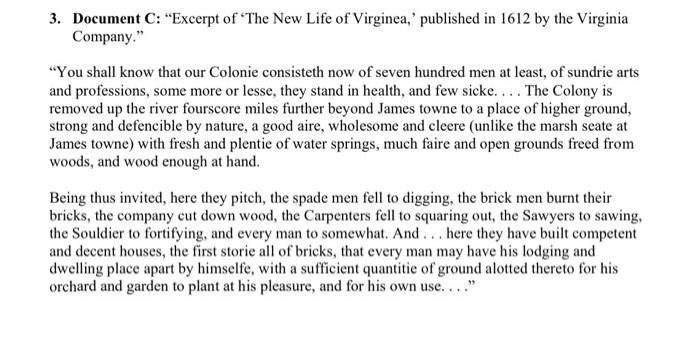
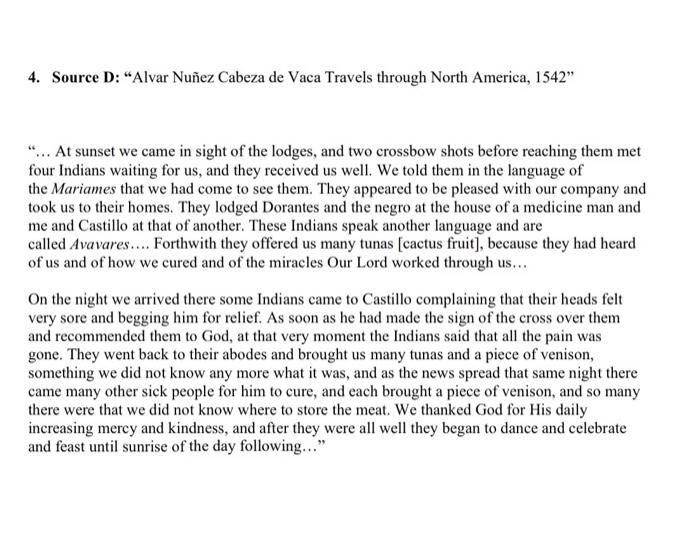
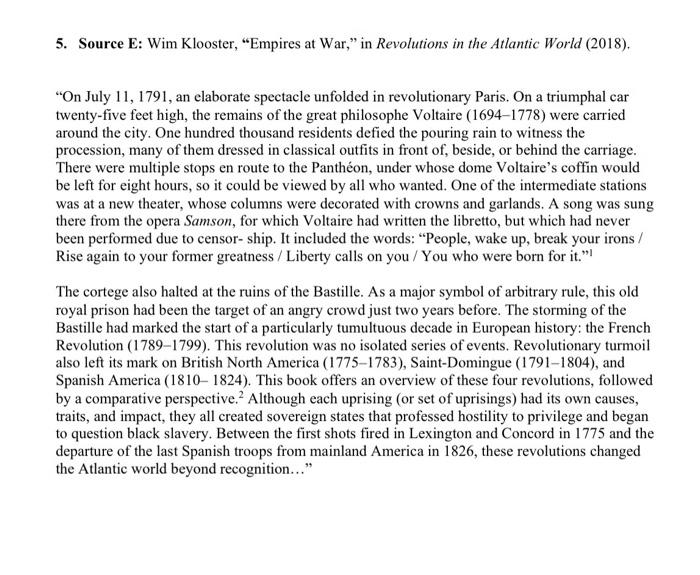
2. Document B: Juan Pau Rubis, "The Worlds of Europeans, Africans, and Americans, c. 1490," in The Oxford Handbook of the Atlantic World: 1450-1850, edited by Nicholas Canny and Philip Morgan (2012). "European exploration of the Atlantic 1300-1492 The voyages undertaken by the Portuguese in the Atlantic in the fifteenth century were extensions of those organized by the trading nations of the western Mediterranean. In effect, the Portuguese relied on colonial, cartographic, and some navigational techniques of Mediterranean origin, in order to pursue their Atlantic agenda. They also (p. 23) benefited from fourteenth- century oceanic voyages, mostly by Genoese and Catalan traders from the island of Majorca. These traders were active in the North African ports of Tunis, Bugie, and Ceuta, where they learnt that the sources of gold lay beyond the Sahara. Thus, information concerning the trans- Saharan caravan trade reached Europe. In the remarkable atlas made c.1375 for the princes of Aragon by Cresques Abraham, a Jewish Majorcan cartographer, the 'lord of the blacks of Guinea' Mansa Mali (of the same dynasty that elsewhere claimed to have crossed the Atlantic) achieved an almost mythical status as 'the wealthiest and noblest lord of those parts, for the abundance of gold that he orders to be gathered in his land'.5 Despite some anachronisms in Cresques' illustrated world map, evidence from subsequent works of the same school suggests that information on the Sudan and on the Portuguese exploration of the Atlantic coast was regularly updated.6 Fourteenth-century Mediterranean traders had also sailed to Flanders and England, the Genoese using the Andalusian ports of Seville and Cdiz as bases. Others (such as the Venetian Cadamosto) followed in the fifteenth century, occasionally working with the princes of the house of Avis in Portugal, who also enticed Majorcan cartographers. By the 1480s some Italians were important investors in the licensed trade of the Atlantic islands and mainland Africa, as far as Benin, notably the Florentine Bartolomeo Marchionni, who had settled in Lisbon. Building on such connections, the Portuguese thus achieved the hybridization of the two largely distinct navigational and commercial traditions of the Mediterranean and the Atlantic. The most enduring legacy of the explorers of the fourteenth century was the mapping and commercial exploitation of the Canary Islands, including some interesting attempts at colonization or even missionary work. Few episodes are as revealing of the deep economic, institutional, and ideological roots of the European conquest of the Atlantic.7..." 3. Document C: "Excerpt of "The New Life of Virginea," published in 1612 by the Virginia Company." "You shall know that our Colonie consisteth now of seven hundred men at least, of sundrie arts and professions, some more or lesse, they stand in health, and few sicke.... The Colony is removed up the river fourscore miles further beyond James towne to a place of higher ground, strong and defencible by nature, a good aire, wholesome and cleere (unlike the marsh seate at James towne) with fresh and plentie of water springs, much faire and open grounds freed from woods, and wood enough at hand. Being thus invited, here they pitch, the spade men fell to digging, the brick men burnt their bricks, the company cut down wood, the Carpenters fell to squaring out, the Sawyers to sawing, the Souldier to fortifying, and every man to somewhat. And... here they have built competent and decent houses, the first storie all of bricks, that every man may have his lodging and dwelling place apart by himselfe, with a sufficient quantitie of ground alotted thereto for his orchard and garden to plant at his pleasure, and for his own use...." 4. Source D: "Alvar Nuez Cabeza de Vaca Travels through North America, 1542" "... At sunset we came in sight of the lodges, and two crossbow shots before reaching them met four Indians waiting for us, and they received us well. We told them in the language of the Mariames that we had come to see them. They appeared to be pleased with our company and took us to their homes. They lodged Dorantes and the negro at the house of a medicine man and me and Castillo at that of another. These Indians speak another language and are called Avavares.... Forthwith they offered us many tunas [cactus fruit], because they had heard of us and of how we cured and of the miracles Our Lord worked through us... On the night we arrived there some Indians came to Castillo complaining that their heads felt very sore and begging him for relief. As soon as he had made the sign of the cross over them and recommended them to God, at that very moment the Indians said that all the pain was gone. They went back to their abodes and brought us many tunas and a piece of venison, something we did not know any more what it was, and as the news spread that same night there came many other sick people for him to cure, and each brought a piece of venison, and so many there were that we did not know where to store the meat. We thanked God for His daily increasing mercy and kindness, and after they were all well they began to dance and celebrate and feast until sunrise of the day following..." 5. Source E: Wim Klooster, "Empires at War," in Revolutions in the Atlantic World (2018). "On July 11, 1791, an elaborate spectacle unfolded in revolutionary Paris. On a triumphal car twenty-five feet high, the remains of the great philosophe Voltaire (1694-1778) were carried around the city. One hundred thousand residents defied the pouring rain to witness the procession, many of them dressed in classical outfits in front of, beside, or behind the carriage. There were multiple stops en route to the Panthon, under whose dome Voltaire's coffin would be left for eight hours, so it could be viewed by all who wanted. One of the intermediate stations was at a new theater, whose columns were decorated with crowns and garlands. A song was sung there from the opera Samson, for which Voltaire had written the libretto, but which had never been performed due to censor- ship. It included the words: "People, wake up, break your irons / Rise again to your former greatness / Liberty calls on you/You who were born for it." The cortege also halted at the ruins of the Bastille. As a major symbol of arbitrary rule, this old royal prison had been the target of an angry crowd just two years before. The storming of the Bastille had marked the start of a particularly tumultuous decade in European history: the French Revolution (1789-1799). This revolution was no isolated series of events. Revolutionary turmoil also left its mark on British North America (1775-1783), Saint-Domingue (1791-1804), and Spanish America (1810-1824). This book offers an overview of these four revolutions, followed by a comparative perspective. Although each uprising (or set of uprisings) had its own causes, traits, and impact, they all created sovereign states that professed hostility to privilege and began to question black slavery. Between the first shots fired in Lexington and Concord in 1775 and the departure of the last Spanish troops from mainland America in 1826, these revolutions changed the Atlantic world beyond recognition..." 2. Document B: Juan Pau Rubis, "The Worlds of Europeans, Africans, and Americans, c. 1490," in The Oxford Handbook of the Atlantic World: 1450-1850, edited by Nicholas Canny and Philip Morgan (2012). "European exploration of the Atlantic 1300-1492 The voyages undertaken by the Portuguese in the Atlantic in the fifteenth century were extensions of those organized by the trading nations of the western Mediterranean. In effect, the Portuguese relied on colonial, cartographic, and some navigational techniques of Mediterranean origin, in order to pursue their Atlantic agenda. They also (p. 23) benefited from fourteenth- century oceanic voyages, mostly by Genoese and Catalan traders from the island of Majorca. These traders were active in the North African ports of Tunis, Bugie, and Ceuta, where they learnt that the sources of gold lay beyond the Sahara. Thus, information concerning the trans- Saharan caravan trade reached Europe. In the remarkable atlas made c.1375 for the princes of Aragon by Cresques Abraham, a Jewish Majorcan cartographer, the 'lord of the blacks of Guinea' Mansa Mali (of the same dynasty that elsewhere claimed to have crossed the Atlantic) achieved an almost mythical status as 'the wealthiest and noblest lord of those parts, for the abundance of gold that he orders to be gathered in his land'.5 Despite some anachronisms in Cresques' illustrated world map, evidence from subsequent works of the same school suggests that information on the Sudan and on the Portuguese exploration of the Atlantic coast was regularly updated.6 Fourteenth-century Mediterranean traders had also sailed to Flanders and England, the Genoese using the Andalusian ports of Seville and Cdiz as bases. Others (such as the Venetian Cadamosto) followed in the fifteenth century, occasionally working with the princes of the house of Avis in Portugal, who also enticed Majorcan cartographers. By the 1480s some Italians were important investors in the licensed trade of the Atlantic islands and mainland Africa, as far as Benin, notably the Florentine Bartolomeo Marchionni, who had settled in Lisbon. Building on such connections, the Portuguese thus achieved the hybridization of the two largely distinct navigational and commercial traditions of the Mediterranean and the Atlantic. The most enduring legacy of the explorers of the fourteenth century was the mapping and commercial exploitation of the Canary Islands, including some interesting attempts at colonization or even missionary work. Few episodes are as revealing of the deep economic, institutional, and ideological roots of the European conquest of the Atlantic.7..." 3. Document C: "Excerpt of "The New Life of Virginea," published in 1612 by the Virginia Company." "You shall know that our Colonie consisteth now of seven hundred men at least, of sundrie arts and professions, some more or lesse, they stand in health, and few sicke.... The Colony is removed up the river fourscore miles further beyond James towne to a place of higher ground, strong and defencible by nature, a good aire, wholesome and cleere (unlike the marsh seate at James towne) with fresh and plentie of water springs, much faire and open grounds freed from woods, and wood enough at hand. Being thus invited, here they pitch, the spade men fell to digging, the brick men burnt their bricks, the company cut down wood, the Carpenters fell to squaring out, the Sawyers to sawing, the Souldier to fortifying, and every man to somewhat. And... here they have built competent and decent houses, the first storie all of bricks, that every man may have his lodging and dwelling place apart by himselfe, with a sufficient quantitie of ground alotted thereto for his orchard and garden to plant at his pleasure, and for his own use...." 4. Source D: "Alvar Nuez Cabeza de Vaca Travels through North America, 1542" "... At sunset we came in sight of the lodges, and two crossbow shots before reaching them met four Indians waiting for us, and they received us well. We told them in the language of the Mariames that we had come to see them. They appeared to be pleased with our company and took us to their homes. They lodged Dorantes and the negro at the house of a medicine man and me and Castillo at that of another. These Indians speak another language and are called Avavares.... Forthwith they offered us many tunas [cactus fruit], because they had heard of us and of how we cured and of the miracles Our Lord worked through us... On the night we arrived there some Indians came to Castillo complaining that their heads felt very sore and begging him for relief. As soon as he had made the sign of the cross over them and recommended them to God, at that very moment the Indians said that all the pain was gone. They went back to their abodes and brought us many tunas and a piece of venison, something we did not know any more what it was, and as the news spread that same night there came many other sick people for him to cure, and each brought a piece of venison, and so many there were that we did not know where to store the meat. We thanked God for His daily increasing mercy and kindness, and after they were all well they began to dance and celebrate and feast until sunrise of the day following..." 5. Source E: Wim Klooster, "Empires at War," in Revolutions in the Atlantic World (2018). "On July 11, 1791, an elaborate spectacle unfolded in revolutionary Paris. On a triumphal car twenty-five feet high, the remains of the great philosophe Voltaire (1694-1778) were carried around the city. One hundred thousand residents defied the pouring rain to witness the procession, many of them dressed in classical outfits in front of, beside, or behind the carriage. There were multiple stops en route to the Panthon, under whose dome Voltaire's coffin would be left for eight hours, so it could be viewed by all who wanted. One of the intermediate stations was at a new theater, whose columns were decorated with crowns and garlands. A song was sung there from the opera Samson, for which Voltaire had written the libretto, but which had never been performed due to censor- ship. It included the words: "People, wake up, break your irons / Rise again to your former greatness / Liberty calls on you/You who were born for it." The cortege also halted at the ruins of the Bastille. As a major symbol of arbitrary rule, this old royal prison had been the target of an angry crowd just two years before. The storming of the Bastille had marked the start of a particularly tumultuous decade in European history: the French Revolution (1789-1799). This revolution was no isolated series of events. Revolutionary turmoil also left its mark on British North America (1775-1783), Saint-Domingue (1791-1804), and Spanish America (1810-1824). This book offers an overview of these four revolutions, followed by a comparative perspective. Although each uprising (or set of uprisings) had its own causes, traits, and impact, they all created sovereign states that professed hostility to privilege and began to question black slavery. Between the first shots fired in Lexington and Concord in 1775 and the departure of the last Spanish troops from mainland America in 1826, these revolutions changed the Atlantic world beyond recognition









 Study Help