Question: write your own objectives for a training program or module of your choice. Critique your objectives by comparing them to the principles in Tables 5.1
write your own objectives for a training program or module of your choice. Critique your objectives by comparing them to the principles in Tables 5.1 and 5.2. Once your objectives are completed, go further with your train- ing design by addressing the following nine questions:
1. Objectives: What are the specific goals for training?
2. Content: What is being learned?
3. Activities: How are trainees learning?
4. Materials and resources: With what are trainees learning?
5. Grouping: With whom are trainees learning?
6. Location: Where are trainees learning?
7. Time: When are trainees learning?
8. Trainer role: How is the trainer facilitating/guiding learning?
9. Assessment: Assessment: How will trainee learning be assessed ?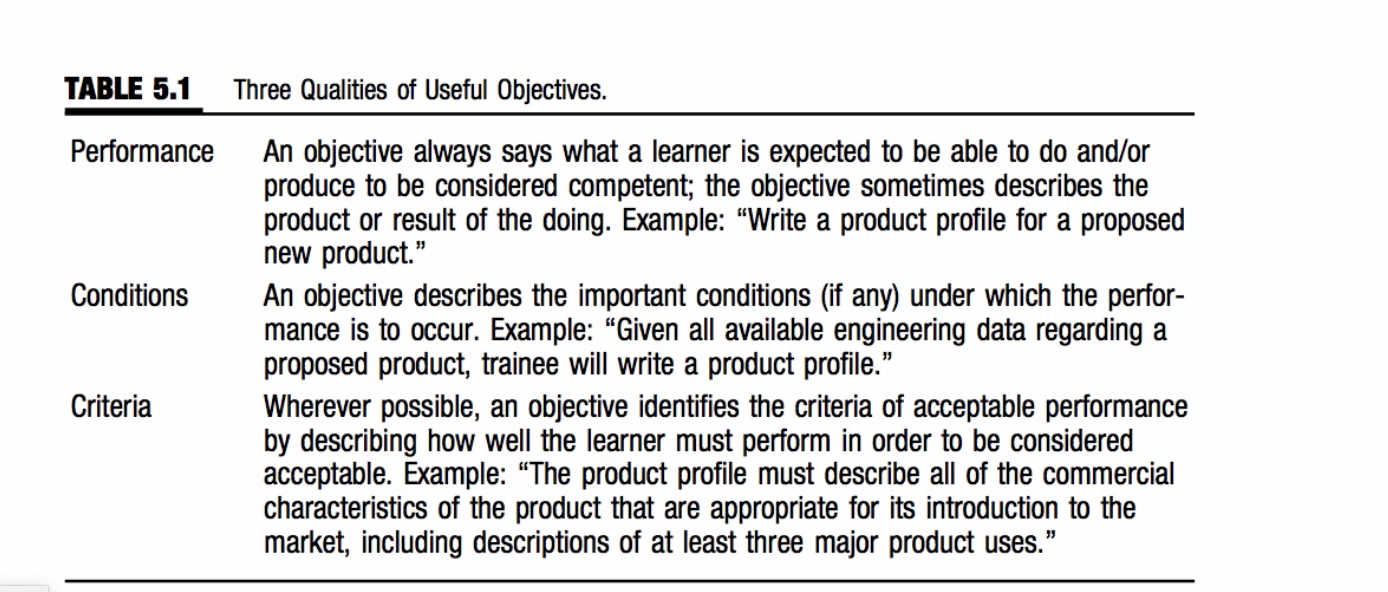
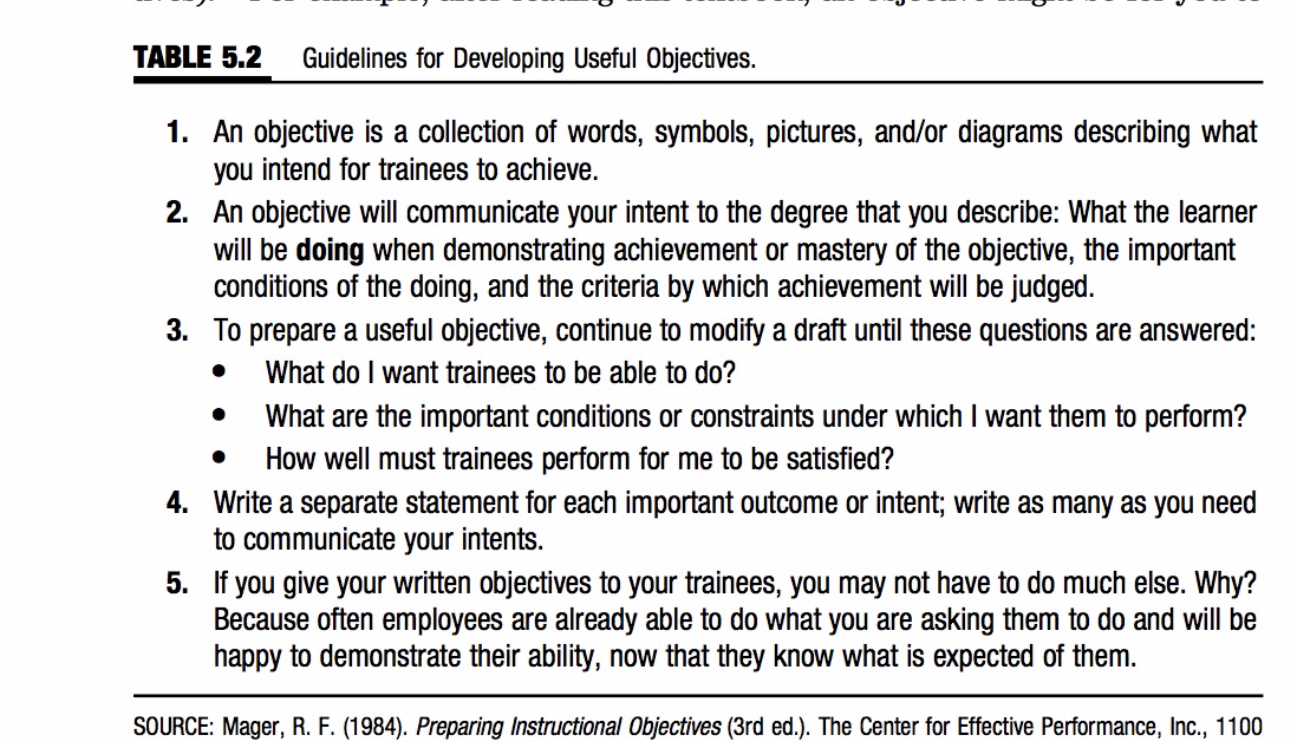
TABLE 5.1 Three Qualities of Useful Objectives. Performance Conditions An objective always says what a learner is expected to be able to do and/or produce to be considered competent; the objective sometimes describes the product or result of the doing. Example: "Write a product profile for a proposed new product." An objective describes the important conditions (if any) under which the perfor- mance is to occur. Example: "Given all available engineering data regarding a proposed product, trainee will write a product profile." Wherever possible, an objective identifies the criteria of acceptable performance by describing how well the learner must perform in order to be considered acceptable. Example: The product profile must describe all of the commercial characteristics of the product that are appropriate for its introduction to the market, including descriptions of at least three major product uses." Criteria TABLE 5.2 Guidelines for Developing Useful Objectives. . 1. An objective is a collection of words, symbols, pictures, and/or diagrams describing what you intend for trainees to achieve. 2. An objective will communicate your intent to the degree that you describe: What the learner will be doing when demonstrating achievement or mastery of the objective, the important conditions of the doing, and the criteria by which achievement will be judged. 3. To prepare a useful objective, continue to modify a draft until these questions are answered: What do I want trainees to be able to do? What are the important conditions or constraints under which I want them to perform? How well must trainees perform for me to be satisfied? 4. Write a separate statement for each important outcome or intent; write as many as you need to communicate your intents. 5. If you give your written objectives to your trainees, you may not have to do much else. Why? Because often employees are already able to do what you are asking them to do and will be happy to demonstrate their ability, now that they know what is expected of them. SOURCE: Mager, R. F. (1984). Preparing Instructional Objectives (3rd ed.). The Center for Effective Performance, Inc., 1100









 Study Help