







Question: Writing an array to a text file. Create a 2D array parts, and write it out to a text file. To do this, do import
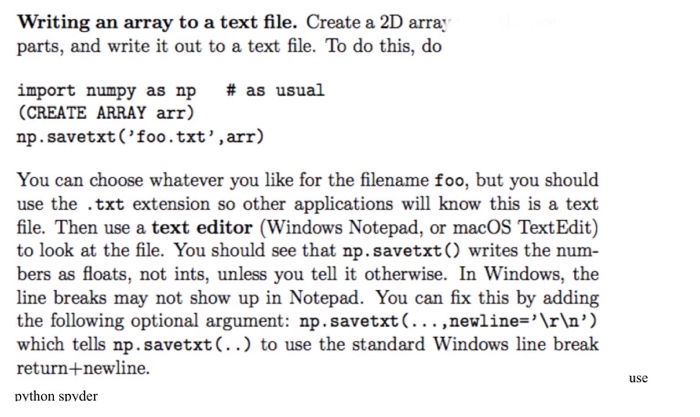
Writing an array to a text file. Create a 2D array parts, and write it out to a text file. To do this, do import numpy as np # as usual (CREATE ARRAY arr) np.savetxt ('foo.txt',arr) You can choose whatever you like for the filename foo, but you should use the .txt extension so other applications will know this is a text file. Then use a text editor (Windows Notepad, or macOS TextEdit) to look at the file. You should see that np. savetxt ) writes the num- bers as floats, not ints, unless you tell it otherwise. In Windows, the line breaks may not show up in Notepad. You can fix this by adding the following optional argument: np.savetxt(... .newline rln') which tells np.savetxt(..) to use the standard Windows line break return+newline. pvthon spvder use Writing an array to a text file. Create a 2D array parts, and write it out to a text file. To do this, do import numpy as np # as usual (CREATE ARRAY arr) np.savetxt ('foo.txt',arr) You can choose whatever you like for the filename foo, but you should use the .txt extension so other applications will know this is a text file. Then use a text editor (Windows Notepad, or macOS TextEdit) to look at the file. You should see that np. savetxt ) writes the num- bers as floats, not ints, unless you tell it otherwise. In Windows, the line breaks may not show up in Notepad. You can fix this by adding the following optional argument: np.savetxt(... .newline rln') which tells np.savetxt(..) to use the standard Windows line break return+newline. pvthon spvder use
Step by Step Solution
There are 3 Steps involved in it

Get step-by-step solutions from verified subject matter experts
 Study Help