







Question: WW11: Problem 4 (1 point) (Section 4.3) Consider the function f^(')(x)=(3)/(x)+4 . (a) Find the Riemann sum for the area under f^(')(x) between x=1 and
WW11: Problem 4\ (1 point)\ (Section 4.3) Consider the function
f^(')(x)=(3)/(x)+4.\ (a) Find the Riemann sum for the area under
f^(')(x)between
x=1and
x=5using right endpoints and
n=4.\ (b) Find the Riemann sum for this same area, using left endpoints and
n=4.\ The following is an alternate way of wording the same problem:\ Consider the function
f^(')(x)given above.\ The function gives the rate of change of a bacteria's mass as a function of time,
x.\ interval. Use the right end point of each interval as your estimate for constant rate of change.
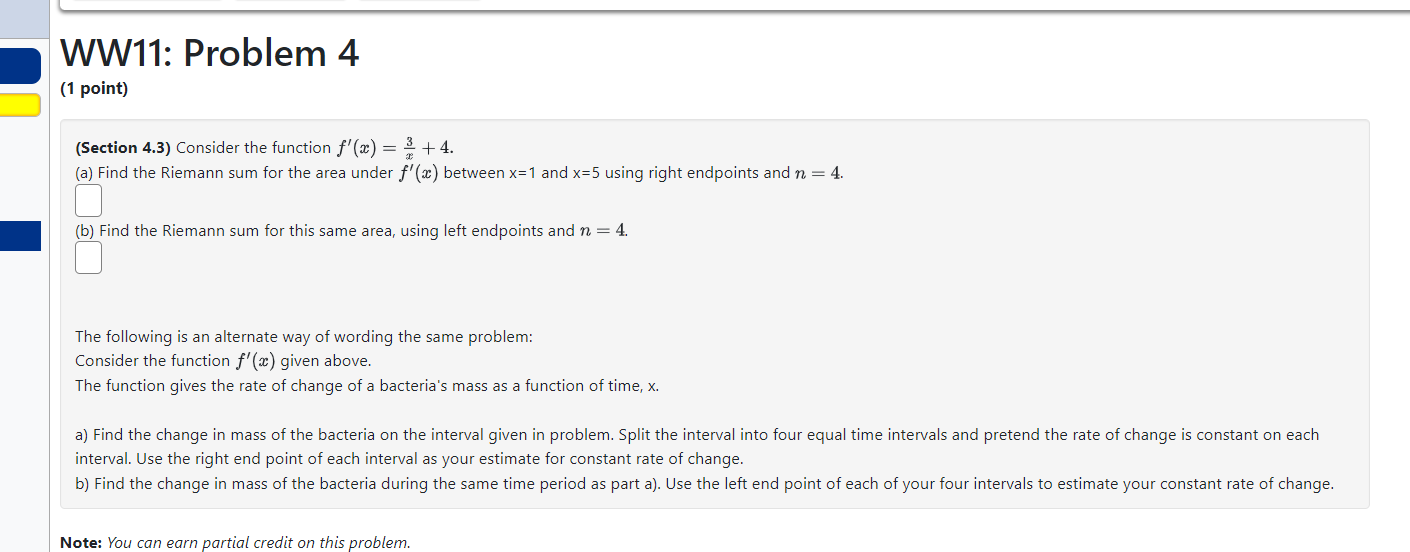
(Section 4.3) Consider the function f(x)=x3+4. (a) Find the Riemann sum for the area under f(x) between x=1 and x=5 using right endpoints and n=4. (b) Find the Riemann sum for this same area, using left endpoints and n=4. The following is an alternate way of wording the same problem: Consider the function f(x) given above. The function gives the rate of change of a bacteria's mass as a function of time, x. a) Find the change in mass of the bacteria on the interval given in problem. Split the interval into four equal time intervals and pretend the rate of change is constant on each interval. Use the right end point of each interval as your estimate for constant rate of change. b) Find the change in mass of the bacteria during the same time period as part a). Use the left end point of each of your four intervals to estimate your constant rate of change
Step by Step Solution
There are 3 Steps involved in it

Get step-by-step solutions from verified subject matter experts
 Study Help