



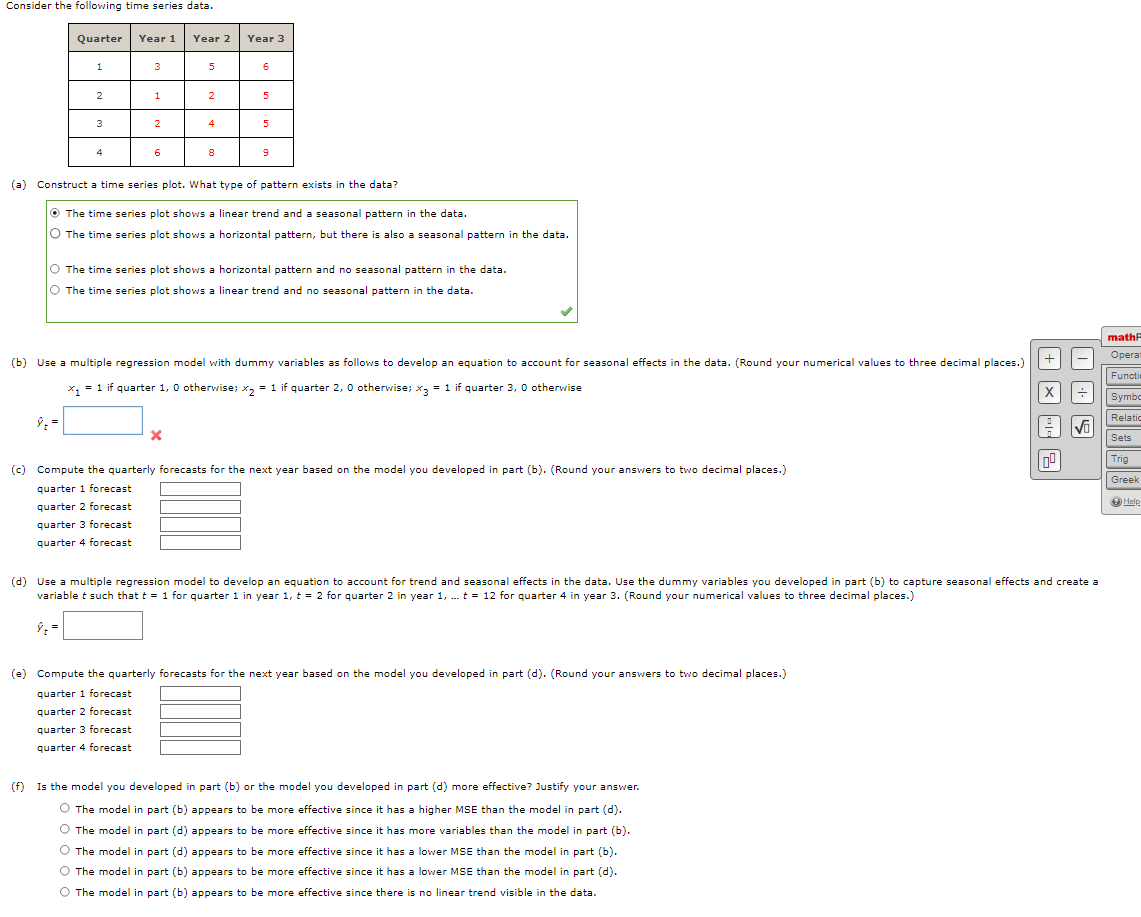
Question: x 1 = 1 if quarter 1 , 0 otherwise; x 2 = 1 if quarter 2 , 0 otherwise; x 3 = 1 if
if quarter otherwise; if quarter otherwise; if quarter otherwise
hat
c Compute the quarterly forecasts for the next year based on the model you developed in part bRound your answers to two decimal places.
quarter forecast
quarter forecast
quarter forecast
quarter forecast
variable such that for quarter in year for quarter in year dotst for quarter in year Round your numerical values to three decimal places.
hat
e Compute the quarterly forecasts for the next year based on the model you developed in part dRound your answers to two decimal places.
quarter forecast
quarter forecast
quarter forecast
quarter forecast
f Is the model you developed in part b or the model you developed in part d more effective? Justify your answer.
The model in part b appears to be more effective since it has a higher MSE than the model in part d
The model in part d appears to be more effective since it has more variables than the model in part b
The model in part d appears to be more effective since it has a lower MSE than the model in part b
The model in part b appears to be more effective since it has a lower MSE than the model in part d
The model in part b appears to be more effective since there is no linear trend visible in the data.
Step by Step Solution
There are 3 Steps involved in it
1 Expert Approved Answer
Step: 1 Unlock

Question Has Been Solved by an Expert!
Get step-by-step solutions from verified subject matter experts
Step: 2 Unlock
Step: 3 Unlock