



Question: X = 1.8 2. A 10 m deep excavation is being made as part of a new metro station construction. In plan (i.e. viewed from
X = 1.8
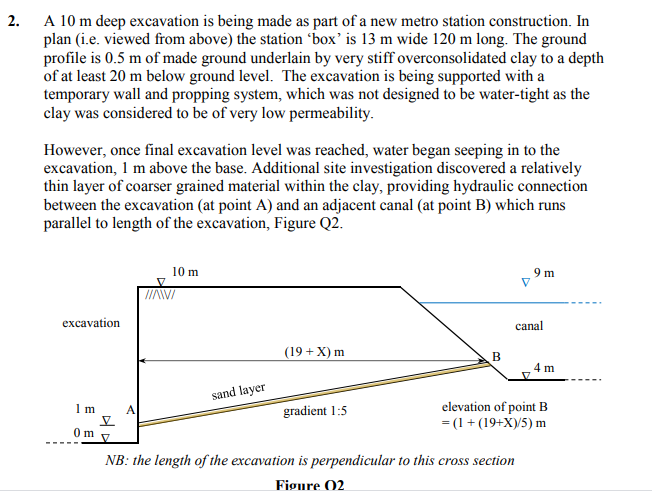
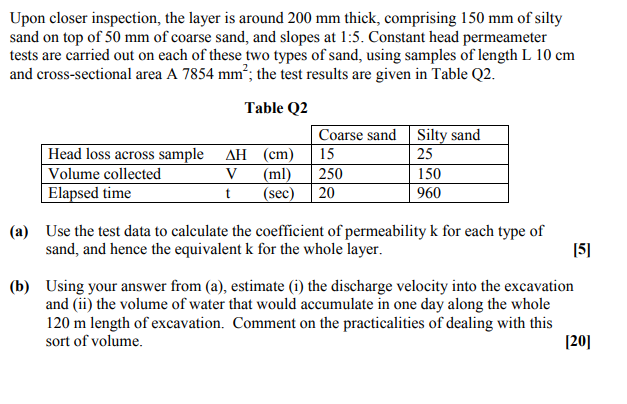
2. A 10 m deep excavation is being made as part of a new metro station construction. In plan (i.e. viewed from above) the station box is 13 m wide 120 m long. The ground profile is 0.5 m of made ground underlain by very stiff overconsolidated clay to a depth of at least 20 m below ground level. The excavation is being supported with a temporary wall and propping system, which was not designed to be water-tight as the clay was considered to be of very low permeability. However, once final excavation level was reached, water began seeping in to the excavation, 1 m above the base. Additional site investigation discovered a relatively thin layer of coarser grained material within the clay, providing hydraulic connection between the excavation (at point A) and an adjacent canal (at point B) which runs parallel to length of the excavation, Figure Q2. 9 m 10 m //// excavation canal (19+X) m B 4 m sand layer 1 m A gradient 1:5 elevation of point B = (1 + (19+X)/5) m 0 m NB: the length of the excavation is perpendicular to this cross section Figure 02 Upon closer inspection, the layer is around 200 mm thick, comprising 150 mm of silty sand on top of 50 mm of coarse sand, and slopes at 1:5. Constant head permeameter tests are carried out on each of these two types of sand, using samples of length L 10 cm and cross-sectional area A 7854 mm; the test results are given in Table Q2. Table Q2 Coarse sand Silty sand Head loss across sample AH (cm) 15 25 Volume collected V (ml) 250 150 Elapsed time t (sec) 20 960 151 (a) Use the test data to calculate the coefficient of permeability k for each type of sand, and hence the equivalent k for the whole layer. (b) Using your answer from (a), estimate (i) the discharge velocity into the excavation and (ii) the volume of water that would accumulate in one day along the whole 120 m length of excavation. Comment on the practicalities of dealing with this sort of volume. [20] 2. A 10 m deep excavation is being made as part of a new metro station construction. In plan (i.e. viewed from above) the station box is 13 m wide 120 m long. The ground profile is 0.5 m of made ground underlain by very stiff overconsolidated clay to a depth of at least 20 m below ground level. The excavation is being supported with a temporary wall and propping system, which was not designed to be water-tight as the clay was considered to be of very low permeability. However, once final excavation level was reached, water began seeping in to the excavation, 1 m above the base. Additional site investigation discovered a relatively thin layer of coarser grained material within the clay, providing hydraulic connection between the excavation (at point A) and an adjacent canal (at point B) which runs parallel to length of the excavation, Figure Q2. 9 m 10 m //// excavation canal (19+X) m B 4 m sand layer 1 m A gradient 1:5 elevation of point B = (1 + (19+X)/5) m 0 m NB: the length of the excavation is perpendicular to this cross section Figure 02 Upon closer inspection, the layer is around 200 mm thick, comprising 150 mm of silty sand on top of 50 mm of coarse sand, and slopes at 1:5. Constant head permeameter tests are carried out on each of these two types of sand, using samples of length L 10 cm and cross-sectional area A 7854 mm; the test results are given in Table Q2. Table Q2 Coarse sand Silty sand Head loss across sample AH (cm) 15 25 Volume collected V (ml) 250 150 Elapsed time t (sec) 20 960 151 (a) Use the test data to calculate the coefficient of permeability k for each type of sand, and hence the equivalent k for the whole layer. (b) Using your answer from (a), estimate (i) the discharge velocity into the excavation and (ii) the volume of water that would accumulate in one day along the whole 120 m length of excavation. Comment on the practicalities of dealing with this sort of volume. [20]
Step by Step Solution
There are 3 Steps involved in it

Get step-by-step solutions from verified subject matter experts