







Question: x Assignment: Chapter 11 Investment Planning How much capital do you need to start investing? The motivation for making investments is largely driven by the
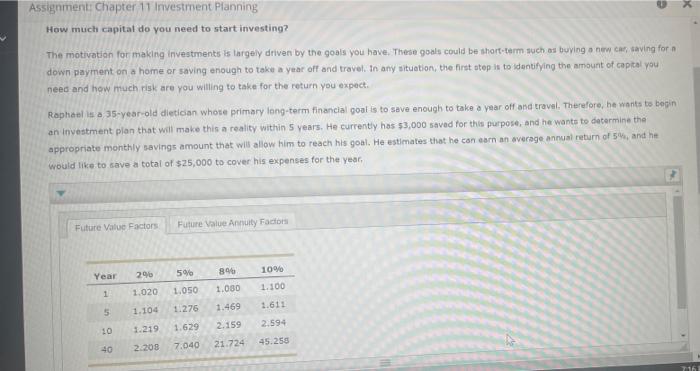
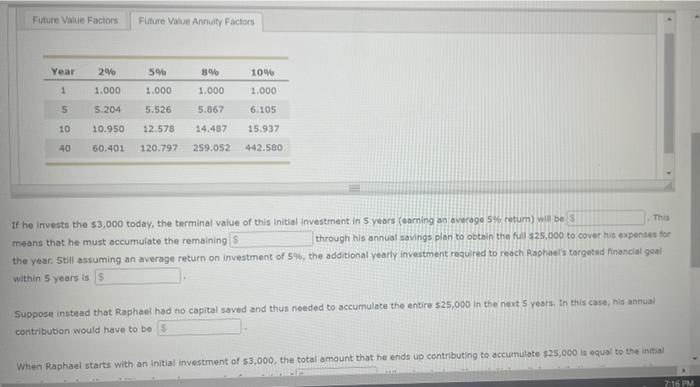
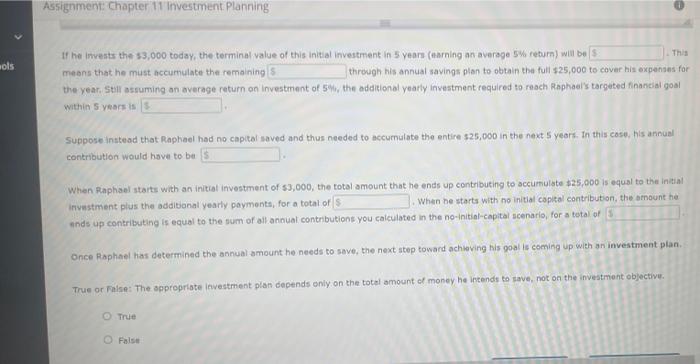
x Assignment: Chapter 11 Investment Planning How much capital do you need to start investing? The motivation for making investments is largely driven by the goals you have. These goals could be short-term such as buying a new ca saving for down payment on a home or saving enough to take a year off and travel. In any situation, the first step is to identifying the amount of capital you need and how much risk are you willing to take for the return you expect Raphael is a 35-year-old dietician whore primary long-term financial goal is to save enough to take a year off and travel. Therefore, he wants to bepin an Investment plan that will make this a reality within 5 years. He currently has 53,000 saved for this purpose, and he wants to determine the appropriate monthly savings amount that will allow him to reach his goal. He estimates that he can earn an average annual return of 5, and he would like to save a total of $25,000 to cover his expenses for the year Future Value Factors Future Value Annuity Factor 296 Year 5% 890 10% 1.100 1 1.020 1.050 1.030 1.469 5 1.104 1.276 1.629 2.159 2.594 10 1.219 2.208 7.040 21.724 45.255 40 7161 Future Value Factors Future Value Annuity Factors Year 2% 59 896 1096 1.000 1 1.000 1.000 1.000 5 5.204 5.867 6.105 5.526 12.578 10 10.950 14.487 15.937 40 60.401 120.797 259.052 442.580 If he invests the $3,000 today, the terminal value of this initial Investment in 5 years (earning an average return) will be This means that he must accumulate the remainings through his annual savings plan to obtain the full 25,000 to cover his expenses for the year. Still assuming an average return on investment of 5%, the additional yearly investment required to reach Raphael's targeted Financial goal within 5 years is s Suppose instead that Raphael had no capital saved and thus needed to accumulate the entire $25,000 in the next 5 years. In this case, his annual contribution would have to be 5 When Raphael starts with an initial investment of $3,000, the total amount that he ends up contributing to accumulate $25,000 is equal to the initial 7:16 PM Assignmery: Chapter 11 Investment Planning This ols If he invests the $3,000 today, the terminal value of this initial investment in 5 years (earning an average return) will be means that he must accumulate the remainings through his annual savings plan to obtain the full $25,000 to cover his expenses for the year still assuming an average return on investment of the additional yearly Investment required to reach Raphael's targeted financial goal within 5 years is Suppose instead that Raphael had no capital saved and thus needed to accumulate the entire $25,000 in the next 5 years. In this case, his annual contribution would have to be When Raphael starts with an initial investment of $3,000, the total amount that he ends up contributing to accumulate $25,000 is equal to the initial investment plus the additional yearly payments, for a total of When he starts with no initial capital contribution, the amount he ends up contributing is equal to the sum of all annual contributions you calculated in the no-Initial-capital scenario, for a total of 3 Once Raphael has determined the annual amount he needs to save the next step toward achieving his goal is coming up with an investment plan True or False: The appropriate Investment plan depends only on the total amount of money he intends to save, not on the investment objective True False
Step by Step Solution
There are 3 Steps involved in it

Get step-by-step solutions from verified subject matter experts
 Study Help