



Question: X MindTap - Cengage Learning X Q Philippines You're the manager c x Search Results | Course Hero X + 5:/g.cengage.com/staticb/ui/evo/index.html?deploymentld=5796251934523889227206060197&eISBN=978... A* @ O CENGAGE
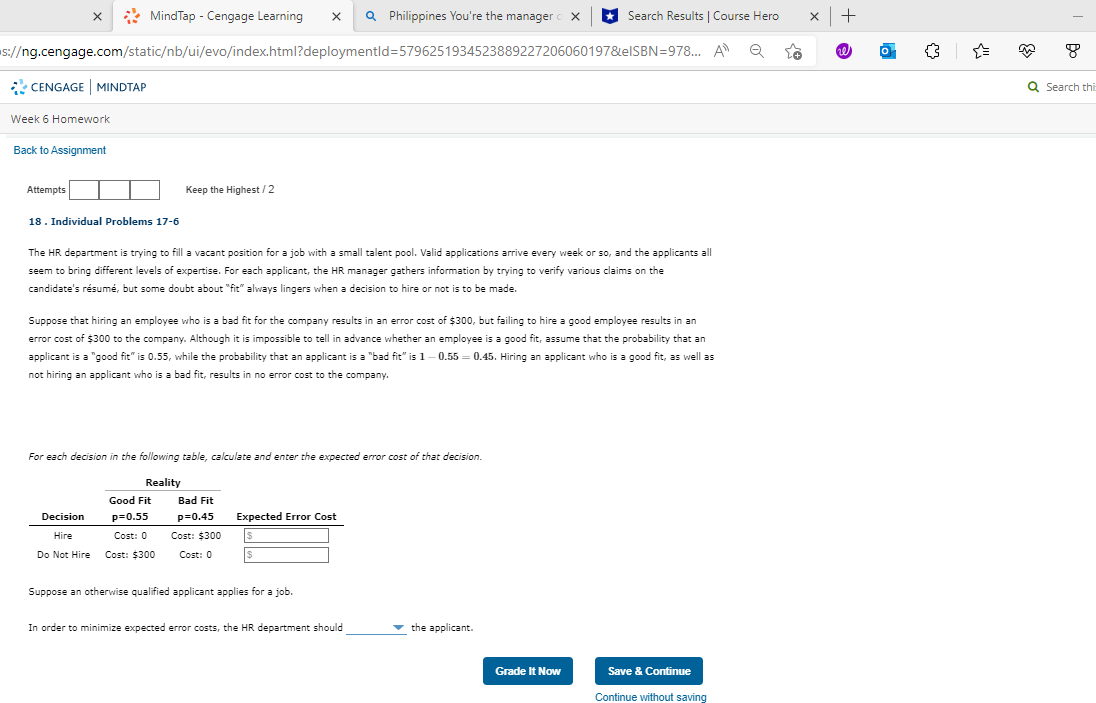
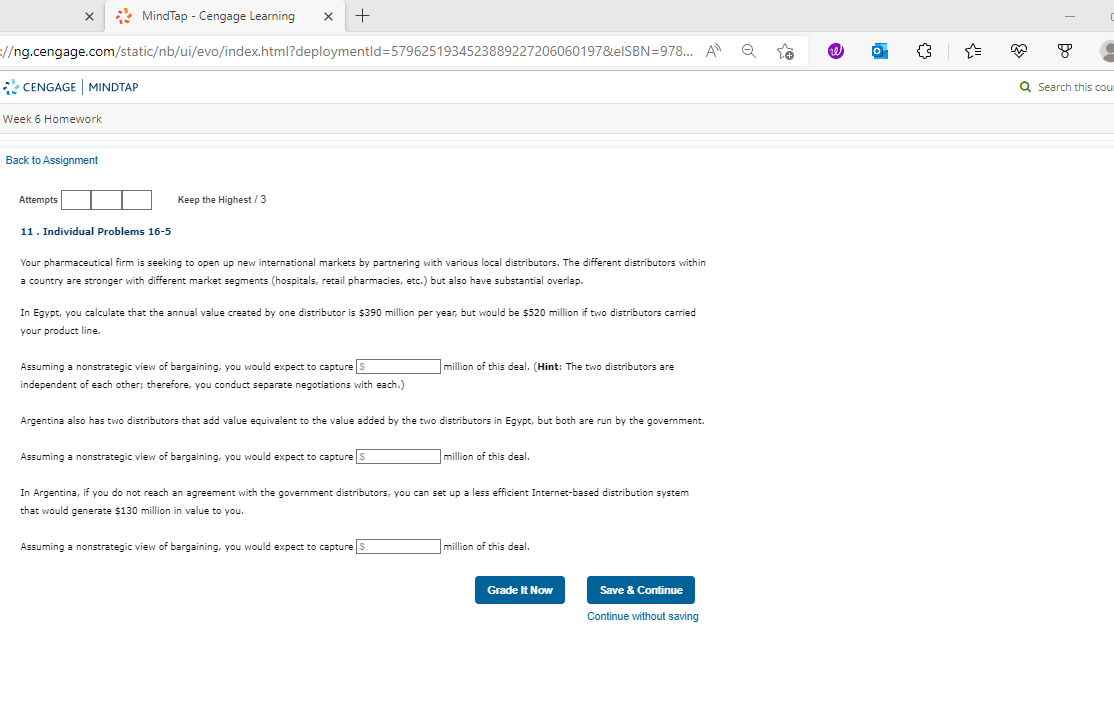
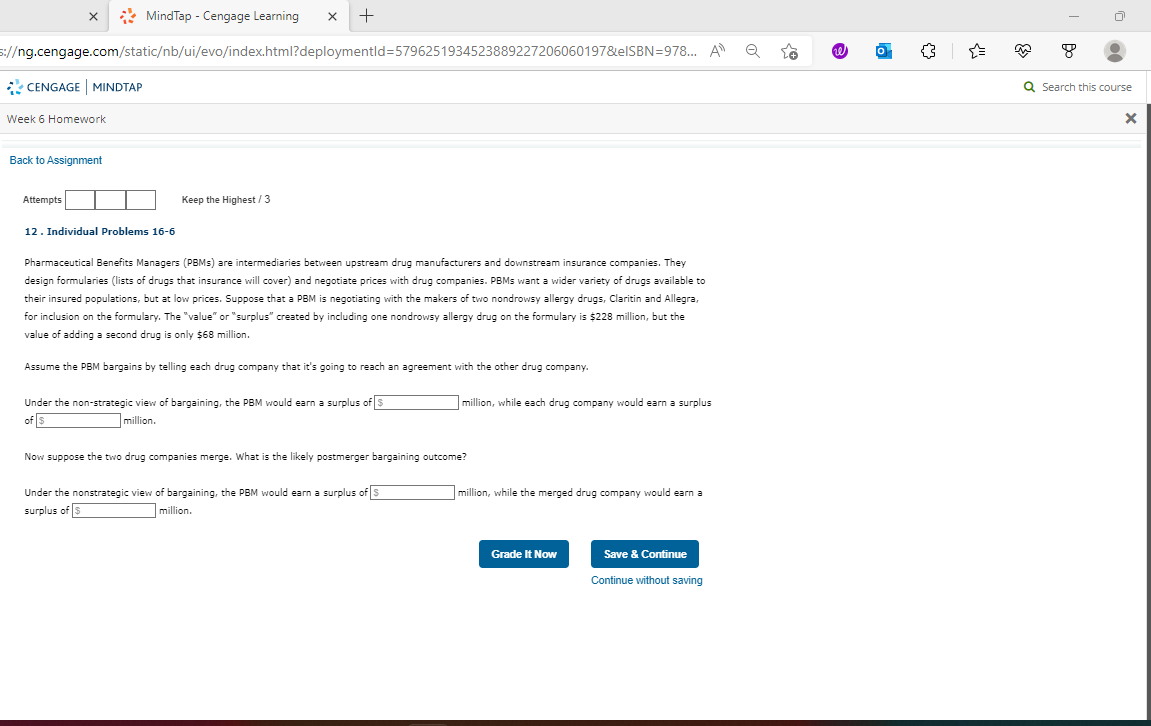
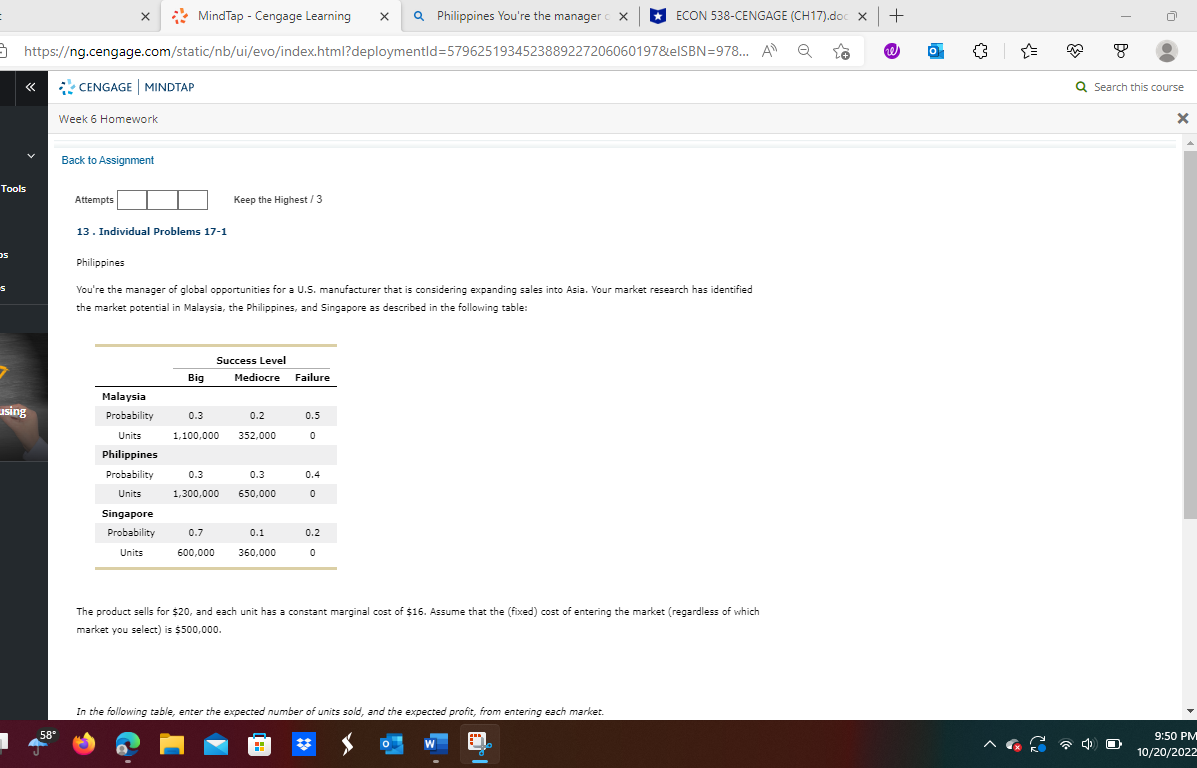
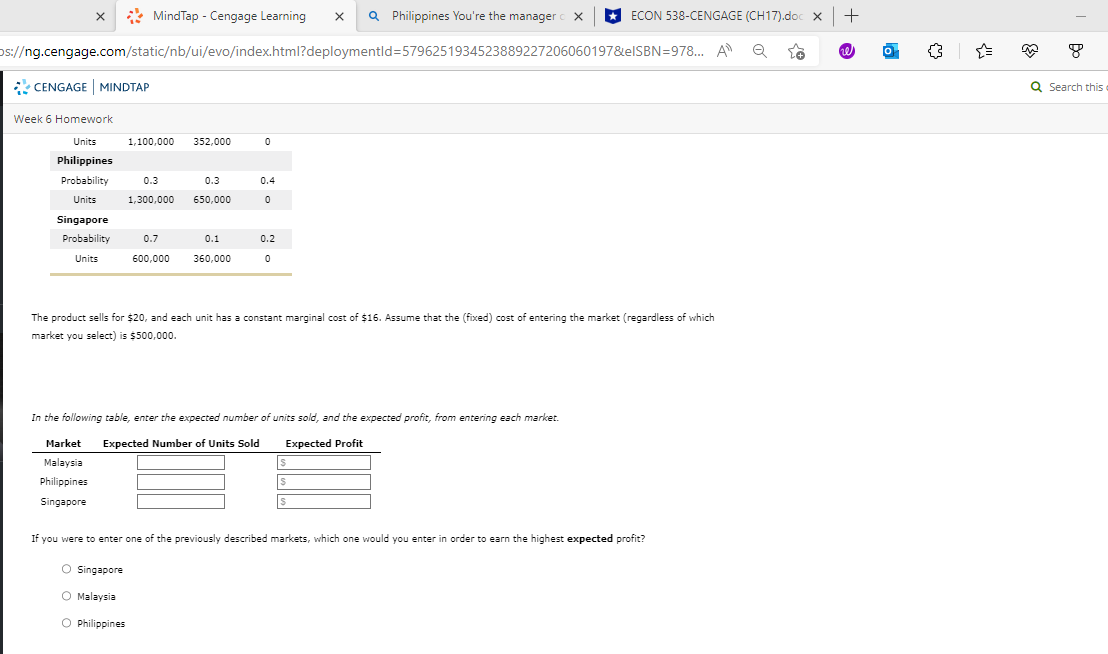
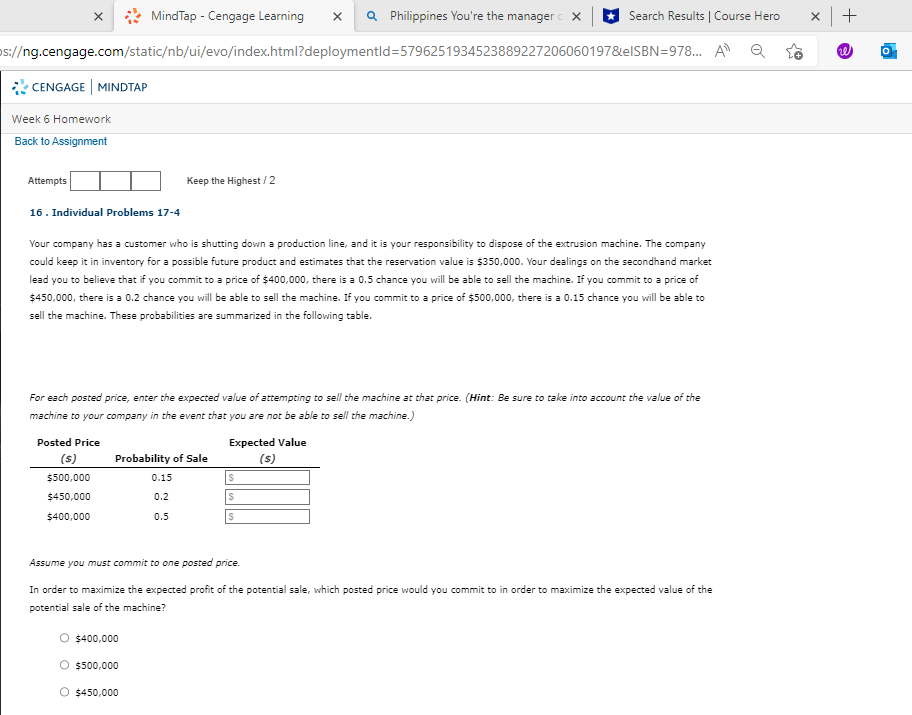
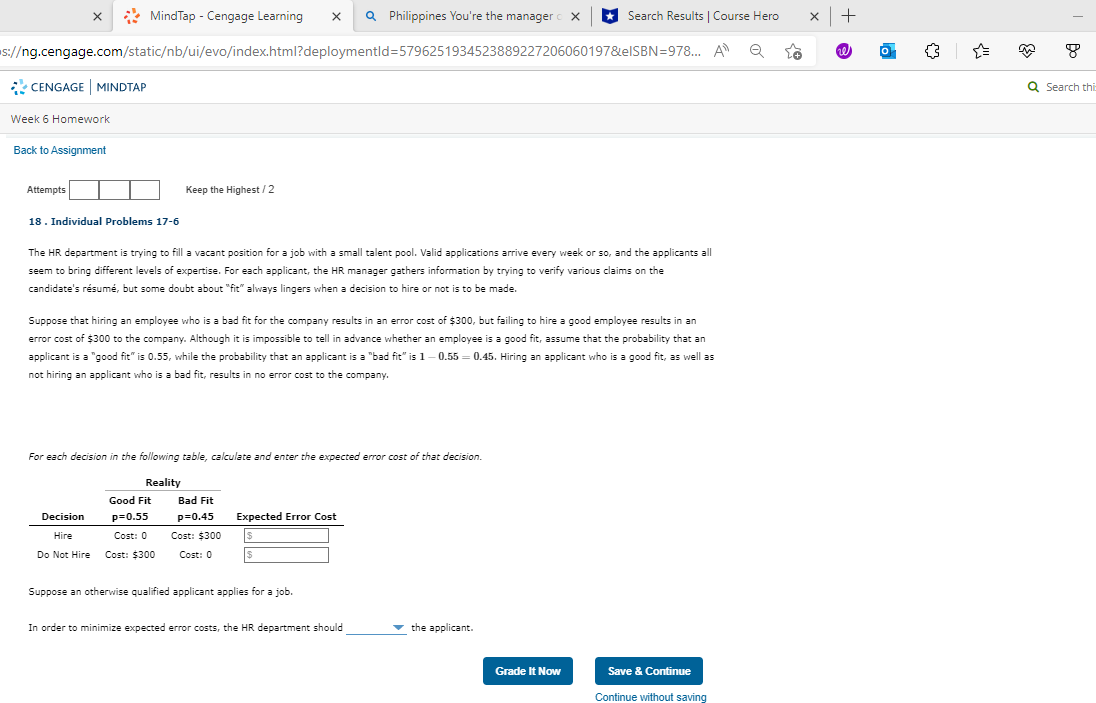
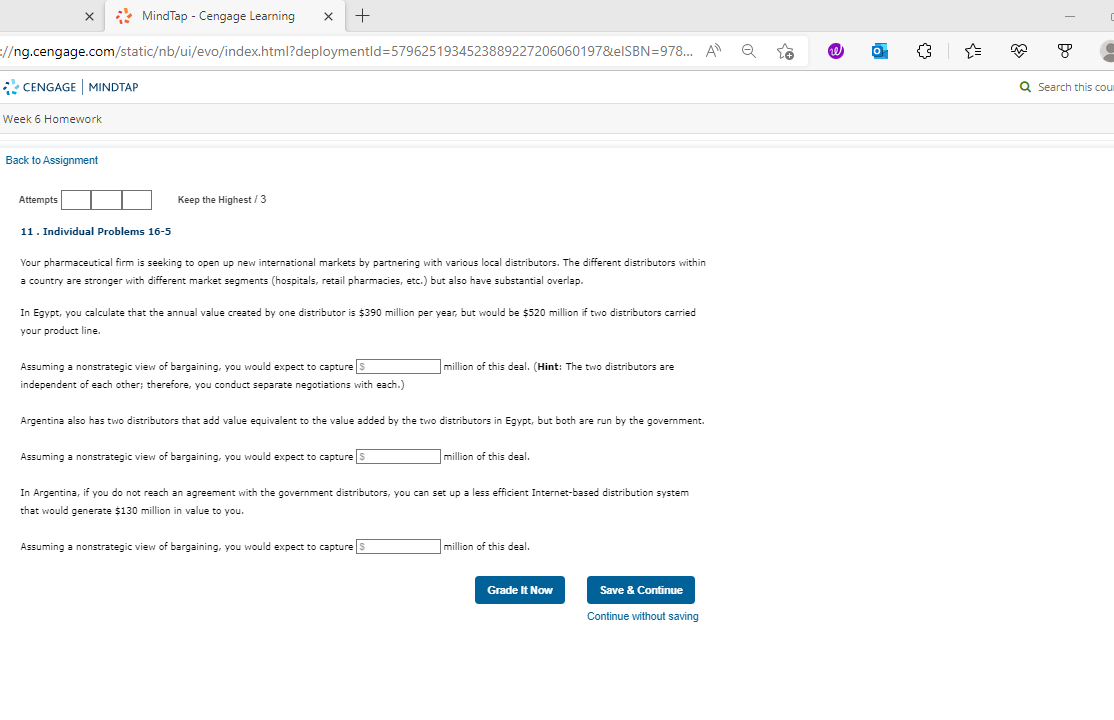
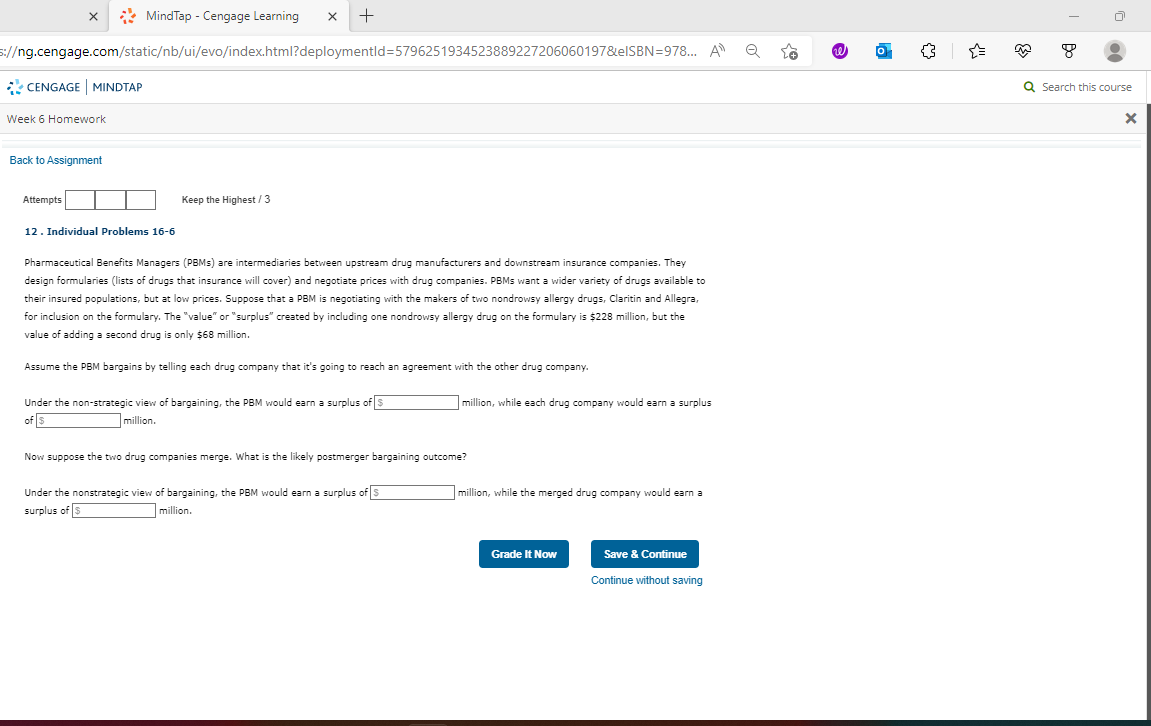
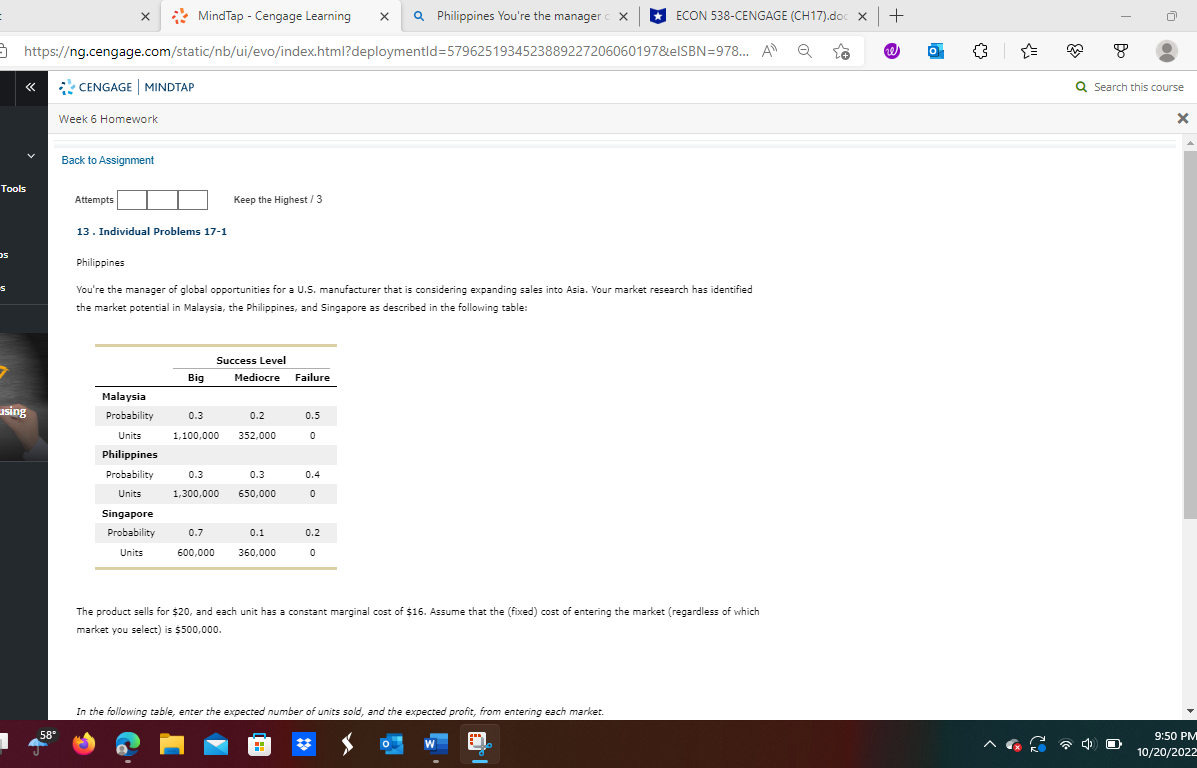
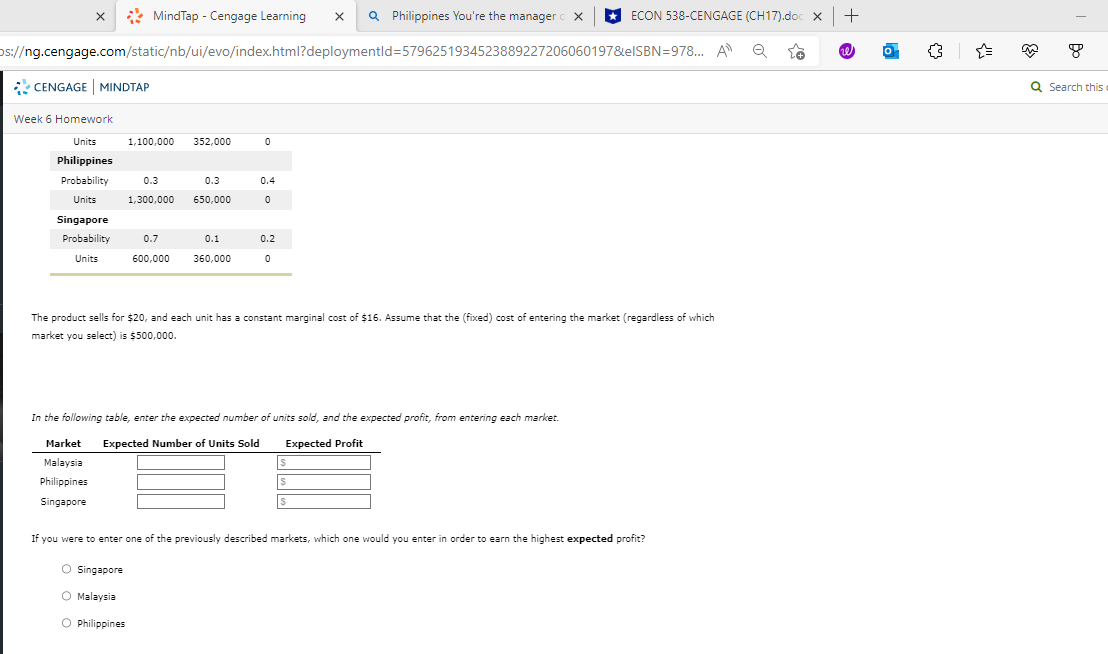
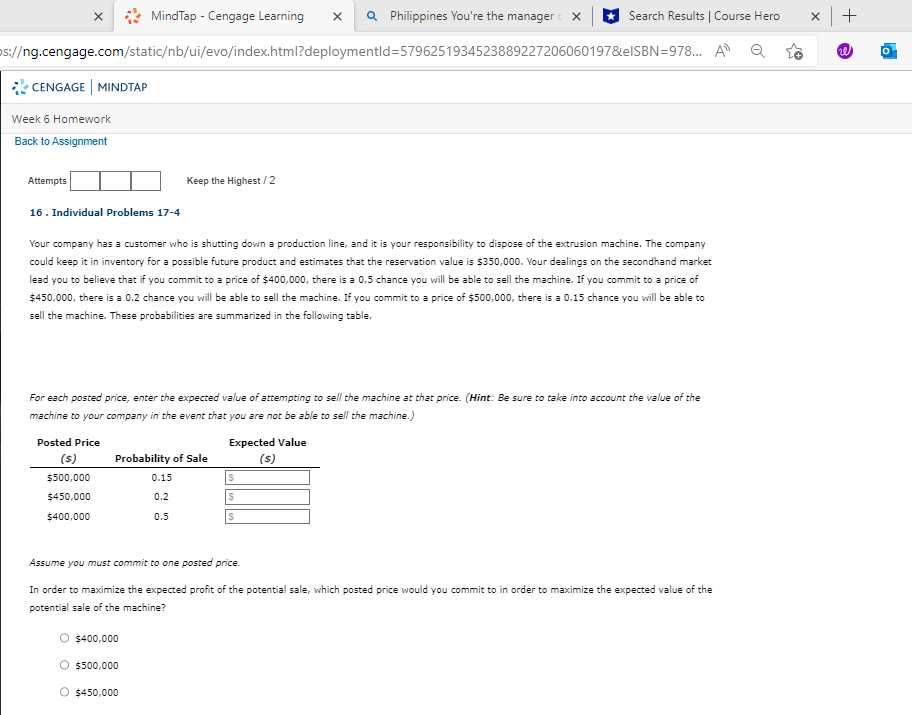
X MindTap - Cengage Learning X Q Philippines You're the manager c x Search Results | Course Hero X + 5:/g.cengage.com/staticb/ui/evo/index.html?deploymentld=5796251934523889227206060197&eISBN=978... A* @ O CENGAGE | MINDTAP Q Search th Week 6 Homework Back to Assignment Attempts Keep the Highest / 2 18 . Individual Problems 17-6 The HR department is trying to fill a vacant position for a job with a small talent pool. Valid applications arrive every week or so, and the applicants all seem to bring different levels of expertise. For each applicant, the HR manager gathers information by trying to verify various claims on the candidate's resume, but some doubt about "fit" always lingers when a decision to hire or not is to be made. Suppose that hiring an employee who is a bad fit for the company results in an error cost of $300, but failing to hire a good employee results in an error cost of $300 to the company. Although it is impossible to tell in advance whether an employee is a good fit, assume that the probability that an applicant is a "good fit" is 0.55, while the probability that an applicant is a "bad fit" is 1 - 0.55 = 0.45. Hiring an applicant who is a good fit, as well as not hiring an applicant who is a bad fit, results in no error cost to the company. For each decision in the following table, calculate and enter the expected error cost of that decision. Reality Good Fit Bad Fit Decision p=0.55 D=0.45 Expected Error Cost Hire Cost: 0 Cost: $300 Do Not Hire Cost: $300 Cost: 0 Suppose an otherwise qualified applicant applies for a job. In order to minimize expected error costs, the HR department should the applicant. Grade It Now Save & Continue Continue without savingX MindTap - Cengage Learning X + /g.cengage.com/staticb/ui/evo/index.html?deploymentld=5796251934523889227206060197&eISBN=978... A Q o CENGAGE | MINDTAP Q. Search this cou Week 6 Homework Back to Assignment Attempts Keep the Highest / 3 11 . Individual Problems 16-5 Your pharmaceutical firm is seeking to open up new international markets by partnering with various local distributors. The different distributors within a country are stronger with different market segments (hospitals, retail pharmacies, etc.) but also have substantial overlap. In Egypt, you calculate that the annual value created by one distributor is $390 million per year, but would be $520 million if two distributors carried your product line. Assuming a nonstrategic view of bargaining, you would expect to capture |$ million of this deal. (Hint: The two distributors are independent of each other; therefore, you conduct separate negotiations with each.) Argentina also has two distributors that add value equivalent to the value added by the two distributors in Egypt, but both are run by the government. Assuming a nonstrategic view of bargaining, you would expect to capture |$ million of this deal. In Argentina, if you do not reach an agreement with the government distributors, you can set up a less efficient Internet-based distribution system that would generate $130 million in value to you. Assuming a nonstrategic view of bargaining, you would expect to capture |$ million of this deal. Grade It Now Save & Continue Continue without savingX MindTap - Cengage Learning X + :/g.cengage.com/staticb/ui/evo/index.html?deploymentld=5796251934523889227206060197&LeISBN=978... A Q CENGAGE | MINDTAP Q. Search this course Week 6 Homework X Back to Assignment Attempts Keep the Highest / 3 12 . Individual Problems 16-6 Pharmaceutical Benefits Managers (PBMs) are intermediaries between upstream drug manufacturers and downstream insurance companies, They design formularies (lists of drugs that insurance will cover) and negotiate prices with drug companies. PBMs want a wider variety of drugs available to their insured populations, but at low prices. Suppose that a PBM is negotiating with the makers of two nondrowsy allergy drugs, Claritin and Allegra, for inclusion on the formulary. The "value" or "surplus" created by including one nondrowsy allergy drug on the formulary is $228 million, but the value of adding a second drug is only $68 million. Assume the PBM bargains by telling each drug company that it's going to reach an agreement with the other drug company. Under the non-strategic view of bargaining, the PBM would earn a surplus of |$ million, while each drug company would earn a surplus of E million. Now suppose the two drug companies merge. What is the likely postmerger bargaining outcome? Under the nonstrategic view of bargaining, the PBM would earn a surplus of S million, while the merged drug company would earn a surplus of $ million. Grade It Now Save & Continue Continue without savingX MindTap - Cengage Learning X Q Philippines You're the manager c x ECON 538-CENGAGE (CH17).doc x + https:/g.cengage.com/staticb/ui/evo/index.html?deploymentld=5796251934523889227206060197&eISBN=978... A Q O CENGAGE | MINDTAP Q. Search this course X Week 6 Homework Back to Assignment Tools Attempts Keep the Highest / 3 13 . Individual Problems 17-1 Philippines You're the manager of global opportunities for a U.S. manufacturer that is considering expanding sales into Asia. Your market research has identified the market potential in Malaysia, the Philippines, and Singapore as described in the following table: Success Level Big Mediocre Failure Malaysia sing Probability 0.3 0.2 Units 1,100,000 352,000 Philippines Probability 0.3 0.3 0.4 Units 1,300,000 650,000 Singapore Probability 0.7 0.1 0.2 Units 600,000 360,000 The product sells for $20, and each unit has a constant marginal cost of $16. Assume that the (fixed) cost of entering the market (regardless of which market you select) is $500,000. In the following table, enter the expected number of units sold, and the expected profit, from entering each market. 9:50 PM 58 10/20/2022X MindTap - Cengage Learning X Q Philippines You're the manager c x ECON 538-CENGAGE (CH17).doc x + 5:/g.cengage.com/staticb/ui/evo/index.html?deploymentld=5796251934523889227206060197&leISBN=978... A @ O g CENGAGE | MINDTAP Q. Search this Week 6 Homework Units 1,100,000 352,000 0 Philippines Probability 0.3 0.3 0.4 Units 1,300,000 650,000 Singapore Probability 0.7 0.1 0.2 Units 600,000 360,000 0 The product sells for $20, and each unit has a constant marginal cost of $16. Assume that the (fixed) cost of entering the market (regardless of which market you select) is $500,000. In the following table, enter the expected number of units sold, and the expected profit, from entering each market. Market Expected Number of Units Sold Expected Profit Malaysia Philippines Singapore If you were to enter one of the previously described markets, which one would you enter in order to earn the highest expected profit? Singapore O Malaysia PhilippinesX MindTap - Cengage Learning X Q Philippines You're the manager c x Search Results | Course Hero + s:/g.cengage.com/staticb/ui/evo/index.html?deploymentld=5796251934523889227206060197&leISBN=978... A Q O CENGAGE | MINDTAP Week 6 Homework Back to Assignment Attempts Keep the Highest / 2 16 . Individual Problems 17-4 Your company has a customer who is shutting down a production line, and it is your responsibility to dispose of the extrusion machine. The company could keep it in inventory for a possible future product and estimates that the reservation value is $350,000. Your dealings on the secondhand market lead you to believe that if you commit to a price of $400,000, there is a 0.5 chance you will be able to sell the machine. If you commit to a price of $450,000, there is a 0.2 chance you will be able to sell the machine. If you commit to a price of $500,000, there is a 0.15 chance you will be able to sell the machine. These probabilities are summarized in the following table. For each posted price, enter the expected value of attempting to sell the machine at that price. (Hint: Be sure to take into account the value of the machine to your company in the event that you are not be able to sell the machine.) Posted Price Expected Value ($) Probability of Sale ($) $500,000 0.15 $450,000 0.2 $400,000 0.5 Assume you must commit to one posted price. In order to maximize the expected profit of the potential sale, which posted price would you commit to in order to maximize the expected value of the potential sale of the machine? O $400,000 O $500,000 $450,000
Step by Step Solution
There are 3 Steps involved in it

Get step-by-step solutions from verified subject matter experts