







Question: x ms D 5 ms C 4 ms 0 ms A B x ms 3 ms x ms (Question 3) Starting from the Nash equilibrium
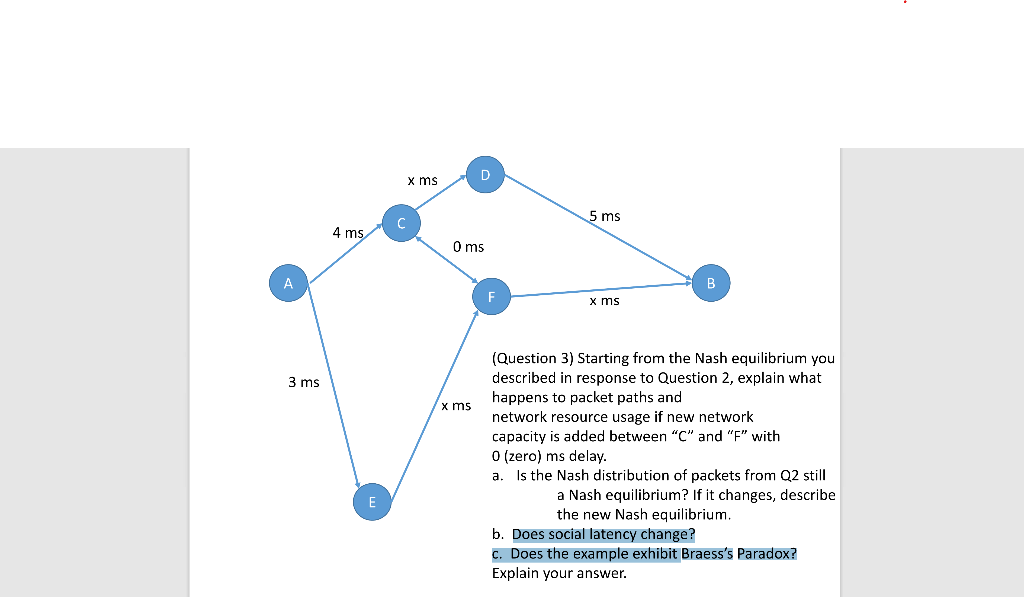
x ms D 5 ms C 4 ms 0 ms A B x ms 3 ms x ms (Question 3) Starting from the Nash equilibrium you described in response to Question 2, explain what happens to packet paths and network resource usage if new network capacity is added between "C" and "F" with 0 (zero) ms delay. a. Is the Nash distribution of packets from Q2 still a Nash equilibrium? If it changes, describe the new Nash equilibrium. b. Does social latency change? C. Does the example exhibit Braess's Paradox? Explain your answer. E x ms D 5 ms C 4 ms 0 ms A B x ms 3 ms x ms (Question 3) Starting from the Nash equilibrium you described in response to Question 2, explain what happens to packet paths and network resource usage if new network capacity is added between "C" and "F" with 0 (zero) ms delay. a. Is the Nash distribution of packets from Q2 still a Nash equilibrium? If it changes, describe the new Nash equilibrium. b. Does social latency change? C. Does the example exhibit Braess's Paradox? Explain your answer. E
Step by Step Solution
There are 3 Steps involved in it

Get step-by-step solutions from verified subject matter experts
 Study Help