







Question: X Technology Input Screen One Sample Prop. Summary # of successes: # of observations: Perform: Hypothesis test for p Ho: p = 0.5 HA :
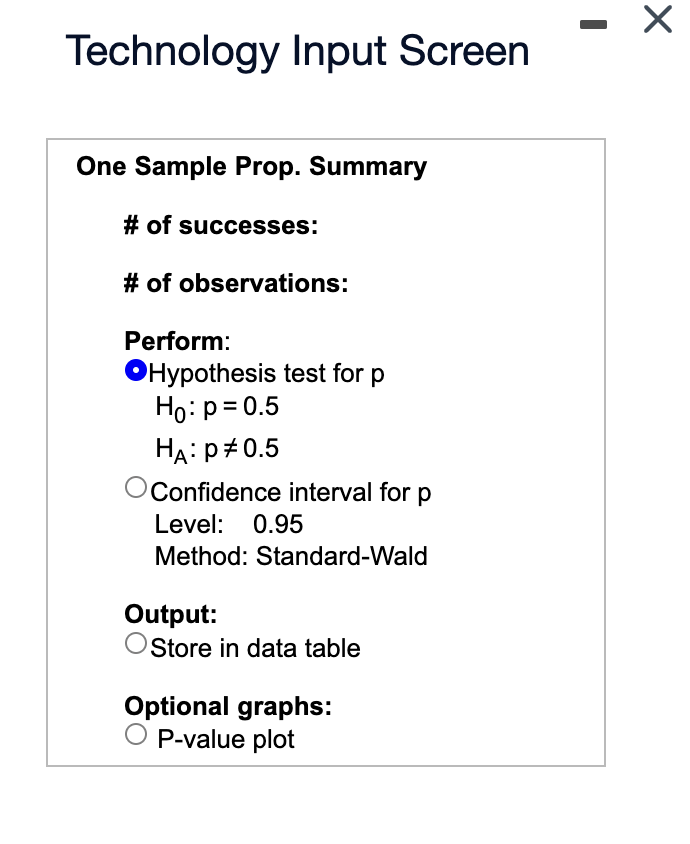
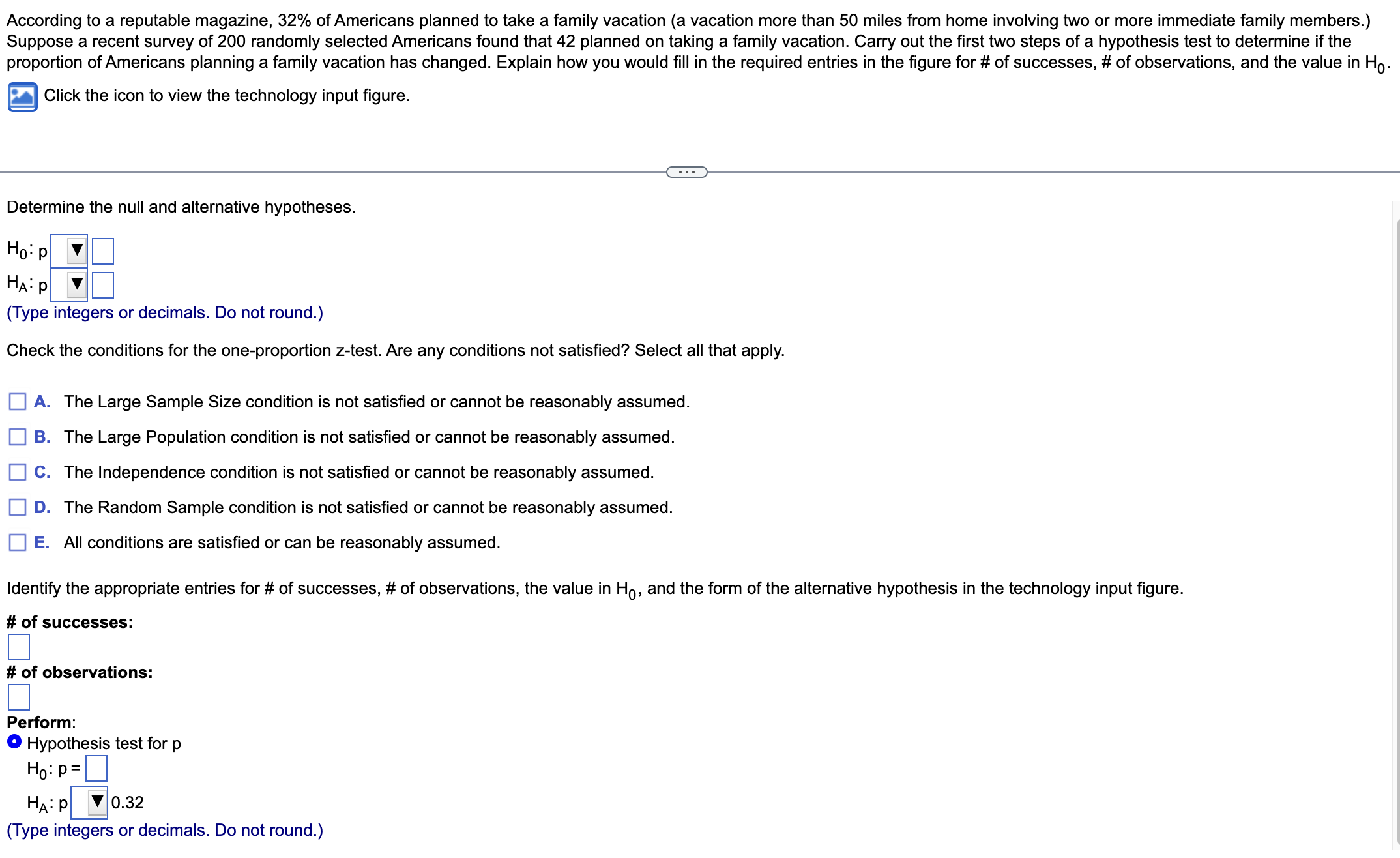
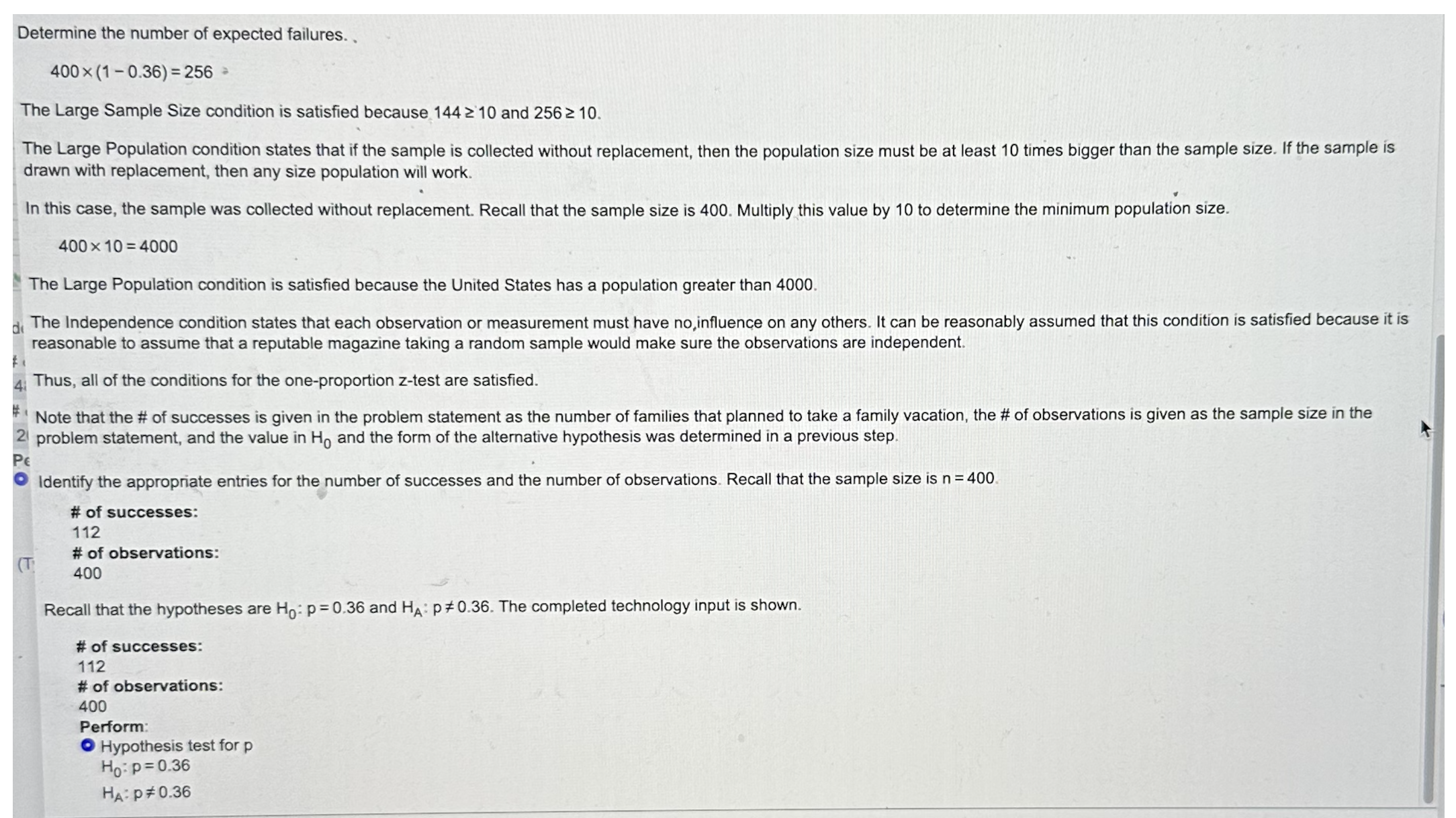
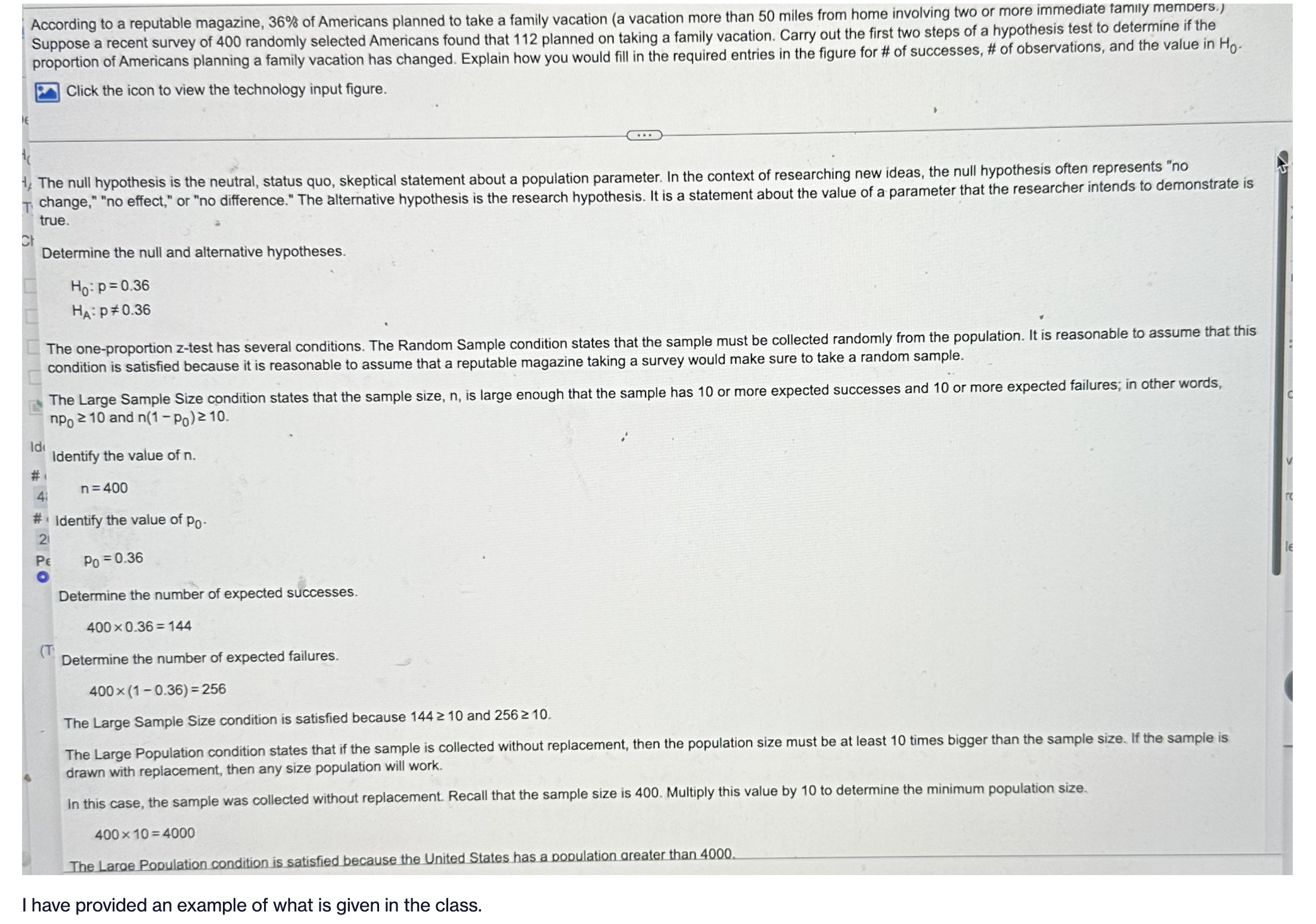
X Technology Input Screen One Sample Prop. Summary # of successes: # of observations: Perform: Hypothesis test for p Ho: p = 0.5 HA : P #0.5 OConfidence interval for p Level: 0.95 Method: Standard-Wald Output: OStore in data table Optional graphs: O P-value plotAccording to a reputable magazine, 32% ofAmericans planned to take a family vacation (a vacation more than 50 miles from home involving two or more immediate family members.) Suppose a recent survey of 200 randomly selected Americans found that 42 planned on taking a family vacation. Carry out the rst two steps of a hypothesis test to determine if the proportion ofAmericans planning a family vacation has changed. Explain how you would ll in the required entries in the gure for # of successes, # of observations, and the value in H0. Q Click the icon to view the technology input gure. Determine the null and alternative hypotheses. \"03 P HA: p (Type integers or decimals. Do not round.) Check the conditions for the one-proportion ztest. Are any conditions not satised? Select all that apply. The Large Sample Size condition is not satisfied or cannot be reasonably assumed. The Large Population condition is not satisfied or cannot be reasonably assumed. The Random Sample condition is not satisfied or cannot be reasonably assumed. A. B. C. The Independence condition is not satised or cannot be reasonably assumed. D. E. All conditions are satisfied or can be reasonably assumed. Identify the appropriate entries for # of successes, # of observations, the value in H0, and the form of the alternative hypothesis in the technology input gure. # of successes: # of observations: Perform: O Hypothesis test for p H0: p= :l HA: p V 0.32 (Type integers or decimals. Do not round.) Determine the number of expected failures. _ 400x (1 - 0.36) = 256 a The Large Sample Size condition is satised because 144 210 and 256 2 10. The Large Population condition states that it the sample is collected without replacement. then the population size must be at least 10 times bigger than the sample srze. If the sample is drawn with replacement, then any size population Will work. : In this case, the sample was collected without replacement Recall that the sample size is 400. Multiply this value by 10 to determine the minimum population size. ' 400 x 10 = 4000 The Large Population condition is satised because the United States has a population greater than 4000. d. The Independence condition states mat each observation or measurement must have no,inuence on any others. It can be reasonably assumed that this condition is satised because it is reasonable to assume that a reputable magazme taking a random sample would make sure the observations are independent. F I 4; Thus, all of the conditions for the one-proportion ztest are satised. " ' Note that the # of successes is given in the problem statement as the number of families that planned to take a family vacation, the # of observations is given as the sample size in the 2' problem statement. and the value in H0 and the form of the alternative hypothesis was determined in a preVIous step, Pt ' Identify the appropriate entries for the number of successes and the number of observations, Recall that the sample size is n = 400 it of successes: 1 12 , It of observations: (T- 400 Rewll that the hypotheses are Ho: p = 0.36 and HA: p at 0.361 The completed technology input is shown. # of successes: 1 12 i of observations: 400 Perform: O Hypothesis test for p H0: p = 0.36 HA: p 0.36 According to a reputable magazine, 36% of Americans planned to take a family vacation (a vacation more than 50 miles from home involving two or more immediate family members.) Suppose a recent survey of 400 randomly selected Americans found that 112 planned on taking a family vacation. Carry out the first two steps of a hypothesis test to determine if the proportion of Americans planning a family vacation has changed. Explain how you would fill in the required entries in the figure for # of successes, # of observations, and the value in Ho Click the icon to view the technology input figure. I, The null hypothesis is the neutral, status quo, skeptical statement about a population parameter. In the context of researching new ideas, the null hypothesis often represents "no change," "no effect," or "no difference." The alternative hypothesis is the research hypothesis. It is a statement about the value of a parameter that the researcher intends to demonstrate is true Determine the null and alternative hypotheses. Ho: P = 0.36 HA: P #0.36 The one-proportion z-test has several conditions. The Random Sample condition states that the sample must be collected randomly from the population. It is reasonable to assume that this condition is satisfied because it is reasonable to assume that a reputable magazine taking a survey would make sure to take a random sample. The Large Sample Size condition states that the sample size, n, is large enough that the sample has 10 or more expected successes and 10 or more expected failures; in other words, npo 2 10 and n(1 - Po) 2 10. Idi Identify the value of n. # 4 n = 400 # Identify the value of Po- 2 PE Po = 0.36 Determine the number of expected successes. 400 x 0.36 = 144 (T Determine the number of expected failures. 400 x (1 -0.36) = 256 The Large Sample Size condition is satisfied because 144 2 10 and 256 2 10. The Large Population condition states that if the sample is collected without replacement, then the population size must be at least 10 times bigger than the sample size. If the sample is drawn with replacement, then any size population will work. In this case, the sample was collected without replacement. Recall that the sample size is 400. Multiply this value by 10 to determine the minimum population size. 400 x 10 = 4000 The Large Population condition is satisfied because the United States has a population greater than 4000. I have provided an example of what is given in the class
Step by Step Solution
There are 3 Steps involved in it

Get step-by-step solutions from verified subject matter experts
 Study Help