







Question: i) ii) x (t) A 3A 4 0 x(t) + x (t) = 2.4+0.8 sin (200nt) + 0.3 sin(400nt +60) + cos(600nt) T 5T
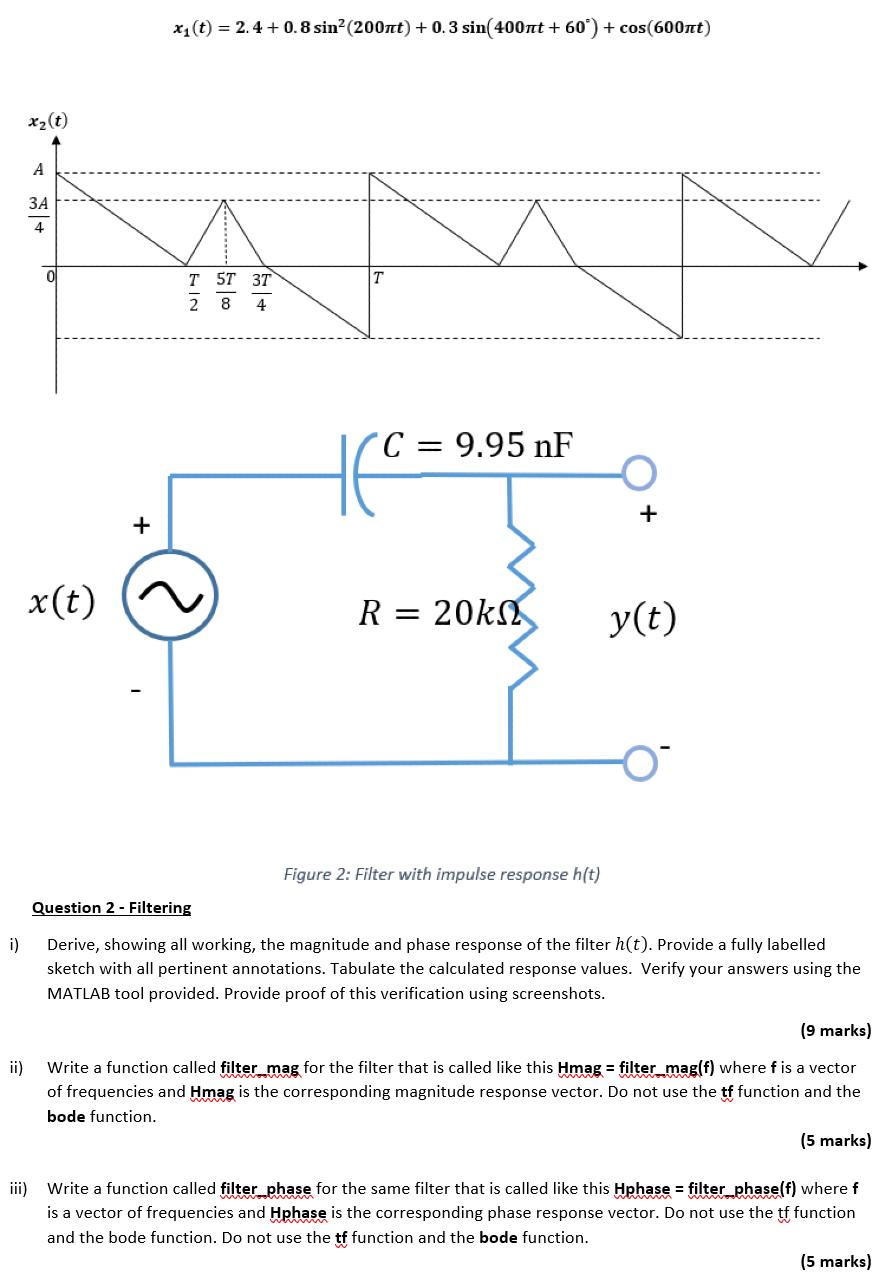
i) ii) x (t) A 3A 4 0 x(t) + x (t) = 2.4+0.8 sin (200nt) + 0.3 sin(400nt +60) + cos(600nt) T 5T 3T 28 4 T C = 9.95 nF HE R = 20k Figure 2: Filter with impulse response h(t) + y(t) Question 2 - Filtering Derive, showing all working, the magnitude and phase response of the filter h(t). Provide a fully labelled sketch with all pertinent annotations. Tabulate the calculated response values. Verify your answers using the MATLAB tool provided. Provide proof of this verification using screenshots. (9 marks) Write a function called filter_mag for the filter that is called like this Hmag = filter_mag(f) where f is a vector of frequencies and Hmag is the corresponding magnitude response vector. Do not use the tf function and the bode function. (5 marks) Write a function called filter_phase for the same filter that is called like this Hphase = filter_phase(f) where f is a vector of frequencies and Hphase is the corresponding phase response vector. Do not use the tf function and the bode function. Do not use the tf function and the bode function. (5 marks)
Step by Step Solution
3.36 Rating (146 Votes )
There are 3 Steps involved in it
you want to derive the magnitude and phase response of a filter with impulse response ht and write t... View full answer

Get step-by-step solutions from verified subject matter experts
 Study Help