







Question: x(t) = 84+ 10 (100+)+202250) (a) Using Euler's relation, the signal x(t) defined above can be expressed as a sum of complex exponential signals
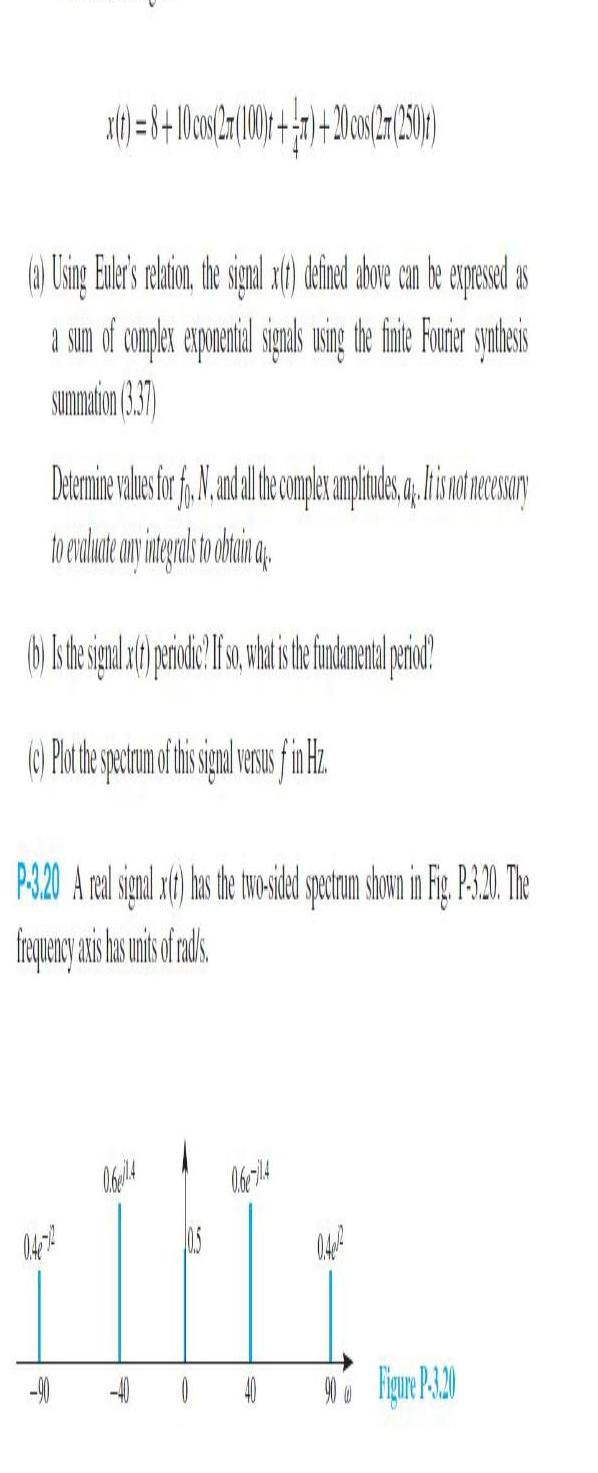
x(t) = 84+ 10 (100+)+202250) (a) Using Euler's relation, the signal x(t) defined above can be expressed as a sum of complex exponential signals using the finite Fourier synthesis summation (3.37) Determine values for fr. N. and allthe complex amplitudes,aq. It is not necessary to evaluate any integrals to obtain a (b) Is the signal x(t) periodic? If so, what is the fundamental period? (c) Plot the spectrum of this signal versus fin Hz. P-3.20 A real signal x(t) has the two-sided spectrum shown in Fig. P-3.20. The frequency axis has units of rad/s. 0.4% 06-14 CO 4G CC 10 90% Figure P-330
Step by Step Solution
There are 3 Steps involved in it

Get step-by-step solutions from verified subject matter experts
 Study Help