







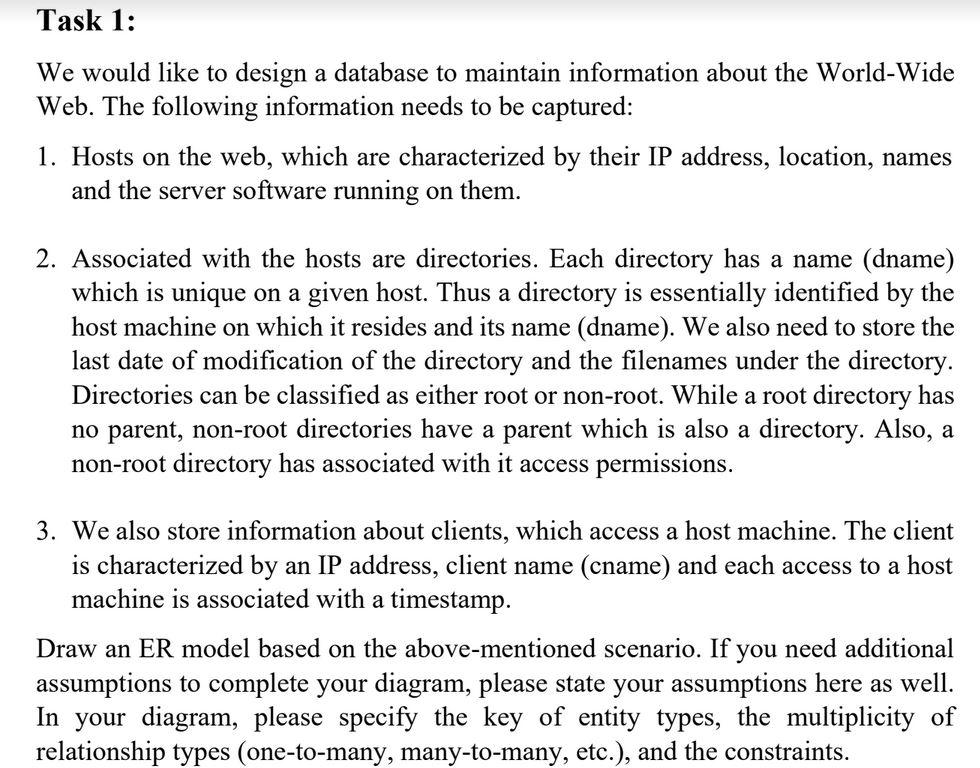
Question: XX= 10 Only task 2 needed.urgent Task 1: We would like to design a database to maintain information about the World-Wide Web. The following information
XX= 10
Only task 2 needed.urgent
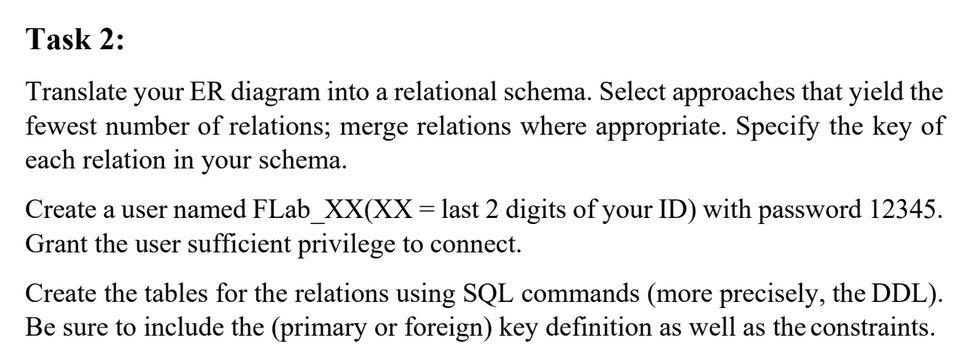
Task 1: We would like to design a database to maintain information about the World-Wide Web. The following information needs to be captured: 1. Hosts on the web, which are characterized by their IP address, location, names and the server software running on them. 2. Associated with the hosts are directories. Each directory has a name (dname) which is unique on a given host. Thus a directory is essentially identified by the host machine on which it resides and its name (dname). We also need to store the last date of modification of the directory and the filenames under the directory. Directories can be classified as either root or non-root. While a root directory has no parent, non-root directories have a parent which is also a directory. Also, a non-root directory has associated with it access permissions. 3. We also store information about clients, which access a host machine. The client is characterized by an IP address, client name (cname) and each access to a host machine is associated with a timestamp. Draw an ER model based on the above-mentioned scenario. If you need additional assumptions to complete your diagram, please state your assumptions here as well. In your diagram, please specify the key of entity types, the multiplicity of relationship types (one-to-many, many-to-many, etc.), and the constraints. Task 2: Translate your ER diagram into a relational schema. Select approaches that yield the fewest number of relations; merge relations where appropriate. Specify the key of each relation in your schema. Create a user named FLab_XX(XX = last 2 digits of your ID) with password 12345. Grant the user sufficient privilege to connect. Create the tables for the relations using SQL commands (more precisely, the DDL). Be sure to include the (primary or foreign) key definition as well as the constraints. Task 1: We would like to design a database to maintain information about the World-Wide Web. The following information needs to be captured: 1. Hosts on the web, which are characterized by their IP address, location, names and the server software running on them. 2. Associated with the hosts are directories. Each directory has a name (dname) which is unique on a given host. Thus a directory is essentially identified by the host machine on which it resides and its name (dname). We also need to store the last date of modification of the directory and the filenames under the directory. Directories can be classified as either root or non-root. While a root directory has no parent, non-root directories have a parent which is also a directory. Also, a non-root directory has associated with it access permissions. 3. We also store information about clients, which access a host machine. The client is characterized by an IP address, client name (cname) and each access to a host machine is associated with a timestamp. Draw an ER model based on the above-mentioned scenario. If you need additional assumptions to complete your diagram, please state your assumptions here as well. In your diagram, please specify the key of entity types, the multiplicity of relationship types (one-to-many, many-to-many, etc.), and the constraints. Task 2: Translate your ER diagram into a relational schema. Select approaches that yield the fewest number of relations; merge relations where appropriate. Specify the key of each relation in your schema. Create a user named FLab_XX(XX = last 2 digits of your ID) with password 12345. Grant the user sufficient privilege to connect. Create the tables for the relations using SQL commands (more precisely, the DDL). Be sure to include the (primary or foreign) key definition as well as the constraints
Step by Step Solution
There are 3 Steps involved in it

Get step-by-step solutions from verified subject matter experts
 Study Help