







Question: y = (4+ e) dy Use Logarithmic Differentiation to find dx dy dx Type sin(x) for sin(x), cos(x) for cos(x), and so on. Use
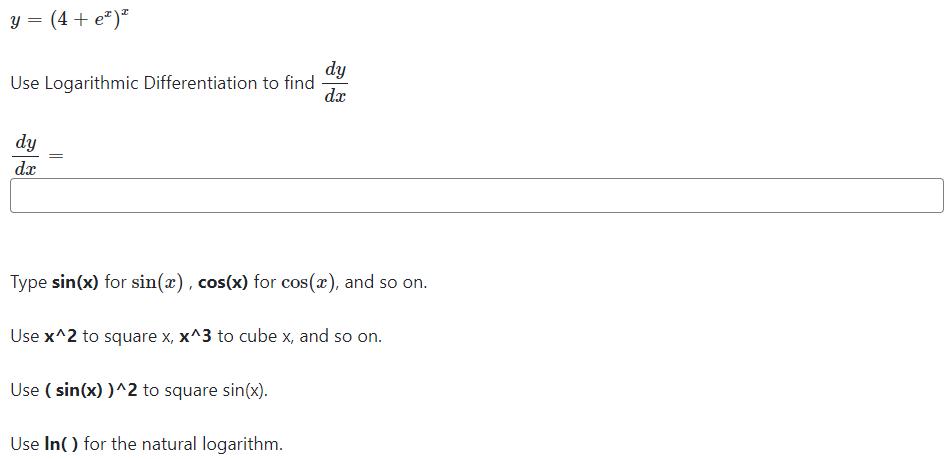
y = (4+ e) dy Use Logarithmic Differentiation to find dx dy dx Type sin(x) for sin(x), cos(x) for cos(x), and so on. Use x^2 to square x, x^3 to cube x, and so on. Use (sin(x))^2 to square sin(x). Use In() for the natural logarithm.
Step by Step Solution
There are 3 Steps involved in it
1 Expert Approved Answer
Step: 1 Unlock

Question Has Been Solved by an Expert!
Get step-by-step solutions from verified subject matter experts
Step: 2 Unlock
Step: 3 Unlock
 Study Help