







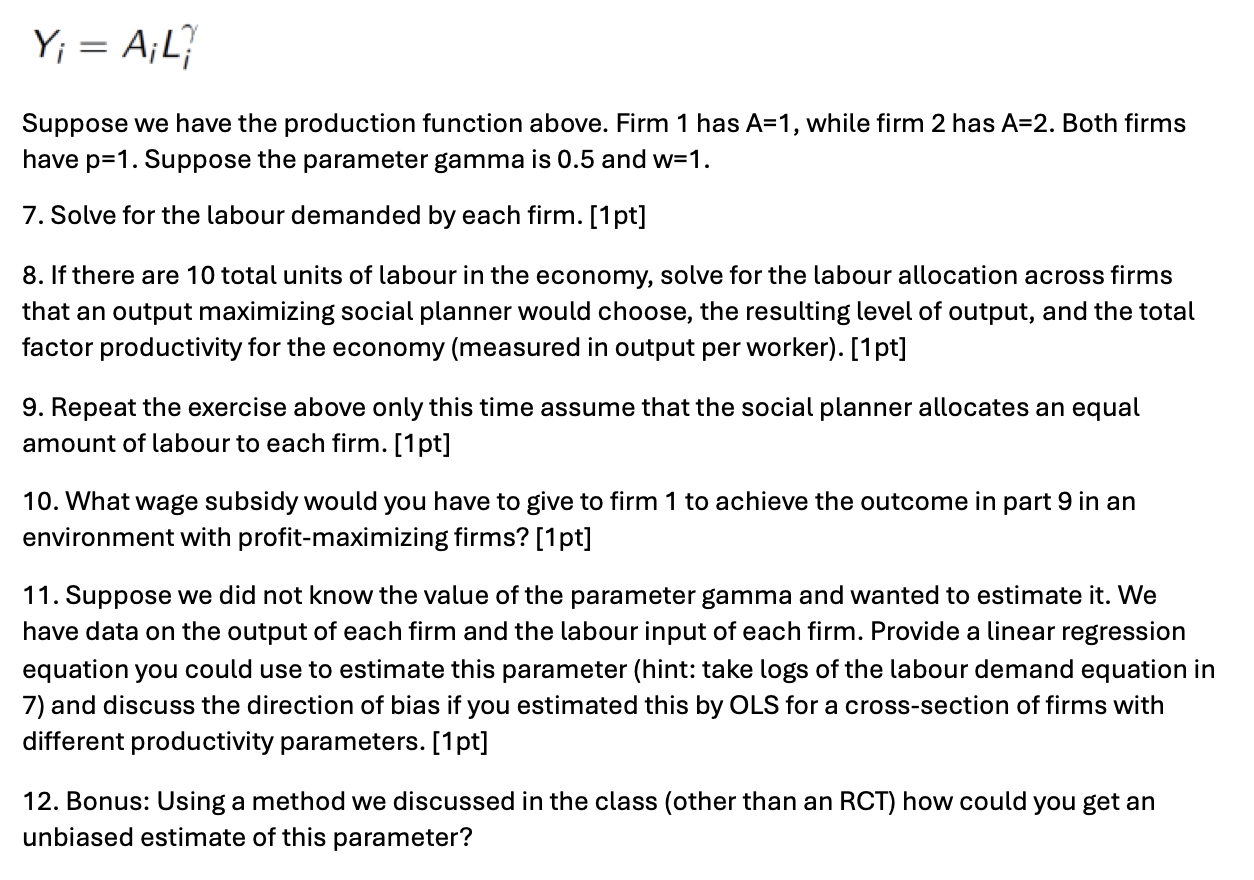
Question: [ Y _ { i } = A _ { i } L _ { i } ^ { gamma } ]
YiAi Ligamma
Suppose we have the production function above. Firm has A while firm has A Both firms have mathrmp Suppose the parameter gamma is and w
Solve for the labour demanded by each firm. pt
If there are total units of labour in the economy, solve for the labour allocation across firms that an output maximizing social planner would choose, the resulting level of output, and the total factor productivity for the economy measured in output per workerpt
Repeat the exercise above only this time assume that the social planner allocates an equal amount of labour to each firm. pt
What wage subsidy would you have to give to firm to achieve the outcome in part in an environment with profitmaximizing firms? pt
Suppose we did not know the value of the parameter gamma and wanted to estimate it We have data on the output of each firm and the labour input of each firm. Provide a linear regression equation you could use to estimate this parameter hint: take logs of the labour demand equation in and discuss the direction of bias if you estimated this by OLS for a crosssection of firms with different productivity parameters. pt
Bonus: Using a method we discussed in the class other than an RCT how could you get an unbiased estimate of this parameter?
Step by Step Solution
There are 3 Steps involved in it
1 Expert Approved Answer
Step: 1 Unlock

Question Has Been Solved by an Expert!
Get step-by-step solutions from verified subject matter experts
Step: 2 Unlock
Step: 3 Unlock
 Study Help