



Question: You are a new engineer working for the MoldAll Plastics Company and you have been asked to devise an experiment to determine the parameters of
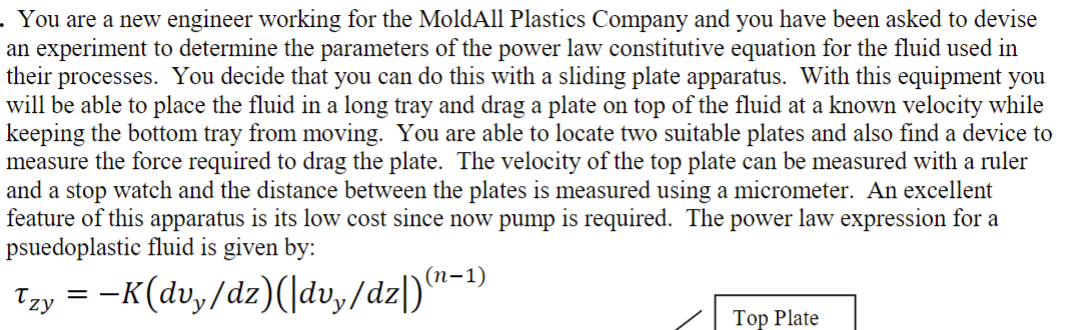
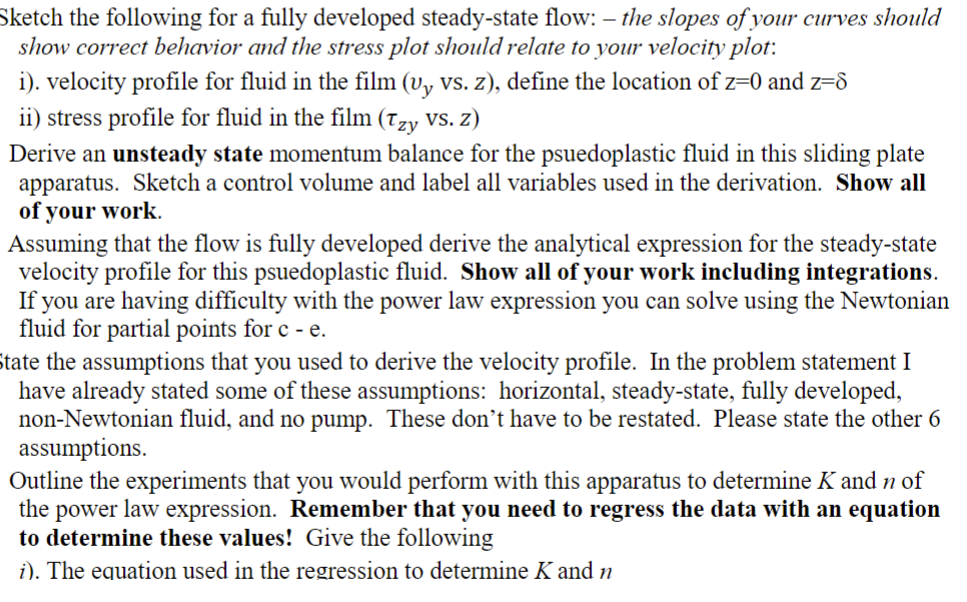
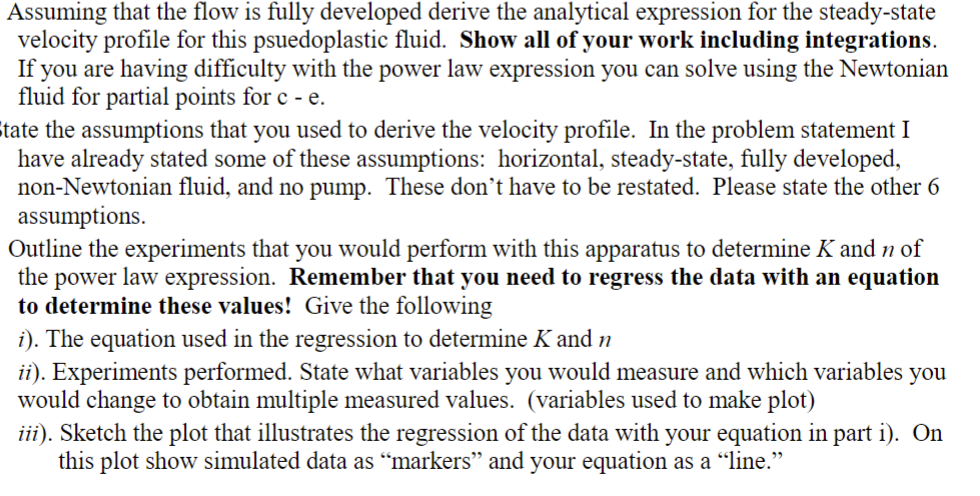
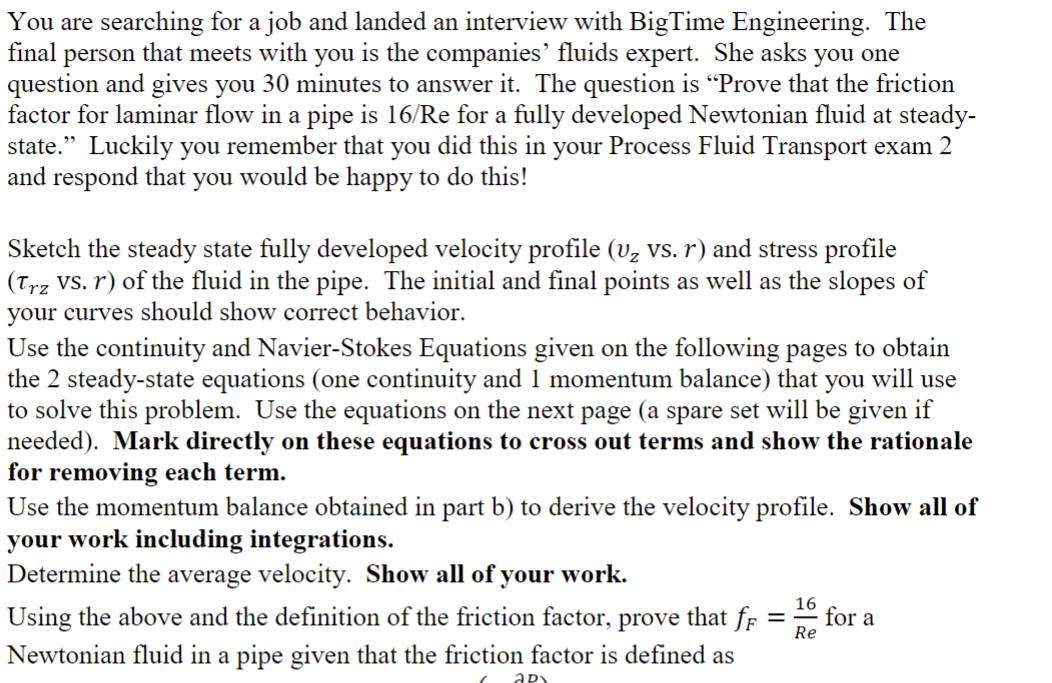
You are a new engineer working for the MoldAll Plastics Company and you have been asked to devise an experiment to determine the parameters of the power law constitutive equation for the fluid used in their processes. You decide that you can do this with a sliding plate apparatus. With this equipment you will be able to place the fluid in a long tray and drag a plate on top of the fluid at a known velocity while keeping the bottom tray from moving. You are able to locate two suitable plates and also find a device to measure the force required to drag the plate. The velocity of the top plate can be measured with a ruler and a stop watch and the distance between the plates is measured using a micrometer. An excellent feature of this apparatus is its low cost since now pump is required. The power law expression for a psuedoplastic fluid is given by: zy=K(dvy/dz)(dvy/dz)(n1) Sketch the following for a fully developed steady-state flow: - the slopes of your curves should show correct behavior and the stress plot should relate to your velocity plot: i). velocity profile for fluid in the film (vy vs. z ), define the location of z=0 and z= ii) stress profile for fluid in the film ( zy vs. z ) Derive an unsteady state momentum balance for the psuedoplastic fluid in this sliding plate apparatus. Sketch a control volume and label all variables used in the derivation. Show all of your work. Assuming that the flow is fully developed derive the analytical expression for the steady-state velocity profile for this psuedoplastic fluid. Show all of your work including integrations. If you are having difficulty with the power law expression you can solve using the Newtonian fluid for partial points for ce. tate the assumptions that you used to derive the velocity profile. In the problem statement I have already stated some of these assumptions: horizontal, steady-state, fully developed, non-Newtonian fluid, and no pump. These don't have to be restated. Please state the other 6 assumptions. Outline the experiments that you would perform with this apparatus to determine K and n of the power law expression. Remember that you need to regress the data with an equation to determine these values! Give the following i). The equation used in the regression to determine K and n Assuming that the flow is fully developed derive the analytical expression for the steady-state velocity profile for this psuedoplastic fluid. Show all of your work including integrations. If you are having difficulty with the power law expression you can solve using the Newtonian fluid for partial points for ce. tate the assumptions that you used to derive the velocity profile. In the problem statement I have already stated some of these assumptions: horizontal, steady-state, fully developed, non-Newtonian fluid, and no pump. These don't have to be restated. Please state the other 6 assumptions. Outline the experiments that you would perform with this apparatus to determine K and n of the power law expression. Remember that you need to regress the data with an equation to determine these values! Give the following i ). The equation used in the regression to determine K and n ii). Experiments performed. State what variables you would measure and which variables you would change to obtain multiple measured values. (variables used to make plot) iii). Sketch the plot that illustrates the regression of the data with your equation in part i). On this plot show simulated data as "markers" and your equation as a "line." You are searching for a job and landed an interview with BigTime Engineering. The final person that meets with you is the companies' fluids expert. She asks you one question and gives you 30 minutes to answer it. The question is "Prove that the friction factor for laminar flow in a pipe is 16/ Re for a fully developed Newtonian fluid at steadystate." Luckily you remember that you did this in your Process Fluid Transport exam 2 and respond that you would be happy to do this! Sketch the steady state fully developed velocity profile (vz Vs. r ) and stress profile ( rz Vs. r ) of the fluid in the pipe. The initial and final points as well as the slopes of your curves should show correct behavior. Use the continuity and Navier-Stokes Equations given on the following pages to obtain the 2 steady-state equations (one continuity and 1 momentum balance) that you will use to solve this problem. Use the equations on the next page (a spare set will be given if needed). Mark directly on these equations to cross out terms and show the rationale for removing each term. Use the momentum balance obtained in part b) to derive the velocity profile. Show all of your work including integrations. Determine the average velocity. Show all of your work. Using the above and the definition of the friction factor, prove that fF=Re16 for a Newtonian fluid in a pipe given that the friction factor is defined as
Step by Step Solution
There are 3 Steps involved in it

Get step-by-step solutions from verified subject matter experts