



Question: You are a senior sales manager at a mid-size software firm. In your role, you oversee many sales teams across different regions and product lines.
You are a senior sales manager at a mid-size software firm. In your role, you oversee many sales teams across different regions and product lines. You are looking to overhaul your organisations compensation/reward system practices. Before doing so, you recently trialed a new bonus plan on a single sales team in your organisation (all other sales teams continued to use the pre-existing compensation package). The bonus plan is designed to improve sales performance. To evaluate whether the bonus plan achieved this objective, you need to examine your sales teams performance data over the past few months.
You decide to compare sales performance for three teams over 5 periods. The chart below provides evidence of the sales performance pre and post the bonus plan introduction. Teams 1 and 3 were not subject to the trial bonus plan. Team 2 was subject to the trial bonus plan, but only after period 4 (as indicated by the dotted line below, which shows when the plan went active). You need to keep in mind that underlying business conditions are time-varying. As such, each teams sales performance is not expected to be constant over time. You also need to keep in mind that the different sales teams may or may not be subject to different economic shocks and may or may not serve different product markets. The performance data, plotted below, should help you determine the comparability of the historical sales performance data both within and across the teams.
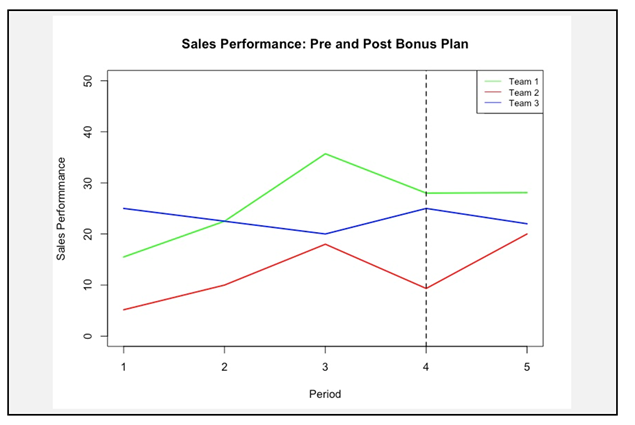
You now wish to investigate whether the bonus plan seems to have contributed to improved performance. Which of the following represents the most valid conclusion from the sales data?
Group of answer choices
You compare the level of Team 2s sales performance in period 5 to the level of its own performance in period 4. Based on this difference, you conclude that bonus plan seemed to have drastically improved sales performance.
You compare the level of Team 2s sales performance in period 5 to the level of Team 3s sales performance in period 5. Based on this difference, you conclude that the bonus plan did not improve performance, but may have actually marginally harmed performance.
You compare the level of Team 2s sales performance in period 5 to the level of Team 1s sales performance in period 5. Based on this difference, you conclude that the bonus plan harmed sales performance.
You compare the change in Teams 2 sales performance between periods 4 and 5, to the change in Team 1s sales performance between periods 4 and 5. Based on this difference, you conclude that the bonus plan seemed to have drastically improved sales performance.
Sales Performance: Pre and Post Bonus Plan 50 Team 1 Team 2 Team 3 40 30 Sales Performmance 20 10 0 2 3 5 PeriodStep by Step Solution
There are 3 Steps involved in it

Get step-by-step solutions from verified subject matter experts