







Question: , , You are a staff engineer for a local geotechnical engineering firm. As part of the geotechnical exploration for a project, several subsurface tests
You are a staff engineer for a local geotechnical engineering firm. As part of the
geotechnical exploration for a project, several subsurface tests have been conducted. You
are given the results of one traditional soil boring with Standard Penetration Testing
SPT The results of this boring, labeled as B are presented on page of this
assignment. Based on testing of collected soil samples, the encountered soils have the
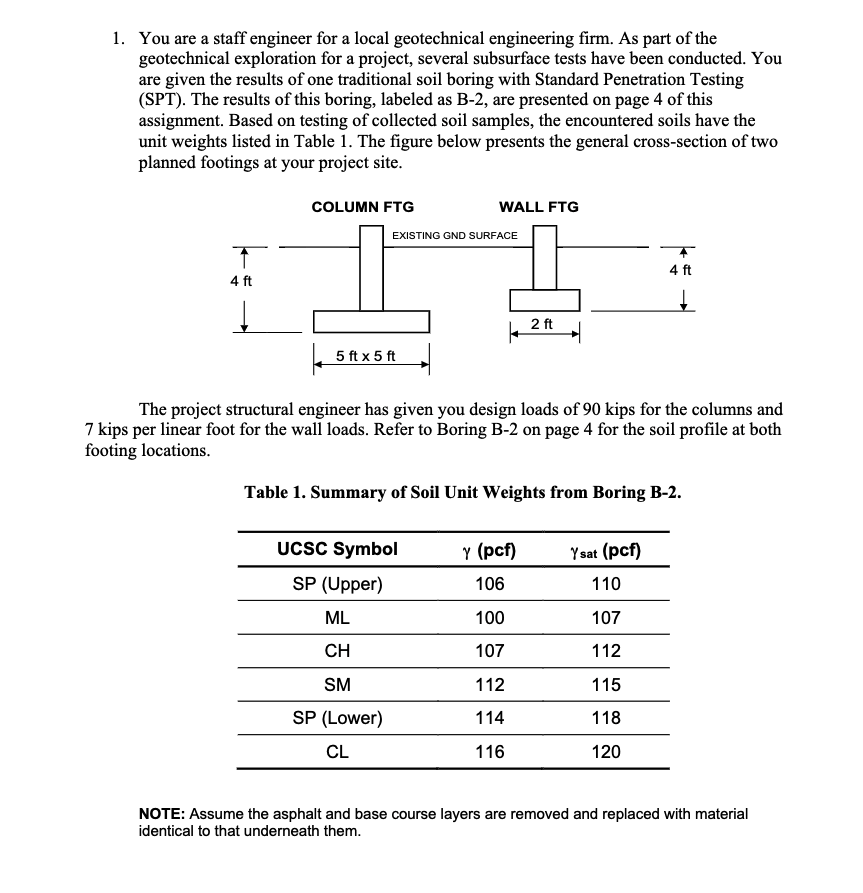
unit weights listed in Table The figure below presents the general crosssection of two
planned footings at your project site.
The project structural engineer has given you design loads of kips for the columns and
kips per linear foot for the wall loads. Refer to Boring B on page for the soil profile at both
footing locations.
Table Summary of Soil Unit Weights from Boring B
NOTE: Assume the asphalt and base course layers are removed and replaced with material
identical to that underneath them.
Consolidation testing was conducted on a soil sample that was taken from the first ML layer its
depth ranging from to ft The table below summarizes the applied pressure and recorded
sample thickness after the deformation under each of the applied pressures has reached their
steady levels. The initial height of the consolidation testing specimen was mm and its initial
water content was Gs
Table Summary of consolidation testing data of the ML sample
a Plot the void ratio vs applied pressure curve esigma and determine the preconsolidation
pressure sigmac compression index and recompression indices Cr&Cc by using the
Casagrande's graphic procedure; Hint: you need to derive the initial void ratio, from which the
void ratio after the application of each of pressure increments can be derived from the change in
sample's thicknessheight
b Based on the consolidation testing results derived from a calculate the primary
consolidation settlement of the ML layer due to the Column footing and the Wall footing,
respectively;
c What would be the water elevation of the midpoint of the first ML layer measured by a
piezometer at the instant when the column footing and the wall footing have been completely
constructed, respectively assuming the construction processes were rapidUsing the sea level
as the datum to calculate the elevation head of the midpoint of the first ML layer; also the
elevation of the soil strata is provided in the attached boring log;
d The time rate of consolidation settlement data shown in Table below Table is for the
increment from to psf from the consolidation testing. The initial sample height is
mm and there are porous stones on the top and at the bottom of the consolidation sample.
Determine the coefficient of consolidation cv by the log timemethod hint: you can calculate
Hdr by using Hmm as the sample's thickness during this loading increment of the
consolidation testing;
e Based on the coefficient of consolidation derived from d determine the time required to reach of primary consolidation settlement for the first ML layer;
f Based on the coefficient of consolidation derived from d what would be the water elevation of the midpoint of the first ML layer measured by a piezometer at a time months after the construction of the column footing and the wall footing, respectively.
Table Summary of elapsed time and dial gauge reading of the ML consolidation sample for the pressure increment from to psf
Elapsed time min Dial reading mm
SHOW ALL STEPS, DO NOT USE CHAT GPT
Step by Step Solution
There are 3 Steps involved in it
1 Expert Approved Answer
Step: 1 Unlock

Question Has Been Solved by an Expert!
Get step-by-step solutions from verified subject matter experts
Step: 2 Unlock
Step: 3 Unlock
 Study Help