







Question: You are comparing each function separately. To do the question you basically have to divide f(n) by first 2^n and see if the limit as
You are comparing each function separately. To do the question you basically have to divide f(n) by first 2^n and see if the limit as n approaches infinity of f(n) over g(n) which is 2^n = 0, infinity, or a constant. If its 0 you find the next limit which is n^k and see if it equals 0, infinity, or a constant. If its infinity, then f(n) = big omega of that function. If its 0 you go on to the next one and so on Then n^a, then logn then a constant. The base for the log are 2 and not 10, so if you do the log then it will simplify 2^n to just n. For example the first question, (logn)^logn (logn)^logn/2^n log both side = lognloglogn - n = negative infinity, log p = negative infinity = 0 so move on to the next one, which is n^k = (logn)^logn^k as n approaches infinity, log both sides = lognlog(logn) - k log n = infinity, = log p = infinity = 2^infinity = infinity so (logn)^logn is big omega of n^k
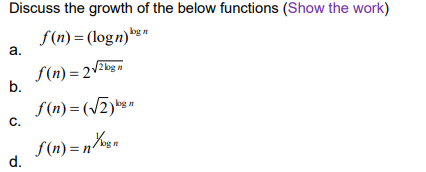
Discuss the growth of the below functions (Show the work) f(n) = (logn) by a. b f(n) = 2V2kby ni c. f(n) =(72)654 d. f(n)= Xest Discuss the growth of the below functions (Show the work) f(n) = (logn) by a. b f(n) = 2V2kby ni c. f(n) =(72)654 d. f(n)= Xest
Step by Step Solution
There are 3 Steps involved in it

Get step-by-step solutions from verified subject matter experts
 Study Help