







Question: You are considering the following two mutually exclusive projects. The required return on each project is 16 percent. Which project should you accept and what
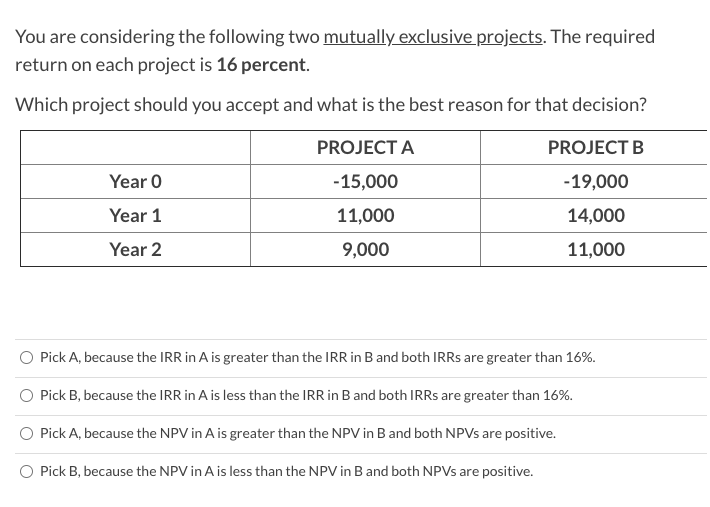
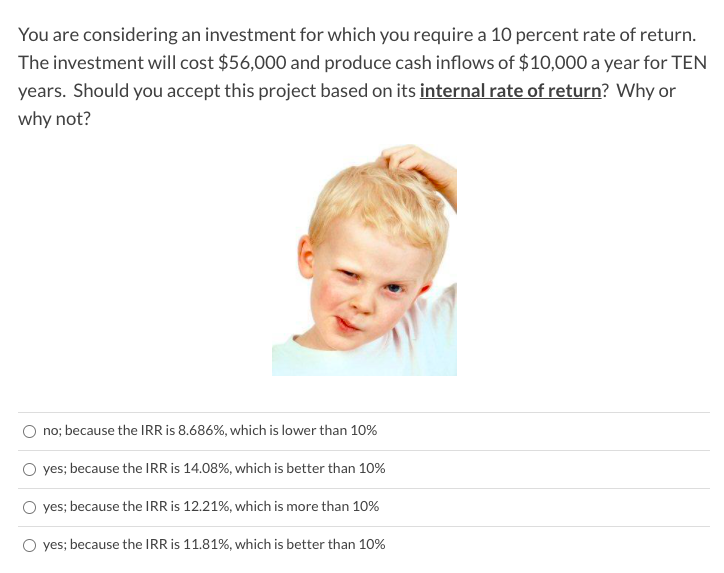
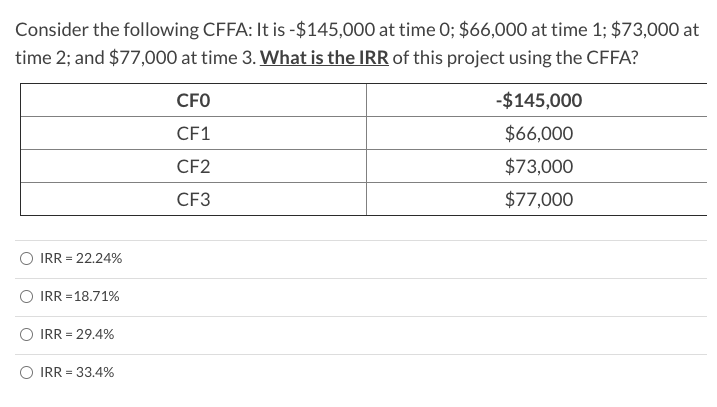
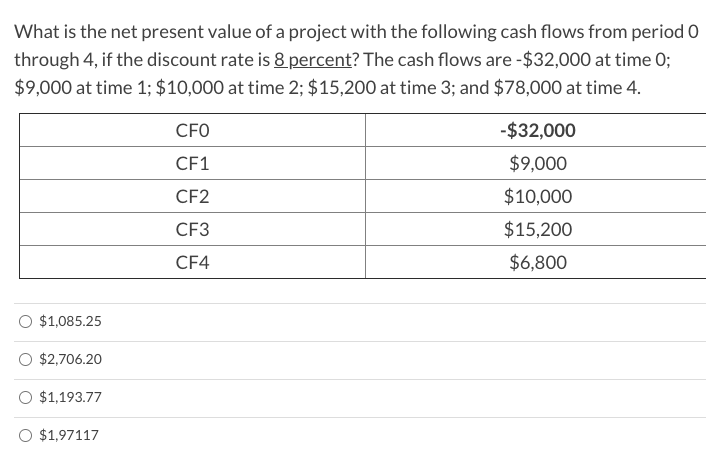
You are considering the following two mutually exclusive projects. The required return on each project is 16 percent. Which project should you accept and what is the best reason for that decision? PROJECTB Year 0 - 19,000 PROJECT A - 15,000 11,000 9,000 Year 1 14,000 11,000 Year 2 Pick A, because the IRR in A is greater than the IRR in B and both IRRs are greater than 16%. Pick B, because the IRR in A is less than the IRR in B and both IRRs are greater than 16%. Pick A, because the NPV in A is greater than the NPV in B and both NPVs are positive. Pick B, because the NPV in A is less than the NPV in B and both NPVs are positive. You are considering an investment for which you require a 10 percent rate of return. The investment will cost $56,000 and produce cash inflows of $10,000 a year for TEN years. Should you accept this project based on its internal rate of return? Why or why not? no; because the IRR is 8.686%, which is lower than 10% yes; because the IRR is 14.08%, which is better than 10% O yes; because the IRR is 12.21%, which is more than 10% O yes; because the IRR is 11.81%, which is better than 10% You are considering an investment called Holy Moly Enterprises. The investment will have the following cash flows in the table below. The Internal Rate of Return is 4%. What concerns do you have using IRR for deciding whether or not to invest in Holy Moly Enterprises? Year Cash Flow 0 -$138,000 1 82,000 2 67,000 3 -3,000 HOLEY MOLEY The IRR is best to use for mutually exclusive projects. The IRR is better than the NPV in all situations. An IRR of 4% is always too low. O The IRR should not be used when cash flows are nonconventional, but the MIRR could be in such circumstances. Consider the following CFFA: It is - $145,000 at time 0; $66,000 at time 1; $73,000 at time 2; and $77,000 at time 3. What is the IRR of this project using the CFFA? CFO CF1 -$145,000 $66,000 $73,000 $77,000 CF2 CF3 IRR = 22.24% IRR = 18.71% IRR = 29.4% IRR = 33.4% What is the net present value of a project with the following cash flows from period 0 through 4, if the discount rate is 8 percent? The cash flows are - $32,000 at time 0; $9,000 at time 1; $10,000 at time 2; $15,200 at time 3; and $78,000 at time 4. CFO CF1 -$32,000 $9,000 $10,000 $15,200 CF2 CF3 CF4 $6,800 $1,085.25 $2,706.20 $1,193.77 O $1,97117 Darlene & Daughters, nick-named D&D, just paid an annual dividend of $1 yesterday. The required return is 12 percent and the growth rate of dividends is 4 percent, which is expected to continue to grow forever. What is the expected price of D&D's stock according to the Dividend Growth Model? D&D $9.45 $13.00 $13.84 $11.05
Step by Step Solution
There are 3 Steps involved in it

Get step-by-step solutions from verified subject matter experts
 Study Help