







Question: You are given an implementation of a function: class solution { public boolean solution(int] a, int k); } This function, given a non-empty array A
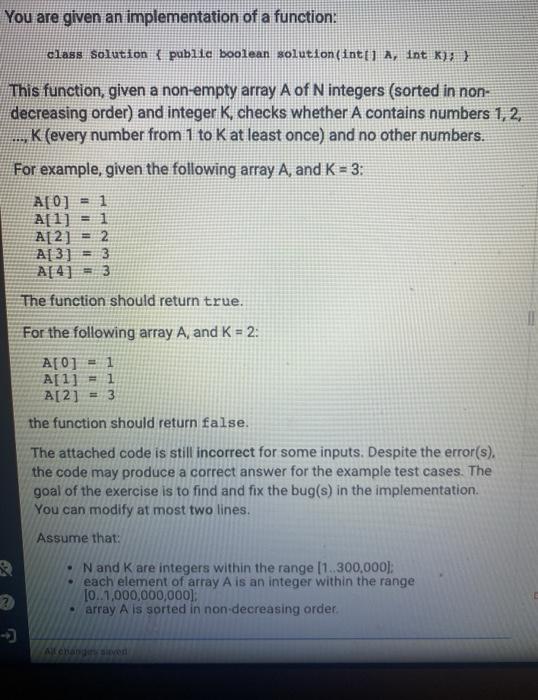
You are given an implementation of a function: class solution { public boolean solution(int] a, int k); } This function, given a non-empty array A of N integers (sorted in non- decreasing order) and integer K, checks whether A contains numbers 1, 2, K(every number from 1 to K at least once) and no other numbers. For example, given the following array A, and K = 3: A[0] = 1 A[1] = 1 A[2] = 2 A[3] = 3 A[4] = 3 The function should return true. For the following array A, and K = 2: A[0] =1 A[1] = 1 A[2] = 3 the function should return false. The attached code is still incorrect for some inputs. Despite the error(s). the code may produce a correct answer for the example test cases. The goal of the exercise is to find and fix the bug(s) in the implementation. You can modify at most two lines. Assume that: N and Kare integers within the range [1.300.000): each element of array A is an integer within the range 10..1,000,000,000) array A is sorted in non-decreasing order All changes
Step by Step Solution
There are 3 Steps involved in it

Get step-by-step solutions from verified subject matter experts
 Study Help