







Question: = = = = = You are given the following training data in a 1D (1 feature), 2-class problem: Sz: X1 = 0, X2 =
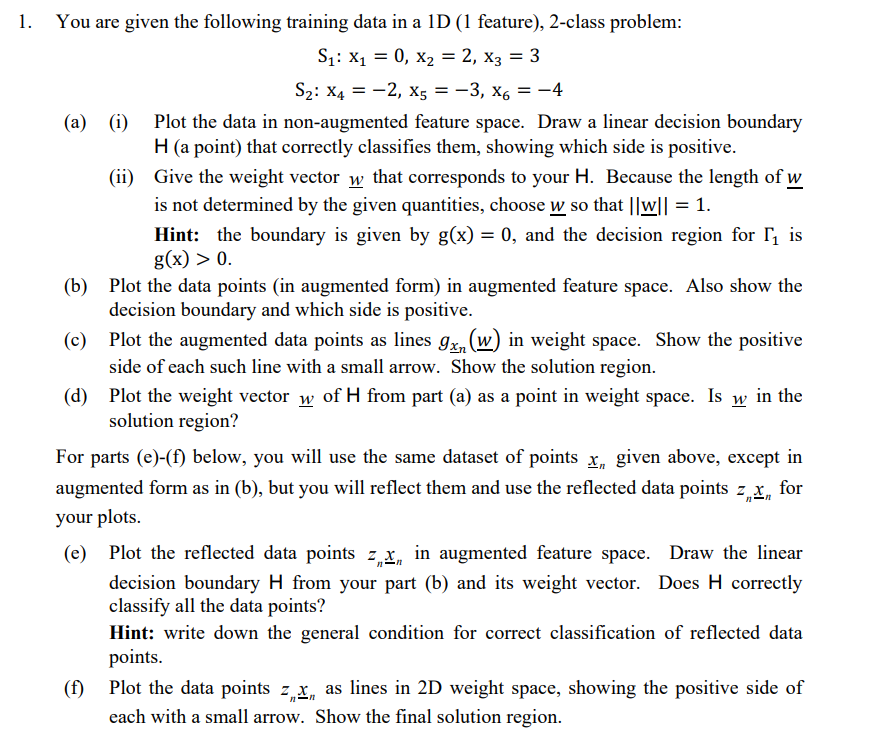
= = = = = You are given the following training data in a 1D (1 feature), 2-class problem: Sz: X1 = 0, X2 = 2, X3 = 3 Sz: X4 = -2, x3 = -3, X = -4 (a) (i) Plot the data in non-augmented feature space. Draw a linear decision boundary Ha point) that correctly classifies them, showing which side is positive. (ii) Give the weight vector w that corresponds to your H. Because the length of w is not determined by the given quantities, choose w so that ||w|| = 1. Hint: the boundary is given by g(x) = 0, and the decision region for is g(x) > 0. (b) Plot the data points (in augmented form) in augmented feature space. Also show the decision boundary and which side is positive. (c) Plot the augmented data points as lines 9xn (w) in weight space. Show the positive side of each such line with a small arrow. Show the solution region. (d) Plot the weight vector w of H from part (a) as a point in weight space. Is w in the solution region? For parts (e)-(f) below, you will use the same dataset of points x, given above, except in augmented form as in (b), but you will reflect them and use the reflected data points z, X.. for your plots. (e) Plot the reflected data points z,x, in augmented feature space. Draw the linear decision boundary H from your part (b) and its weight vector. Does H correctly classify all the data points? Hint: write down the general condition for correct classification of reflected data points. (f) Plot the data points z X, as lines in 2D weight space, showing the positive side of each with a small arrow. Show the final solution region. -11 = = = = = You are given the following training data in a 1D (1 feature), 2-class problem: Sz: X1 = 0, X2 = 2, X3 = 3 Sz: X4 = -2, x3 = -3, X = -4 (a) (i) Plot the data in non-augmented feature space. Draw a linear decision boundary Ha point) that correctly classifies them, showing which side is positive. (ii) Give the weight vector w that corresponds to your H. Because the length of w is not determined by the given quantities, choose w so that ||w|| = 1. Hint: the boundary is given by g(x) = 0, and the decision region for is g(x) > 0. (b) Plot the data points (in augmented form) in augmented feature space. Also show the decision boundary and which side is positive. (c) Plot the augmented data points as lines 9xn (w) in weight space. Show the positive side of each such line with a small arrow. Show the solution region. (d) Plot the weight vector w of H from part (a) as a point in weight space. Is w in the solution region? For parts (e)-(f) below, you will use the same dataset of points x, given above, except in augmented form as in (b), but you will reflect them and use the reflected data points z, X.. for your plots. (e) Plot the reflected data points z,x, in augmented feature space. Draw the linear decision boundary H from your part (b) and its weight vector. Does H correctly classify all the data points? Hint: write down the general condition for correct classification of reflected data points. (f) Plot the data points z X, as lines in 2D weight space, showing the positive side of each with a small arrow. Show the final solution region. -11
Step by Step Solution
There are 3 Steps involved in it

Get step-by-step solutions from verified subject matter experts
 Study Help