







Question: You are given the NewStackInterface interface with some additional abstract methods. The NewLinkedStack class implements this NewStackInterface, and hence you must implement the additional methods
You are given the NewStackInterface interface with some additional abstract methods. The NewLinkedStack class implements this NewStackInterface, and hence you must implement the additional methods in the NewLinkedStack class (indicated by TODO comments). The method descriptions are given below - 1. void popFromBottom() This method removes the element from the bottom of the stack; throws StackUnderflowException if the stack is empty. 2. T bottom() This method returns the element at the bottom of the stack; throws StackUnderflowException if the stack is empty. 3. String toString() This method creates and returns a nicely formatted String representation of the object. Such a method could prove useful for testing and debugging the class and for testing and debugging applications that use the class. 4. int size() This method returns a count of how many elements are currently on the stack. Using the NewLinkedStack class, create an application that finds the largest integer value in the stack. Use the following approach: Prompt the user for the number of elements in a stack. Fill the stack with randomly generated integers (0-999). The topmost element is compared with the bottommost element of the stack. If the top element is greater than the bottom element, then the bottom element is removed from the stack. If the bottom element is greater than the top element, then the top element is removed from the stack. If both the elements are of same value, then either top or bottom element (your choice) is removed from the stack. The process is continued until we are left with the largest element in the stack. Display the result
*DO NOT make any changes to the given method headers, i.e., method return type, method name, and method parameters. *DO NOT add any new instance variables in the NewLinkedStack class (use only one NewLinkedStack object in the driver program) *DO NOT create any copy or temporary stack *DO NOT use any data structure other than NewLinkedStack. ie, no arrays, ArrayList, Stack, List, Node, etc.
Example: 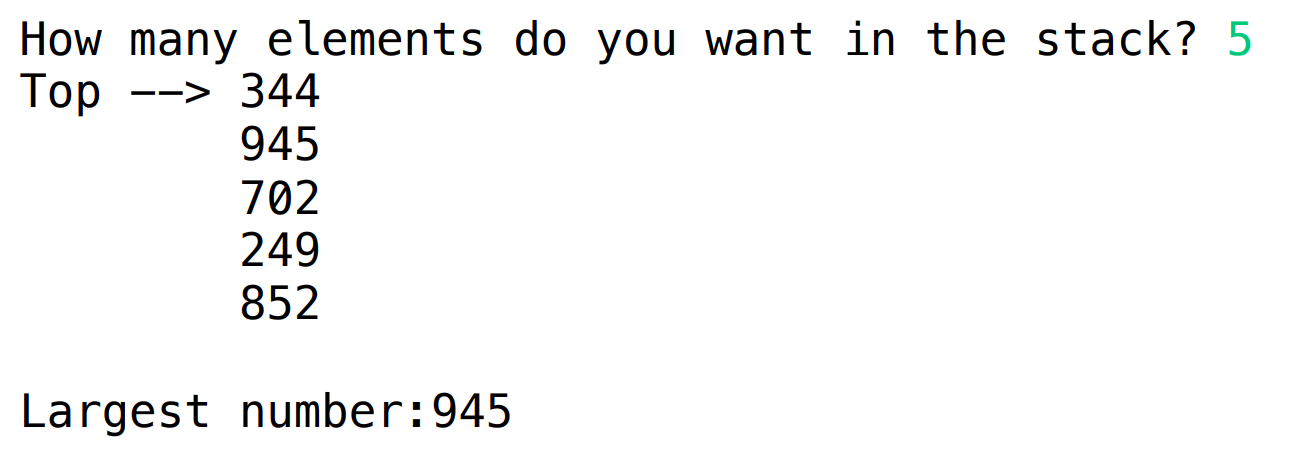
Currently, I have the code written below. But it doesn't yet include an option to prompt users for the stack number and doesn't fill it with random variables; it needs a main driver code
```java
package SP23; import java.util.Random;
public class NewLinkedStack
public NewLinkedStack() { top = null; }
public void push(T element) // Places element at the top of this stack. { LLNode
public void pop() // Throws StackUnderflowException if this stack is empty, // otherwise removes top element from this stack. { if (isEmpty()) throw new StackUnderflowException("Pop attempted on an empty stack."); else top = top.getLink(); }
public T top() // Throws StackUnderflowException if this stack is empty, // otherwise returns top element of this stack. { if (isEmpty()) throw new StackUnderflowException("Top attempted on an empty stack."); else return top.getInfo(); }
public boolean isEmpty() // Returns true if this stack is empty, otherwise returns false. { return (top == null); }
public boolean isFull() // Returns false - a linked stack is never full { return false; } @Override public void popFromBottom() throws StackUnderflowException { // Throws StackUnderflowException if this stack is empty. if (isEmpty()) { throw new StackUnderflowException("PopFromBottom attempted on an empty stack."); } // If there is only one element in the stack, simply remove it if (top.getLink() == null) { top = null; throw new StackUnderflowException("PopFromBottom attempted on a stack with only one element."); } else { // Traverse the stack to the second-to-last element LLNode
```
How many elements do you want in the stack? 5 Top>945702249852344 Largest number:945
Step by Step Solution
There are 3 Steps involved in it

Get step-by-step solutions from verified subject matter experts
 Study Help