





Question: You are given two graphs G and H with V(G) = (a, b, c, d) and V(H) = [1, 2, 3]. How many relations can


You are given two graphs G and H with V(G) = (a,You are given two graphs G and H with V(G) = (a,You are given two graphs G and H with V(G) = (a,
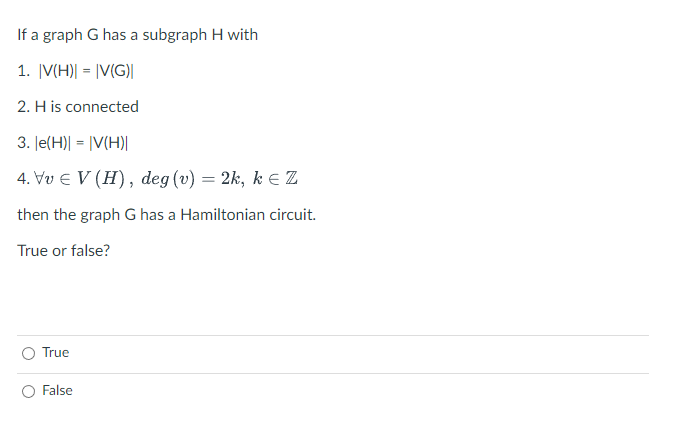
You are given two graphs G and H with V(G) = (a, b, c, d) and V(H) = [1, 2, 3]. How many relations can be defined from set V(G) to set V(H)? How many functions can be defined from set V(G) to set V(H)? How many bijections can be defined from set V(G) to V(G)?\fIf a graph G has a subgraph H with 1. [V(H)I = IV(G)I 2. H is connected 3. le(H)| = IV(H)I 4. VUE V (H) , deg (v) = 2k, ke Z then the graph G has a Hamiltonian circuit. True or false? O True O False
Step by Step Solution

There are 3 Steps involved in it

1 Expert Approved Answer
Step: 1 Unlock blur-text-image

Question Has Been Solved by an Expert!

Get step-by-step solutions from verified subject matter experts

Step: 2 Unlock
Step: 3 Unlock

Students Have Also Explored These Related Mathematics Questions!