Question: You are replying to a client inquiry. You can reply in letter format or memo format. I do not care which one. I do not
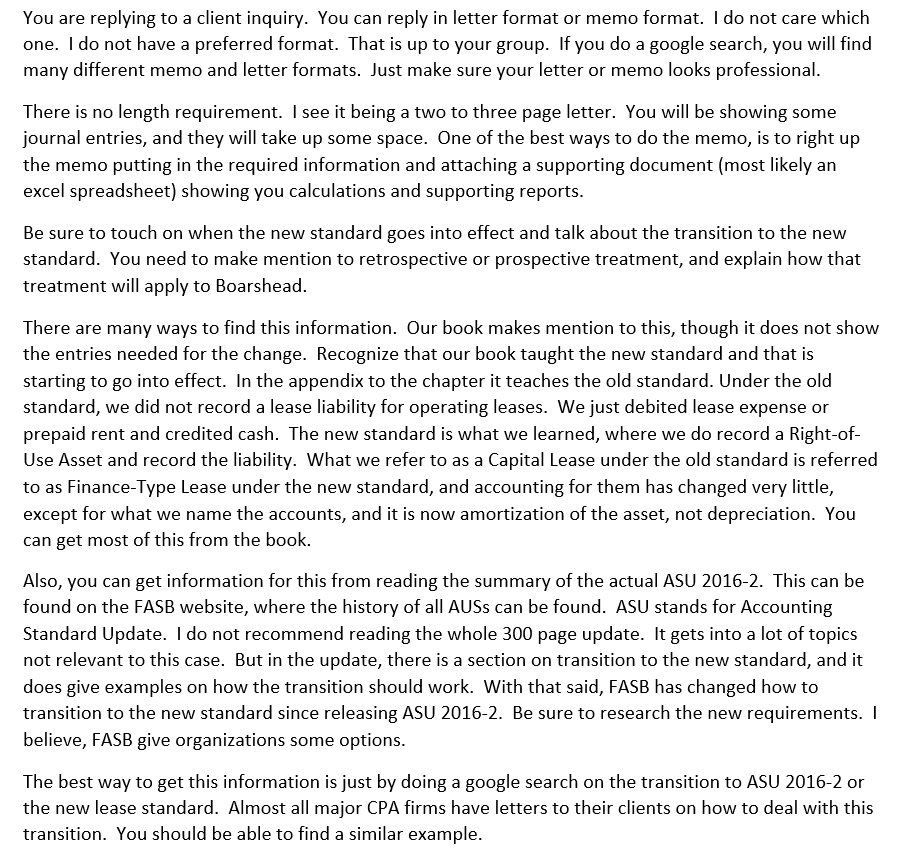
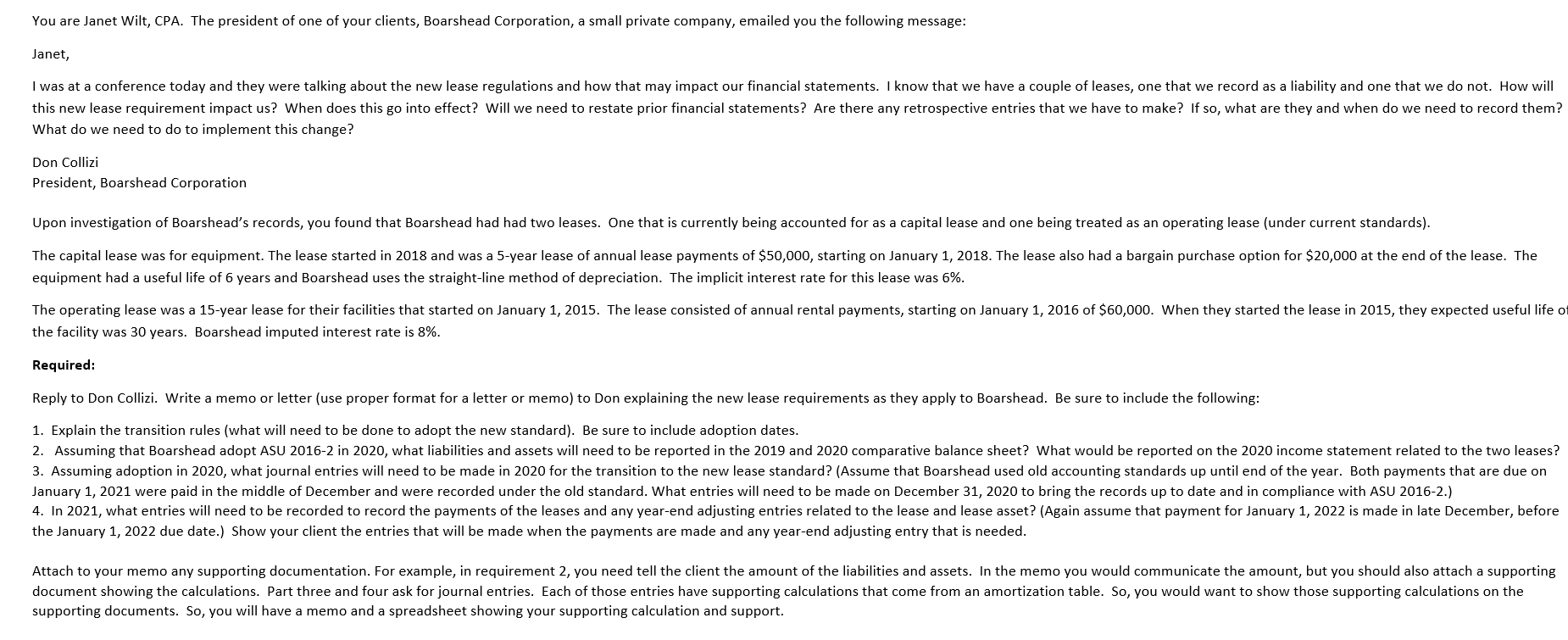
You are replying to a client inquiry. You can reply in letter format or memo format. I do not care which one. I do not have a preferred format. That is up to your group. If you do a google search, you will find many different memo and letter formats. Just make sure your letter or memo looks professional. There is no length requirement. I see it being a two to three page letter. You will be showing some journal entries, and they will take up some space. One of the best ways to do the memo, is to right up the memo putting in the required information and attaching a supporting document (most likely an excel spreadsheet) showing you calculations and supporting reports. Be sure to touch on when the new standard goes into effect and talk about the transition to the new standard. You need to make mention to retrospective or prospective treatment, and explain how that treatment will apply to Boarshead. There are many ways to find this information. Our book makes mention to this, though it does not show the entries needed for the change. Recognize that our book taught the new standard and that is starting to go into effect. In the appendix to the chapter it teaches the old standard. Under the old standard, we did not record a lease liability for operating leases. We just debited lease expense or prepaid rent and credited cash. The new standard is what we learned, where we do record a Right-of- Use Asset and record the liability. What we refer to as a Capital Lease under the old standard is referred to as Finance-Type Lease under the new standard, and accounting for them has changed very little, except for what we name the accounts, and it is now amortization of the asset, not depreciation. You can get most of this from the book. Also, you can get information for this from reading the summary of the actual ASU 2016-2. This can be found on the FASB website, where the history of all AUSs can be found. ASU stands for Accounting Standard Update. I do not recommend reading the whole 300 page update. It gets into a lot of topics not relevant to this case. But in the update, there is a section on transition to the new standard, and it does give examples on how the transition should work. With that said, FASB has changed how to transition to the new standard since releasing ASU 2016-2. Be sure to research the new requirements. I believe, FASB give organizations some options. The best way to get this information is just by doing a google search on the transition to ASU 2016-2 or the new lease standard. Almost all major CPA firms have letters to their clients on how to deal with this transition. You should be able to find a similar example. You are Janet Wilt, CPA. The president of one of your clients, Boarshead Corporation, a small private company, emailed you the following message: Janet, I was at a conference today and they were talking about the new lease regulations and how that may impact our financial statements. I know that we have a couple of leases, one that we record as a liability and one that we do not. How will this new lease requirement impact us? When does this go into effect? Will we need to restate prior financial statements? Are there any retrospective entries that we have to make? If so, what are they and when do we need to record them? What do we need to do to implement this change? Don Collizi President, Boarshead Corporation Upon investigation of Boarshead's records, you found that Boarshead had had two leases. One that is currently being accounted for as a capital lease and one being treated as an operating lease (under current standards). The capital lease was for equipment. The lease started in 2018 and was a 5-year lease of annual lease payments of $50,000, starting on January 1, 2018. The lease also had a bargain purchase option for $20,000 at the end of the lease. The equipment had a useful life of 6 years and Boarshead uses the straight-line method of depreciation. The implicit interest rate for this lease was 6%. The operating lease was a 15-year lease for their facilities that started on January 1, 2015. The lease consisted of annual rental payments, starting on January 1, 2016 of $60,000. When they started the lease in 2015, they expected useful life of the facility was 30 years. Boarshead imputed interest rate is 8%. Required: Reply to Don Collizi. Write a memo or letter (use proper format for a letter or memo) to Don explaining the new lease requirements as they apply to Boarshead. Be sure to include the following: 1. Explain the transition rules (what will need to be done to adopt the new standard). Be sure to include adoption dates. 2. Assuming that Boarshead adopt ASU 2016-2 in 2020, what liabilities and assets will need to be reported in the 2019 and 2020 comparative balance sheet? What would be reported on the 2020 income statement related to the two leases? 3. Assuming adoption in 2020, what journal entries will need to be made in 2020 for the transition to the new lease standard? (Assume that Boarshead used old accounting standards up until end of the year. Both payments that are due on January 1, 2021 were paid in the middle of December and were recorded under the old standard. What entries will need to be made on December 31, 2020 to bring the records up to date and in compliance with ASU 2016-2.) 4. In 2021, what entries will need to be recorded to record the payments of the leases and any year-end adjusting entries related to the lease and lease asset? (Again assume that payment for January 1, 2022 is made in late December, before the January 1, 2022 due date.) Show your client the entries that will be made when the payments are made and any year-end adjusting entry that is needed. Attach to your memo any supporting documentation. For example, in requirement 2, you need tell the client the amount of the liabilities and assets. In the memo you would communicate the amount, but you should also attach a supporting document showing the calculations. Part three and four ask for journal entries. Each of those entries have supporting calculations that come from an amortization table. So, you would want to show those supporting calculations on the supporting documents. So, you will have a memo and a spreadsheet showing your supporting calculation and support. You are replying to a client inquiry. You can reply in letter format or memo format. I do not care which one. I do not have a preferred format. That is up to your group. If you do a google search, you will find many different memo and letter formats. Just make sure your letter or memo looks professional. There is no length requirement. I see it being a two to three page letter. You will be showing some journal entries, and they will take up some space. One of the best ways to do the memo, is to right up the memo putting in the required information and attaching a supporting document (most likely an excel spreadsheet) showing you calculations and supporting reports. Be sure to touch on when the new standard goes into effect and talk about the transition to the new standard. You need to make mention to retrospective or prospective treatment, and explain how that treatment will apply to Boarshead. There are many ways to find this information. Our book makes mention to this, though it does not show the entries needed for the change. Recognize that our book taught the new standard and that is starting to go into effect. In the appendix to the chapter it teaches the old standard. Under the old standard, we did not record a lease liability for operating leases. We just debited lease expense or prepaid rent and credited cash. The new standard is what we learned, where we do record a Right-of- Use Asset and record the liability. What we refer to as a Capital Lease under the old standard is referred to as Finance-Type Lease under the new standard, and accounting for them has changed very little, except for what we name the accounts, and it is now amortization of the asset, not depreciation. You can get most of this from the book. Also, you can get information for this from reading the summary of the actual ASU 2016-2. This can be found on the FASB website, where the history of all AUSs can be found. ASU stands for Accounting Standard Update. I do not recommend reading the whole 300 page update. It gets into a lot of topics not relevant to this case. But in the update, there is a section on transition to the new standard, and it does give examples on how the transition should work. With that said, FASB has changed how to transition to the new standard since releasing ASU 2016-2. Be sure to research the new requirements. I believe, FASB give organizations some options. The best way to get this information is just by doing a google search on the transition to ASU 2016-2 or the new lease standard. Almost all major CPA firms have letters to their clients on how to deal with this transition. You should be able to find a similar example. You are Janet Wilt, CPA. The president of one of your clients, Boarshead Corporation, a small private company, emailed you the following message: Janet, I was at a conference today and they were talking about the new lease regulations and how that may impact our financial statements. I know that we have a couple of leases, one that we record as a liability and one that we do not. How will this new lease requirement impact us? When does this go into effect? Will we need to restate prior financial statements? Are there any retrospective entries that we have to make? If so, what are they and when do we need to record them? What do we need to do to implement this change? Don Collizi President, Boarshead Corporation Upon investigation of Boarshead's records, you found that Boarshead had had two leases. One that is currently being accounted for as a capital lease and one being treated as an operating lease (under current standards). The capital lease was for equipment. The lease started in 2018 and was a 5-year lease of annual lease payments of $50,000, starting on January 1, 2018. The lease also had a bargain purchase option for $20,000 at the end of the lease. The equipment had a useful life of 6 years and Boarshead uses the straight-line method of depreciation. The implicit interest rate for this lease was 6%. The operating lease was a 15-year lease for their facilities that started on January 1, 2015. The lease consisted of annual rental payments, starting on January 1, 2016 of $60,000. When they started the lease in 2015, they expected useful life of the facility was 30 years. Boarshead imputed interest rate is 8%. Required: Reply to Don Collizi. Write a memo or letter (use proper format for a letter or memo) to Don explaining the new lease requirements as they apply to Boarshead. Be sure to include the following: 1. Explain the transition rules (what will need to be done to adopt the new standard). Be sure to include adoption dates. 2. Assuming that Boarshead adopt ASU 2016-2 in 2020, what liabilities and assets will need to be reported in the 2019 and 2020 comparative balance sheet? What would be reported on the 2020 income statement related to the two leases? 3. Assuming adoption in 2020, what journal entries will need to be made in 2020 for the transition to the new lease standard? (Assume that Boarshead used old accounting standards up until end of the year. Both payments that are due on January 1, 2021 were paid in the middle of December and were recorded under the old standard. What entries will need to be made on December 31, 2020 to bring the records up to date and in compliance with ASU 2016-2.) 4. In 2021, what entries will need to be recorded to record the payments of the leases and any year-end adjusting entries related to the lease and lease asset? (Again assume that payment for January 1, 2022 is made in late December, before the January 1, 2022 due date.) Show your client the entries that will be made when the payments are made and any year-end adjusting entry that is needed. Attach to your memo any supporting documentation. For example, in requirement 2, you need tell the client the amount of the liabilities and assets. In the memo you would communicate the amount, but you should also attach a supporting document showing the calculations. Part three and four ask for journal entries. Each of those entries have supporting calculations that come from an amortization table. So, you would want to show those supporting calculations on the supporting documents. So, you will have a memo and a spreadsheet showing your supporting calculation and support









 Study Help