







Question: You are to separate an O2/CO2 stream using a membrane process. The membrane to be used is silicone rubber with a thickness of 2.00x10⁻³ cm.
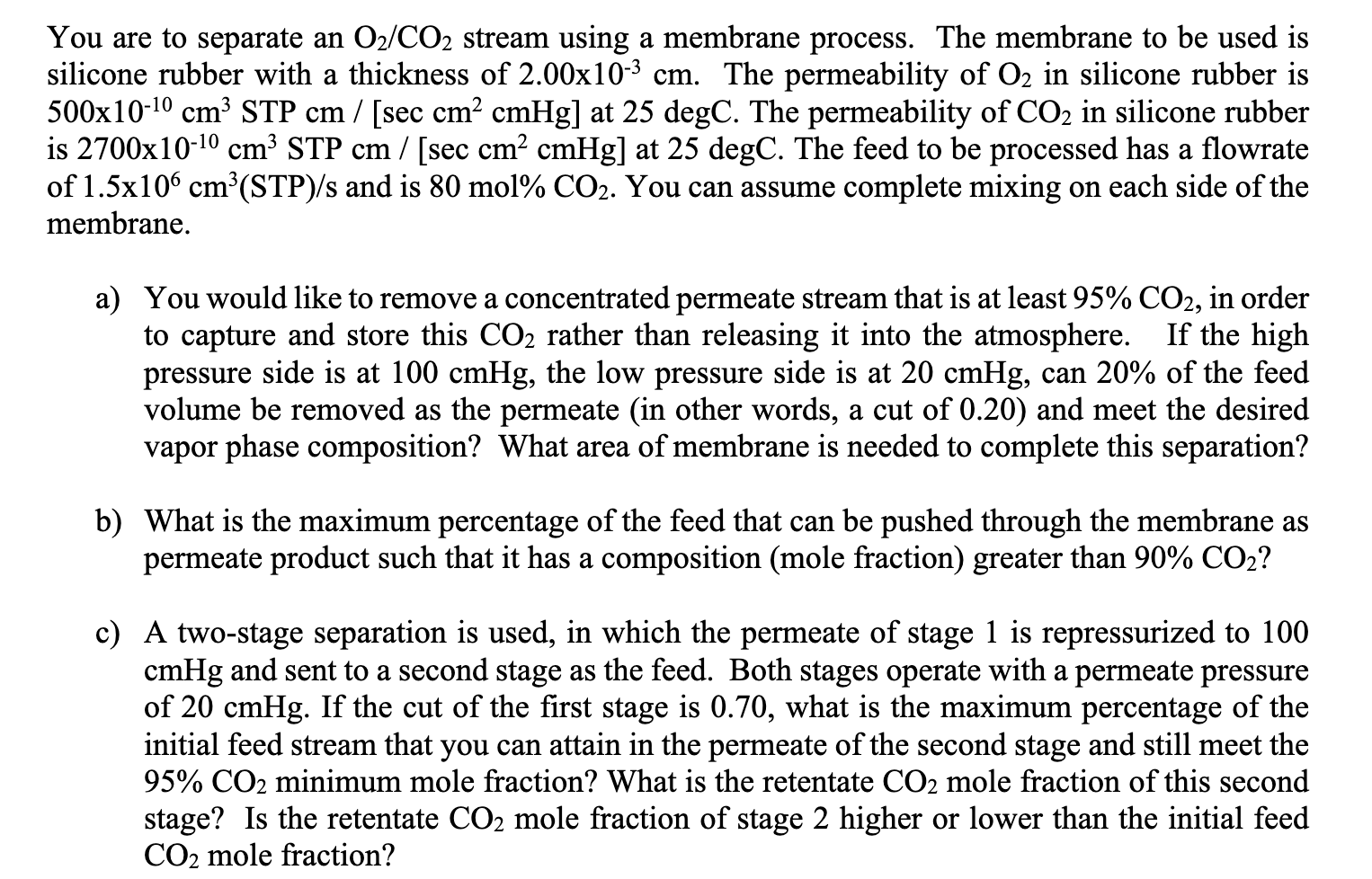
You are to separate an O2/CO2 stream using a membrane process. The membrane to be used is silicone rubber with a thickness of 2.00x10⁻³ cm. The permeability of O2 in silicone rubber is 500x10-10 cm STP cm / [sec cm cmHg] at 25 degC. The permeability of CO2 in silicone rubber is 2700x10-10 cm3 STP cm / [sec cm2 cmHg) at 25 degC. The feed to be processed has a flowrate of 1.5x10 cm}(STP)/s and is 80 mol% CO2. You can assume complete mixing on each side of the membrane. a a) You would like to remove a concentrated permeate stream that is at least 95% CO2, in order to capture and store this CO2 rather than releasing it into the atmosphere. If the high pressure side is at 100 cmHg, the low pressure side is at 20 cmHg, can 20% of the feed volume be removed as the permeate (in other words, a cut of 0.20) and meet the desired vapor phase composition? What area of membrane is needed to complete this separation? b) What is the maximum percentage of the feed that can be pushed through the membrane as permeate product such that it has a composition (mole fraction) greater than 90% CO2? c) A two-stage separation is used, in which the permeate of stage 1 is repressurized to 100 cmHg and sent to a second stage as the feed. Both stages operate with a permeate pressure of 20 cmHg. If the cut of the first stage is 0.70, what is the maximum percentage of the initial feed stream that you can attain in the permeate of the second stage and still meet the 95% CO2 minimum mole fraction? What is the retentate CO2 mole fraction of this second stage? Is the retentate CO2 mole fraction of stage 2 higher or lower than the initial feed CO2 mole fraction
Step by Step Solution
There are 3 Steps involved in it

Get step-by-step solutions from verified subject matter experts
 Study Help