



Question: You are working as a data scientist consultant for Bibitor, LLC. Bibitor, LLC is a retail wine and spirits company, with about 80 locations (depending
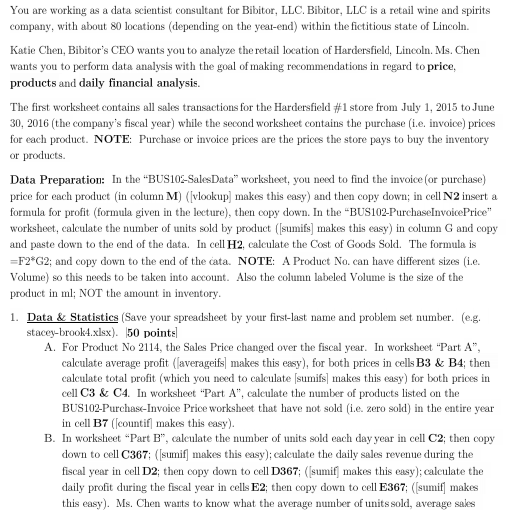
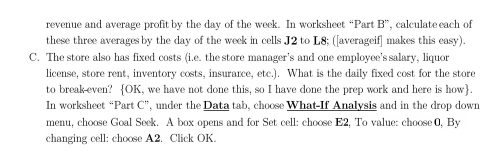
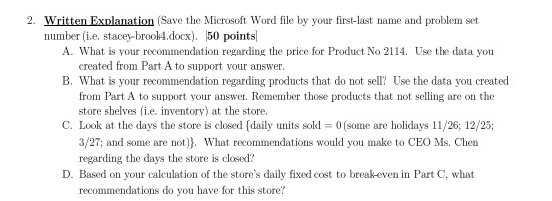
You are working as a data scientist consultant for Bibitor, LLC. Bibitor, LLC is a retail wine and spirits company, with about 80 locations (depending on the year-end) within the fictitious state of Lincoln. Katie Chen, Bibitor's CEO wants you to analyze the retail location of Hardersfield, Lincoln. Ms. Chen wants you to perform data analysis with the goal of making recommendations in regard to price, products and daily financial analysis. The first worksheet contains all sales transactions for the Hardersfield #1 store from July 1, 2015 to June 30, 2016 (the company's fiscal year) while the second worksheet contains the purchase (i.e. invoice) prices for each product. NOTE: Purchase or invoice prices are the prices the store pays to buy the inventory or products. Data Preparation: In the BUS10-SalesData" worksheet, you need to find the invoice (or purchase) price for each product (in column M) ([vlookup makes this easy) and then copy down; in cell N2 insert a formula for profit (formula given in the lecture), then copy down. In the "BUS102-PurchaseInvoicePrice" worksheet, calculate the number of units sold by product (sumifs) makes this easy) in column G and copy and paste down to the end of the data. In cell H2, calculate the Cost of Goods Sold. The formula is =F2*G2; and copy down to the end of the cata. NOTE: A Product No. can have different sizes (i.e. Volume) so this needs to be taken into account. Also the column labeled Volume is the size of the product in ml; NOT the amount in inventory 1. Data & Statistics (Save your spreadsheet by your first-last name and problem set number. (eg, stacey-brook4.xlsx). 150 points) A. For Product No 2114, the Sales Price changed over the fiscal year. In worksheet Part A, calculate average profit (averageifs) makes this easy), for both prices in cells B3 & B4; then calculate total profit (which you need to calculate (sumifs) makes this easy) for both prices in cell C3 & C4. In worksheet Part A", calculate the number of products listed on the BUS102-Purchase-Invoice Price worksheet that have not sold (i.e. zero sold) in the entire year in cell B7 ([countif makes this easy). B. In worksheet Part B, calculate the number of units sold each day year in cell C2; then copy down to cell C367; (sumif makes this easy); calculate the daily sales revenue during the fiscal year in cell D2; then copy down to cell D367; (sumif makes this easy); calculate the daily profit during the fiscal year in cells E2; then copy down to cell E367; (sumit makes this easy). Ms. Chen wants to know what the average number of units sold, average sales revenue and average profit by the day of the week. In worksheet Part B, calculate each of these three averages by the day of the week in cells J2 to L8: ((averageif makes this easy). C. The store also has fixed costs (i.e. the store manager's and one employee's salary, liquor license, store rent, inventory costs, insurance, etc.). What is the daily fixed cost for the store to break-even? {OK, we have not done this, so I have done the prep work and here is how}. In worksheet Part C", under the Data tab, choose What-If Analysis and in the drop down menu, choose Goal Seek. A box opens and for Set cell: choose E2, To value: choose O. By changing cell: choose A2. Click OK. 2. Written Explanation (Save the Microsoft Word file by your first-last name and problem set number (i.e. stacey-brook4.docx). 150 points A. What is your recommendation regarding the price for Product No 2114. Use the data you created from Part A to support your answer. B. What is your recommendation regarding products that do not sell? Use the data you created from Part A to support your answer. Remember those products that not selling are on the store shelves (i.e. inventory) at the store. C. Look at the days the store is closed (daily units sold = 0 (some are holidays 11/26; 12/25; 3/27; and some are not)}. What recommendations would you make to CEO Ms. Chen regarding the days the store is closed? D. Based on your calculation of the store's daily fixed cost to breakeven in Part C, what recommendations do you have for this store? You are working as a data scientist consultant for Bibitor, LLC. Bibitor, LLC is a retail wine and spirits company, with about 80 locations (depending on the year-end) within the fictitious state of Lincoln. Katie Chen, Bibitor's CEO wants you to analyze the retail location of Hardersfield, Lincoln. Ms. Chen wants you to perform data analysis with the goal of making recommendations in regard to price, products and daily financial analysis. The first worksheet contains all sales transactions for the Hardersfield #1 store from July 1, 2015 to June 30, 2016 (the company's fiscal year) while the second worksheet contains the purchase (i.e. invoice) prices for each product. NOTE: Purchase or invoice prices are the prices the store pays to buy the inventory or products. Data Preparation: In the BUS10-SalesData" worksheet, you need to find the invoice (or purchase) price for each product (in column M) ([vlookup makes this easy) and then copy down; in cell N2 insert a formula for profit (formula given in the lecture), then copy down. In the "BUS102-PurchaseInvoicePrice" worksheet, calculate the number of units sold by product (sumifs) makes this easy) in column G and copy and paste down to the end of the data. In cell H2, calculate the Cost of Goods Sold. The formula is =F2*G2; and copy down to the end of the cata. NOTE: A Product No. can have different sizes (i.e. Volume) so this needs to be taken into account. Also the column labeled Volume is the size of the product in ml; NOT the amount in inventory 1. Data & Statistics (Save your spreadsheet by your first-last name and problem set number. (eg, stacey-brook4.xlsx). 150 points) A. For Product No 2114, the Sales Price changed over the fiscal year. In worksheet Part A, calculate average profit (averageifs) makes this easy), for both prices in cells B3 & B4; then calculate total profit (which you need to calculate (sumifs) makes this easy) for both prices in cell C3 & C4. In worksheet Part A", calculate the number of products listed on the BUS102-Purchase-Invoice Price worksheet that have not sold (i.e. zero sold) in the entire year in cell B7 ([countif makes this easy). B. In worksheet Part B, calculate the number of units sold each day year in cell C2; then copy down to cell C367; (sumif makes this easy); calculate the daily sales revenue during the fiscal year in cell D2; then copy down to cell D367; (sumif makes this easy); calculate the daily profit during the fiscal year in cells E2; then copy down to cell E367; (sumit makes this easy). Ms. Chen wants to know what the average number of units sold, average sales revenue and average profit by the day of the week. In worksheet Part B, calculate each of these three averages by the day of the week in cells J2 to L8: ((averageif makes this easy). C. The store also has fixed costs (i.e. the store manager's and one employee's salary, liquor license, store rent, inventory costs, insurance, etc.). What is the daily fixed cost for the store to break-even? {OK, we have not done this, so I have done the prep work and here is how}. In worksheet Part C", under the Data tab, choose What-If Analysis and in the drop down menu, choose Goal Seek. A box opens and for Set cell: choose E2, To value: choose O. By changing cell: choose A2. Click OK. 2. Written Explanation (Save the Microsoft Word file by your first-last name and problem set number (i.e. stacey-brook4.docx). 150 points A. What is your recommendation regarding the price for Product No 2114. Use the data you created from Part A to support your answer. B. What is your recommendation regarding products that do not sell? Use the data you created from Part A to support your answer. Remember those products that not selling are on the store shelves (i.e. inventory) at the store. C. Look at the days the store is closed (daily units sold = 0 (some are holidays 11/26; 12/25; 3/27; and some are not)}. What recommendations would you make to CEO Ms. Chen regarding the days the store is closed? D. Based on your calculation of the store's daily fixed cost to breakeven in Part C, what recommendations do you have for this store
Step by Step Solution
There are 3 Steps involved in it

Get step-by-step solutions from verified subject matter experts