





Question: You are working as a summer intern at a small Cincinnati company that manufactures machine parts. The director of operations has asked you to review
You are working as a summer intern at a small
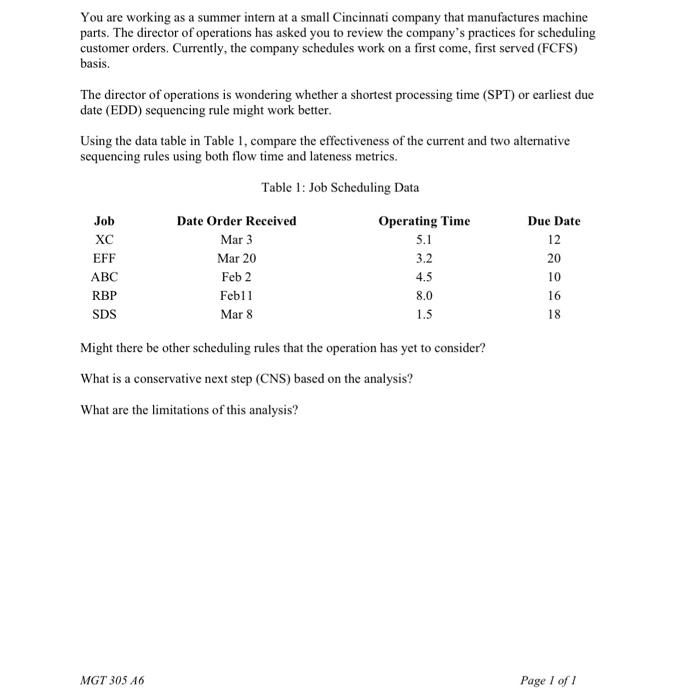
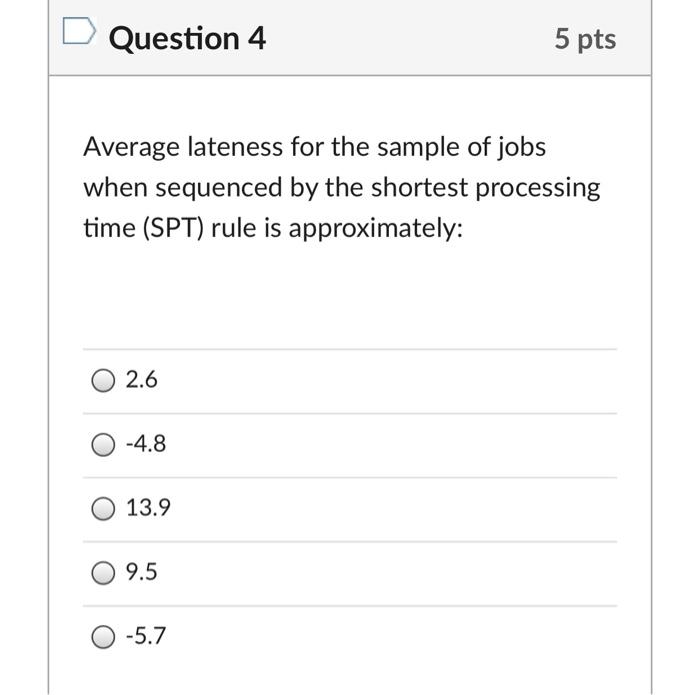
You are working as a summer intern at a small Cincinnati company that manufactures machine parts. The director of operations has asked you to review the company's practices for scheduling customer orders. Currently, the company schedules work on a first come first served (FCFS) basis. The director of operations is wondering whether a shortest processing time (SPT) or earliest due date (EDD) sequencing rule might work better. Using the data table in Table 1, compare the effectiveness of the current and two alternative sequencing rules using both flow time and lateness metrics. Table 1: Job Scheduling Data Date Order Received Operating Time Due Date XC Mar 3 5.1 12 EFF Mar 20 3.2 20 ABC Feb 2 4.5 10 Feb11 8,0 16 SDS Mar 8 1.5 18 Job RBP Might there be other scheduling rules that the operation has yet to consider? What is a conservative next step (CNS) based on the analysis? What are the limitations of this analysis? MGT 305 46 Page 1 of 1 Question 4 5 pts Average lateness for the sample of jobs when sequenced by the shortest processing time (SPT) rule is approximately: 2.6 -4.8 13.9 9.5 -5.7

Step by Step Solution

There are 3 Steps involved in it

1 Expert Approved Answer
Step: 1 Unlock blur-text-image

Question Has Been Solved by an Expert!

Get step-by-step solutions from verified subject matter experts

Step: 2 Unlock
Step: 3 Unlock

Students Have Also Explored These Related General Management Questions!