



Question: You are working for a fund that invests actively in different investment sectors. Analysts at your firm have produced the following estimates of sector portfolio
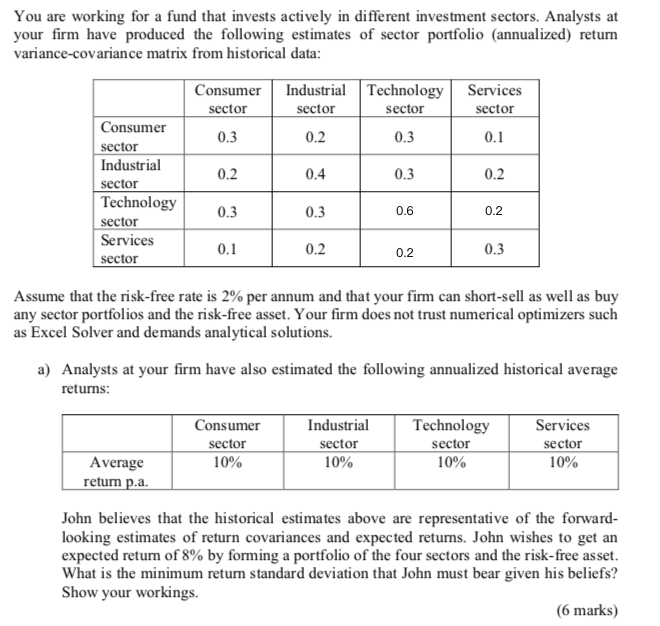
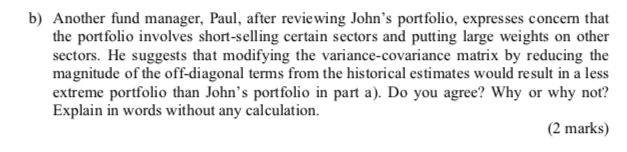
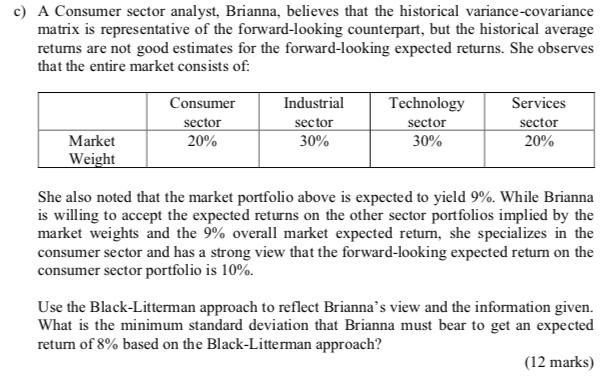
You are working for a fund that invests actively in different investment sectors. Analysts at your firm have produced the following estimates of sector portfolio (annualized) return variance-covariance matrix from historical data: Consumer sector 0.3 Industrial Technology Services sector sector sector 0.2 0.3 0.1 0.2 0.4 0.3 0.2 Consumer sector Industrial sector Technology sector Services sector 0.3 0.3 0.6 0.2 0.1 0.2 0.2 0.3 Assume that the risk-free rate is 2% per annum and that your firm can short-sell as well as buy any sector portfolios and the risk-free asset. Your firm does not trust numerical optimizers such as Excel Solver and demands analytical solutions. a) Analysts at your firm have also estimated the following annualized historical average returns: Consumer Industrial Technology Services sector sector sector sector Average 10% 10% 10% 10% return p.a. John believes that the historical estimates above are representative of the forward- looking estimates of return covariances and expected returns. John wishes to get an expected return of 8% by forming a portfolio of the four sectors and the risk-free asset. What is the minimum return standard deviation that John must bear given his beliefs? Show your workings. (6 marks) b) Another fund manager, Paul, after reviewing John's portfolio, expresses concern that the portfolio involves short-selling certain sectors and putting large weights on other sectors. He suggests that modifying the variance-covariance matrix by reducing the magnitude of the off-diagonal terms from the historical estimates would result in a less extreme portfolio than John's portfolio in part a). Do you agree? Why or why not? Explain in words without any calculation. (2 marks) c) A Consumer sector analyst, Brianna, believes that the historical variance-covariance matrix is representative of the forward-looking counterpart, but the historical average returns are not good estimates for the forward-looking expected returns. She observes that the entire market consists of: Consumer sector 20% Industrial sector 30% Technology sector 30% Services sector 20% Market Weight She also noted that the market portfolio above is expected to yield 9%. While Brianna is willing to accept the expected returns on the other sector portfolios implied by the market weights and the 9% overall market expected return, she specializes in the consumer sector and has a strong view that the forward-looking expected return on the consumer sector portfolio is 10%. Use the Black-Litterman approach to reflect Brianna's view and the information given. What is the minimum standard deviation that Brianna must bear to get an expected return of 8% based on the Black-Litterman approach? (12 marks) You are working for a fund that invests actively in different investment sectors. Analysts at your firm have produced the following estimates of sector portfolio (annualized) return variance-covariance matrix from historical data: Consumer sector 0.3 Industrial Technology Services sector sector sector 0.2 0.3 0.1 0.2 0.4 0.3 0.2 Consumer sector Industrial sector Technology sector Services sector 0.3 0.3 0.6 0.2 0.1 0.2 0.2 0.3 Assume that the risk-free rate is 2% per annum and that your firm can short-sell as well as buy any sector portfolios and the risk-free asset. Your firm does not trust numerical optimizers such as Excel Solver and demands analytical solutions. a) Analysts at your firm have also estimated the following annualized historical average returns: Consumer Industrial Technology Services sector sector sector sector Average 10% 10% 10% 10% return p.a. John believes that the historical estimates above are representative of the forward- looking estimates of return covariances and expected returns. John wishes to get an expected return of 8% by forming a portfolio of the four sectors and the risk-free asset. What is the minimum return standard deviation that John must bear given his beliefs? Show your workings. (6 marks) b) Another fund manager, Paul, after reviewing John's portfolio, expresses concern that the portfolio involves short-selling certain sectors and putting large weights on other sectors. He suggests that modifying the variance-covariance matrix by reducing the magnitude of the off-diagonal terms from the historical estimates would result in a less extreme portfolio than John's portfolio in part a). Do you agree? Why or why not? Explain in words without any calculation. (2 marks) c) A Consumer sector analyst, Brianna, believes that the historical variance-covariance matrix is representative of the forward-looking counterpart, but the historical average returns are not good estimates for the forward-looking expected returns. She observes that the entire market consists of: Consumer sector 20% Industrial sector 30% Technology sector 30% Services sector 20% Market Weight She also noted that the market portfolio above is expected to yield 9%. While Brianna is willing to accept the expected returns on the other sector portfolios implied by the market weights and the 9% overall market expected return, she specializes in the consumer sector and has a strong view that the forward-looking expected return on the consumer sector portfolio is 10%. Use the Black-Litterman approach to reflect Brianna's view and the information given. What is the minimum standard deviation that Brianna must bear to get an expected return of 8% based on the Black-Litterman approach? (12 marks)
Step by Step Solution
There are 3 Steps involved in it

Get step-by-step solutions from verified subject matter experts