







Question: You are working on a bacterial virus that attacks E. coli. When the virus infects a bacterium, it replicates and eventually lyses the bacteria.
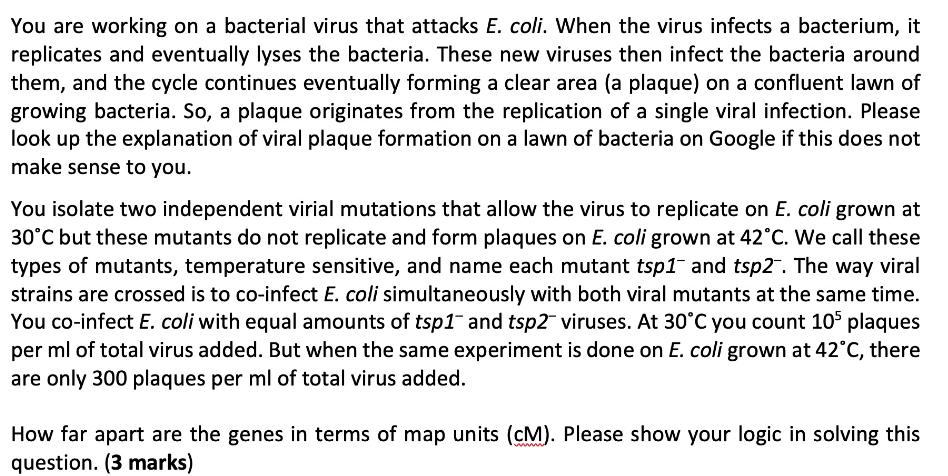
You are working on a bacterial virus that attacks E. coli. When the virus infects a bacterium, it replicates and eventually lyses the bacteria. These new viruses then infect the bacteria around them, and the cycle continues eventually forming a clear area (a plaque) on a confluent lawn of growing bacteria. So, a plaque originates from the replication of a single viral infection. Please look up the explanation of viral plaque formation on a lawn of bacteria on Google if this does not make sense to you. You isolate two independent virial mutations that allow the virus to replicate on E. coli grown at 30C but these mutants do not replicate and form plaques on E. coli grown at 42C. We call these types of mutants, temperature sensitive, and name each mutant tsp1 and tsp2. The way viral strains are crossed is to co-infect E. coli simultaneously with both viral mutants at the same time. You co-infect E. coli with equal amounts of tsp1 and tsp2 viruses. At 30C you count 105 plaques per ml of total virus added. But when the same experiment is done on E. coli grown at 42C, there are only 300 plaques per ml of total virus added. How far apart are the genes in terms of map units (cm). Please show your logic in solving this question. (3 marks)
Step by Step Solution
There are 3 Steps involved in it
To determine the distance between the genes in terms of map units CM we need to use the frequency of ... View full answer

Get step-by-step solutions from verified subject matter experts
 Study Help