







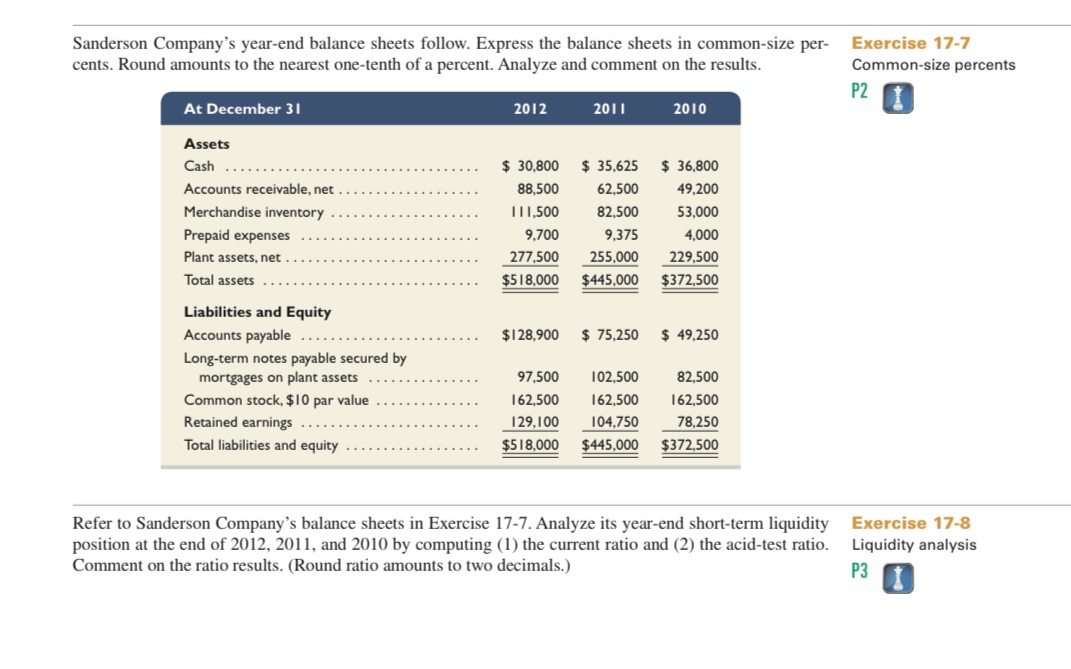
Question: you dont have to do exercise 17-7 , do only 17-8 Sanderson Company's year-end balance sheets follow. Express the balance sheets in common-size per- Exercise
you dont have to do exercise 17-7 , do only 17-8
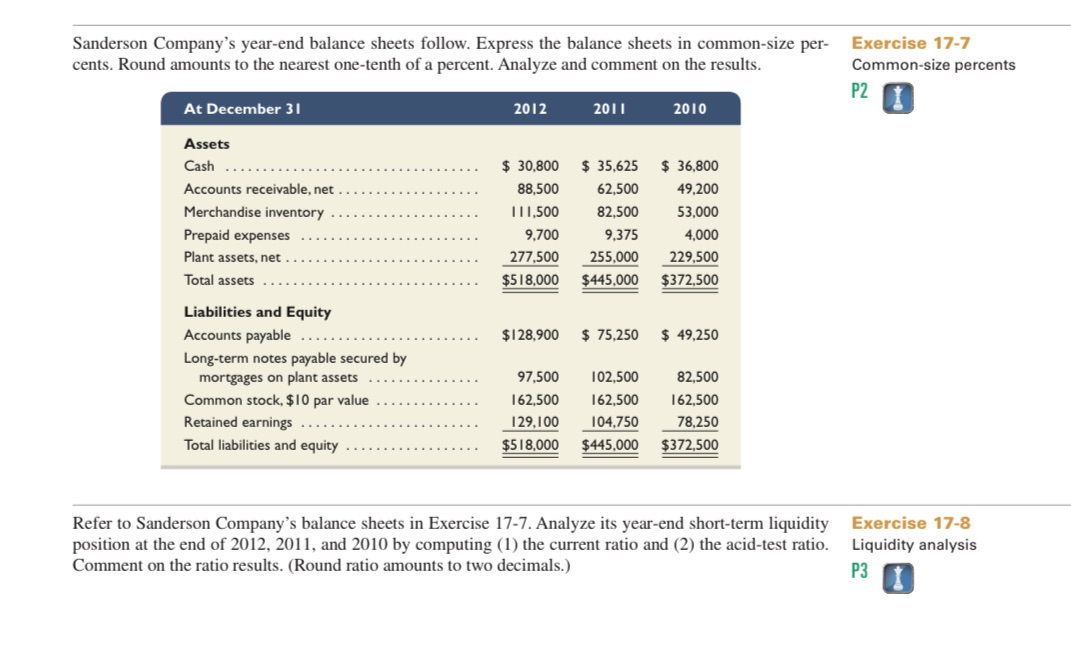
Sanderson Company's year-end balance sheets follow. Express the balance sheets in common-size per- Exercise 17-7 cents. Round amounts to the nearest one-tenth of a percent. Analyze and comment on the results. Common-size percents At December 31 2012 201 1 2010 P2 Assets Cash . . . . . $ 30,800 $ 35,625 $ 36,800 Accounts receivable, net . 88,500 62,500 49,200 Merchandise inventory 1 1 1,500 82,500 53,000 Prepaid expenses . . . . . . . . .. . 9,700 9.375 4,000 Plant assets, net . . . .. 277,500 255,000 229,500 Total assets $518,000 $445,000 $372,500 Liabilities and Equity Accounts payable . ... $128,900 $ 75,250 $ 49,250 Long-term notes payable secured by mortgages on plant assets . . . . . . . 97.500 102,500 82,500 Common stock, $10 par value 162,500 162,500 162,500 Retained earnings 129,100 104,750 78,250 Total liabilities and equity . . .. .. $518,000 $445,000 $372,500 Refer to Sanderson Company's balance sheets in Exercise 17-7. Analyze its year-end short-term liquidity Exercise 17-8 position at the end of 2012, 2011, and 2010 by computing (1) the current ratio and (2) the acid-test ratio. Liquidity analysis Comment on the ratio results. (Round ratio amounts to two decimals.) P3 1
Step by Step Solution
There are 3 Steps involved in it

Get step-by-step solutions from verified subject matter experts
 Study Help