







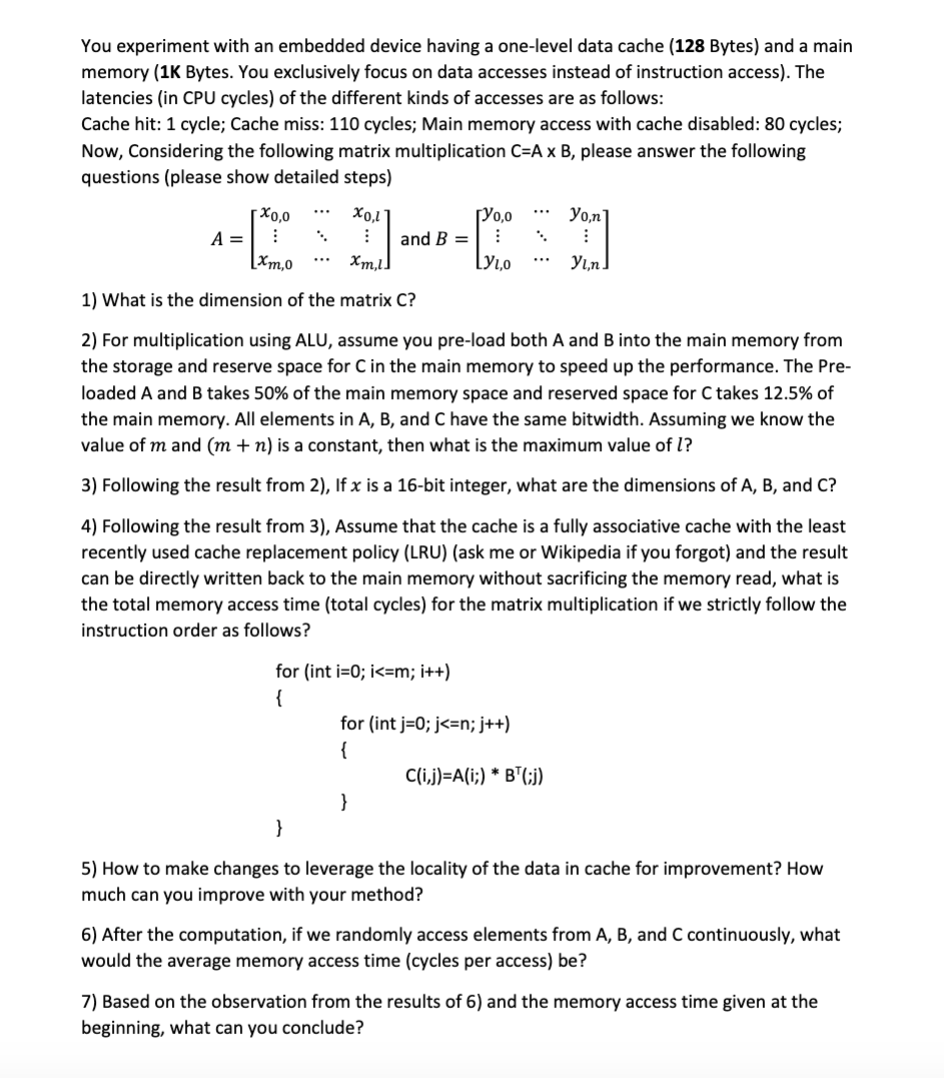
Question: You experiment with an embedded device having a one - level data cache ( 1 2 8 Bytes ) and a main memory ( 1
You experiment with an embedded device having a onelevel data cache Bytes and a main
memory K Bytes. You exclusively focus on data accesses instead of instruction access The
latencies in CPU cycles of the different kinds of accesses are as follows:
Cache hit: cycle; Cache miss: cycles; Main memory access with cache disabled: cycles;
Now, Considering the following matrix multiplication please answer the following
questions please show detailed steps
and
What is the dimension of the matrix
For multiplication using ALU, assume you preload both A and into the main memory from
the storage and reserve space for in the main memory to speed up the performance. The Pre
loaded A and B takes of the main memory space and reserved space for takes of
the main memory. All elements in A B and C have the same bitwidth. Assuming we know the
value of and is a constant, then what is the maximum value of
Following the result from If is a bit integer, what are the dimensions of and
Following the result from Assume that the cache is a fully associative cache with the least
recently used cache replacement policy LRUask me or Wikipedia if you forgot and the result
can be directly written back to the main memory without sacrificing the memory read, what is
the total memory access time total cycles for the matrix multiplication if we strictly follow the
instruction order as follows?
for int ; ;
for int ;;
;;
How to make changes to leverage the locality of the data in cache for improvement? How
much can you improve with your method?
After the computation, if we randomly access elements from A B and C continuously, what
would the average memory access time cycles per access be
Based on the observation from the results of and the memory access time given at the
beginning, what can you conclude?
Step by Step Solution
There are 3 Steps involved in it
1 Expert Approved Answer
Step: 1 Unlock

Question Has Been Solved by an Expert!
Get step-by-step solutions from verified subject matter experts
Step: 2 Unlock
Step: 3 Unlock
 Study Help