



Question: You have been asked to determine if two different production processes have different mean numbers of units produced per hour. Process 1 has a mean
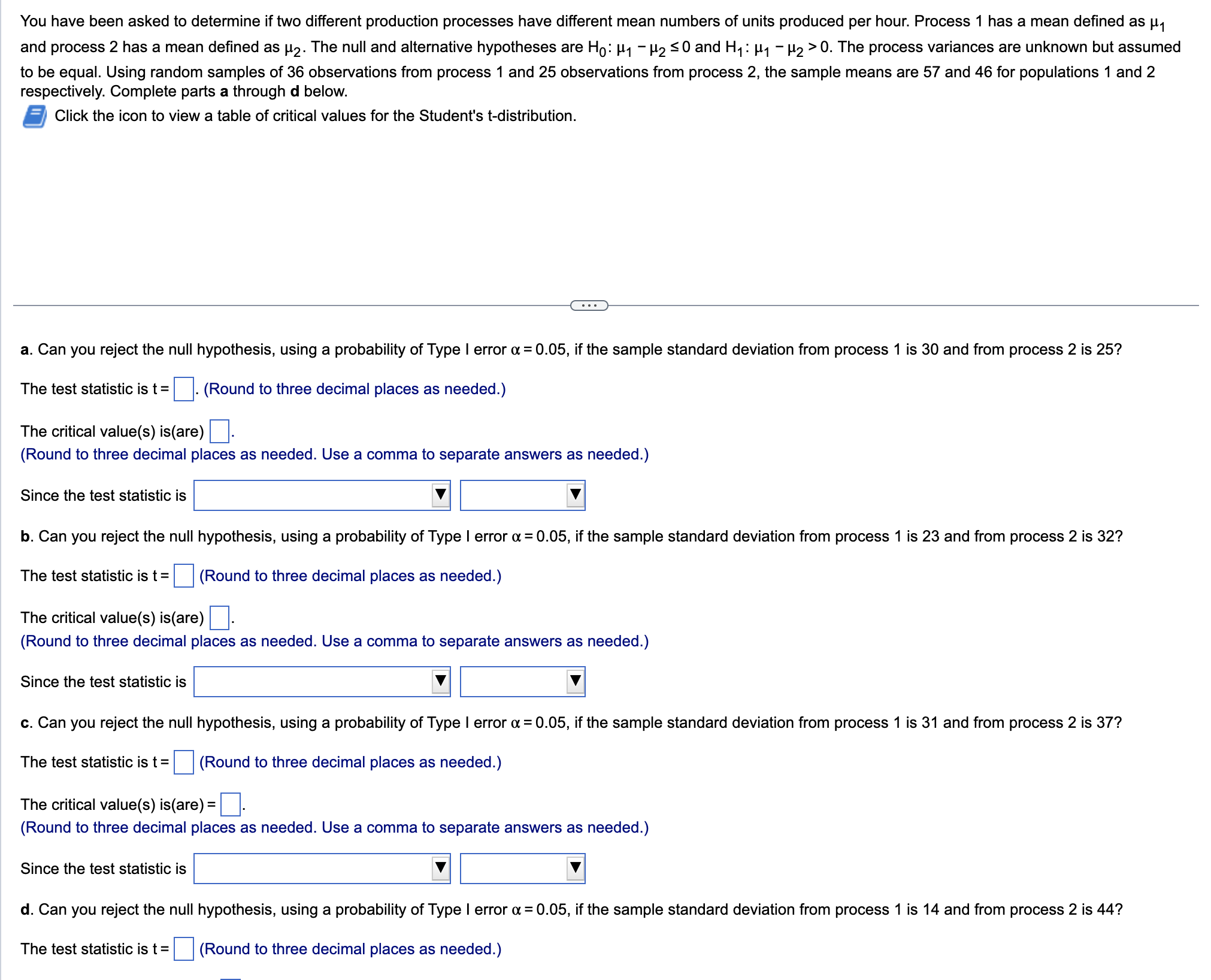

image text in transcribedimage text in transcribed
You have been asked to determine if two different production processes have different mean numbers of units produced per hour. Process 1 has a mean dened as p1 and process 2 has a mean dened as p2. The null and alternative hypotheses are H0: p1 - pz 5 O and H1: u1 - \".2 > O. The process variances are unknown but assumed to be equal. Using random samples of 36 observations from process 1 and 25 observations from process 2, the sample means are 57 and 46 for populations 1 and 2 respectively. Complete parts a through d below. 3 Click the icon to view a table of critical values for the Student's tdistribution. E) a. Can you reject the null hypothesis, using a probability of Type I error (x = 0.05, if the sample standard deviation from process 1 is 30 and from process 2 is 25? The test statistic is t = :|. (Round to three decimal places as needed.) The critical value(s) is(are) D. (Round to three decimal places as needed. Use a comma to separate answers as needed.) Since the test statistic is V V b. Can you reject the null hypothesis, using a probability of Type I error a = 0.05, ifthe sample standard deviation from process 1 is 23 and from process 2 is 32'? The test statistic is t = :| (Round to three decimal places as needed.) The critical value(s) is(are) D. (Round to three decimal places as needed. Use a comma to separate answers as needed.) c. Can you reject the null hypothesis, using a probability of Type I error (x = 0.05, if the sample standard deviation from process 1 is 31 and from process 2 is 37? The test statistic is t = Cl (Round to three decimal places as needed.) The critical value(s) is(are) = (Round to three decimal places as needed. Use a comma to separate answers as needed.) d. Can you reject the null hypothesis, using a probability of Type I error a = 0.05, ifthe sample standard deviation from process 1 is 14 and from process 2 is 44'? The test statistic is t = Cl (Round to three decimal places as needed.) d. Can you reject the null hypothesis, using a probability of Type I error a = 0.05, if the sample standard deviation from process 1 is 14 and from process 2 is 44? The test statistic is t = (Round to three decimal places as needed) The critical valuels) is(are) = ' (Round to three decimal places as needed. Use a comma to separate answers as needed.) Since the test statistic is V V

Step by Step Solution

There are 3 Steps involved in it

1 Expert Approved Answer
Step: 1 Unlock blur-text-image
Question Has Been Solved by an Expert!

Get step-by-step solutions from verified subject matter experts

Step: 2 Unlock
Step: 3 Unlock

Students Have Also Explored These Related Economics Questions!