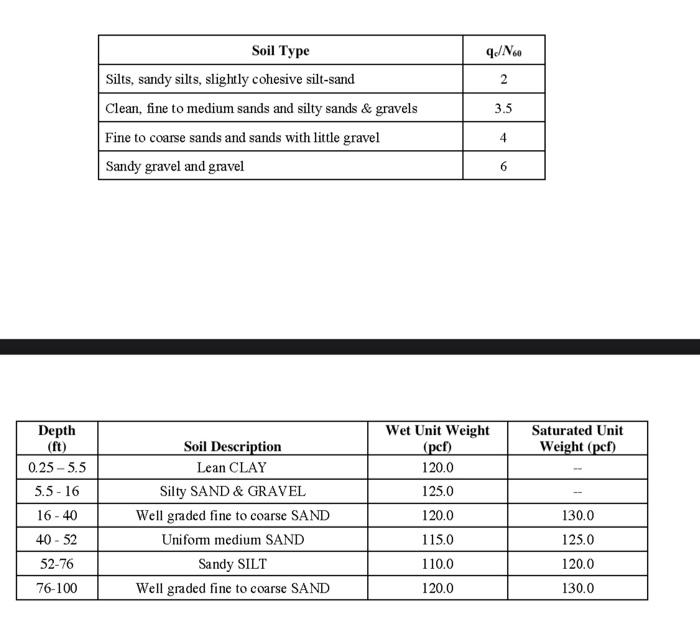
You have been tasked to assist the structural engineer for a bridge replacement project. Your task is to design the size of the footing for a bridge pier, based on the allowable stress design method. A soil test boring was drilled at the location of the bridge pier. The soil test boring log has shown that the soil is fairly uniform at the pier location and consists of a layer of clay overlying a five-layer system of silty sand, well graded sand, uniform sand, sandy silt, and well-graded sand. Detailed information about each layer is given in the attached soil test boring log and in the table below. Groundwater table was encountered at the depth of 25 feet after a stabilization period during the subsurface exploration program. However, the groundwater table was observed to fluctuate at depths ranging from 22 to 27 feet below the ground surface during long term monitoring. Neglect correction factors for borehole diameter, sampler correction, and correction for rod length
The following information was provided by the structural engineer:
Scour is not an issue at the site.
Frost penetration depth is 4.5 feet.
Tolerable settlement for the project is 1.5 inches.
Axial Load = 1800 kips
Shear Load at base of footing = 400 kips
Moment about both axes= 1800 kips-ft
Use Schmertmanns (1975) and Kulhawy and Mayne (1990) correlation between SPT and , and round to nearest degree.
The increase in stress in each layer should be estimated using the 2:1 method
Settlement analyses should be based on the Schmertmanns method.
Using the information provided above, design the size of the footing for the interior bridge pier, based on the allowable stress design method. You should consider both settlement and bearing capacity, and check for overturning and sliding.
4./N. 2 Soil Type Silts, sandy silts, slightly cohesive silt-sand Clean, fine to medium sands and silty sands & gravels Fine to coarse sands and sands with little gravel Sandy gravel and gravel 3.5 4 6 Saturated Unit Weight (per) Depth (ft) 0.25 -5.5 5.5 - 16 16 -40 40-52 Soil Description Lean CLAY Silty SAND & GRAVEL Well graded fine to coarse SAND Uniform medium SAND Sandy SILT Well graded fine to coarse SAND Wet Unit Weight (pc) 120.0 125.0 120.0 115.0 110.0 120.0 130.0 125.0 120.0 52-76 76-100 130.0 4./N. 2 Soil Type Silts, sandy silts, slightly cohesive silt-sand Clean, fine to medium sands and silty sands & gravels Fine to coarse sands and sands with little gravel Sandy gravel and gravel 3.5 4 6 Saturated Unit Weight (per) Depth (ft) 0.25 -5.5 5.5 - 16 16 -40 40-52 Soil Description Lean CLAY Silty SAND & GRAVEL Well graded fine to coarse SAND Uniform medium SAND Sandy SILT Well graded fine to coarse SAND Wet Unit Weight (pc) 120.0 125.0 120.0 115.0 110.0 120.0 130.0 125.0 120.0 52-76 76-100 130.0









 Study Help