







Question: You have been tasked with configuring a secure WLAN for 300 APs at the corporate offices. All the APs and employee Windows laptops have
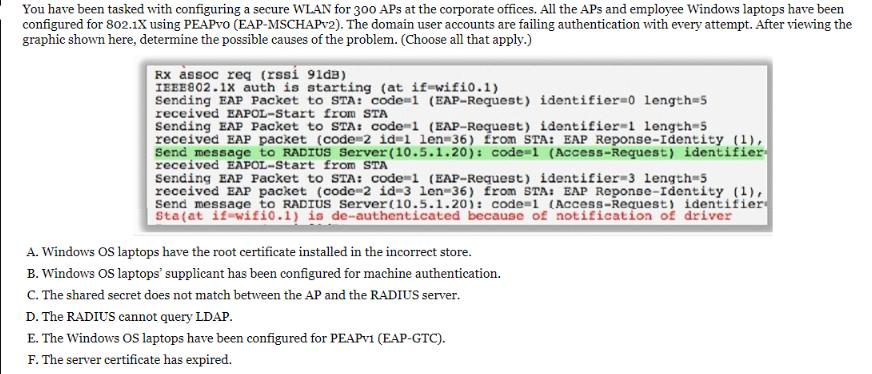
You have been tasked with configuring a secure WLAN for 300 APs at the corporate offices. All the APs and employee Windows laptops have been configured for 802.1X using PEAPVO (EAP-MSCHAPv2). The domain user accounts are failing authentication with every attempt. After viewing the graphic shown here, determine the possible causes of the problem. (Choose all that apply.) Rx assoc req (rssi 91dB) IEEE802.1x auth is starting (at if-wifi0.1) Sending EAP Packet to STA: code=1 (EAP-Request) identifier=0 length=5 received EAPOL-Start from STA Sending EAP Packet to STA: code 1 (EAP-Request) identifier-1 length=5 received EAP packet (code-2 id-1 len-36) from STA: EAP Reponse-Identity (1), Send message to RADIUS Server (10.5.1.20): code-1 (Access-Request) identifier received EAPOL-Start from STA Sending EAP Packet to STA: code-1 (EAP-Request) identifier-3 length 5 received EAP packet (code-2 id-3 len-36) from STA: EAP Reponse-Identity (1), Send message to RADIUS Server(10.5.1.201: code=1 (Access-Request) identifier Sta(at if-wifi0.1) is de-authenticated because of notification of driver A. Windows OS laptops have the root certificate installed in the incorrect store. B. Windows OS laptops' supplicant has been configured for machine authentication. C. The shared secret does not match between the AP and the RADIUS server. D. The RADIUS cannot query LDAP. E. The Windows OS laptops have been configured for PEAPV1 (EAP-GTC). F. The server certificate has expired.
Step by Step Solution
3.39 Rating (152 Votes )
There are 3 Steps involved in it
Based on the provided information the possible causes of the problem include A Windows OS laptops ... View full answer

Get step-by-step solutions from verified subject matter experts
 Study Help