







Question: You have the following code on which the programmer included desired precondition and postconditions and included (hopefully) correct loop invariants on each of the loops.
You have the following code on which the programmer included desired precondition and postconditions and included (hopefully) correct loop invariants on each of the loops. Given the stated postcondition (i.e. goal) for the code, you are to: a) State whether the given loop invariants are correct, and if not to give corrected loop invariants. b) For each numbered statement, give the correct weakest precondition for that statement. c) Determine whether the weakest precondition for statement 1 is logically inferred from the stated precondition of the code.
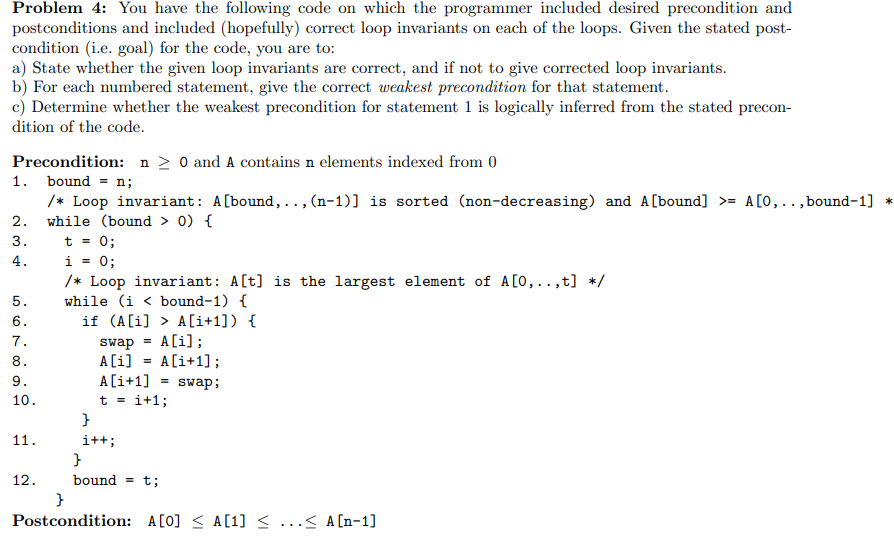
Problem 4: You have the following code on which the programmer included desired precondition and postconditions and included (hopefully) correct loop invariants on each of the loops. Given the stated post- condition i.e. goal) for the code, you are to: a) State whether the given loop invariants are correct, and if not to give corrected loop invariants. b) For each numbered statement, give the correct weakest precondition for that statement. c) Determine whether the weakest precondition for statement 1 is logically inferred from the stated precon- dition of the code. Precondition: n > 0 and A contains n elements indexed from 0 1. bound = n; /* Loop invariant: A[bound, . ., (n-1)] is sorted (non-decreasing) and A[bound] >= A[O,.., bound-1] * 2. while (bound > 0) { t = 0; i = 0; /* Loop invariant: A[t] is the largest element of A[O,..,t] */ while (i A[i+1]) { 7. swap = A[i]; A[i] = A[i+1]; 9. A[i+1] = swap; t = i+1; 5. wh 10. i++; 7 12. bound = t; Postcondition: A[0] A[n-1] Problem 4: You have the following code on which the programmer included desired precondition and postconditions and included (hopefully) correct loop invariants on each of the loops. Given the stated post- condition i.e. goal) for the code, you are to: a) State whether the given loop invariants are correct, and if not to give corrected loop invariants. b) For each numbered statement, give the correct weakest precondition for that statement. c) Determine whether the weakest precondition for statement 1 is logically inferred from the stated precon- dition of the code. Precondition: n > 0 and A contains n elements indexed from 0 1. bound = n; /* Loop invariant: A[bound, . ., (n-1)] is sorted (non-decreasing) and A[bound] >= A[O,.., bound-1] * 2. while (bound > 0) { t = 0; i = 0; /* Loop invariant: A[t] is the largest element of A[O,..,t] */ while (i A[i+1]) { 7. swap = A[i]; A[i] = A[i+1]; 9. A[i+1] = swap; t = i+1; 5. wh 10. i++; 7 12. bound = t; Postcondition: A[0] A[n-1]
Step by Step Solution
There are 3 Steps involved in it

Get step-by-step solutions from verified subject matter experts
 Study Help