







Question: You have to write a class for complex numbers. This class must be called Complex. A basic skeleton of the class is given as a
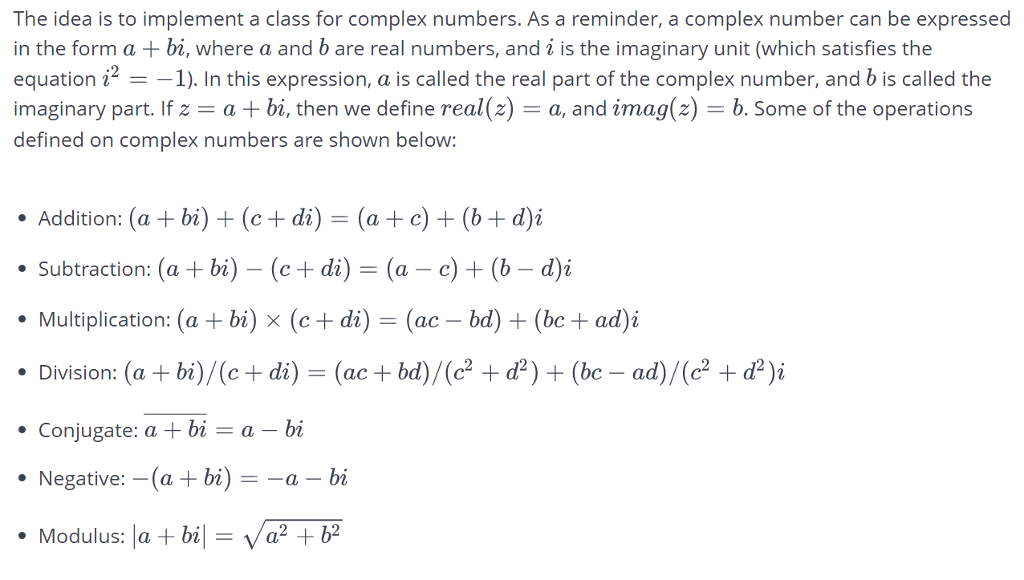
You have to write a class for complex numbers. This class must be called Complex. A basic skeleton of the class is given as a starting point. Your class must be complete enough for a professional use. For example, your class must provide at least one constructor, accessors and mutators, methods add, subtract, multiply, divide, conjugate, negative, modulus, toString, etc. Two static methods (getDecPlaces and setDecPlaces) must also be provided as a way to control the number of decimal places used in method toString to represent the real and imaginary parts of the complex numbers. By default, the number of decimal places will be 2.
To test your complex class, a user will be allowed to enter the following commands from the keyboard:
define
define
set
show
add
subtract
multiply
divide
negative
conjugate
decimal
Write a second class called TestComplex that will read the commands from the keyboard and display the result on the standard output.
Input Format
The input will consist of several lines. In each line, there is a valid command. The commands have to be processed until reaching the end-of-file.
Constraints
Unfortunately, Hackerrank does not allow us to create 2 files. In the ideal solution, we should have a file called Complex.java for the class that manages the complex numbers, and another file called TestComplex.java for the test class. Here, we will just have one file with both classes.
Output Format
The output of the show commands. For more details, see the test cases.
Sample Input 0
decimal 4 define c1 -1.2 -7.83 define c2 -0.45 2.07 define sum add sum c1 c2 show sum
Sample Output 0
-1.6500-5.7600i
Sample Input 1
define c1 1.256 -7.83 define c2 0.45 2.078 define prod multiply prod c1 c2 show prod decimal 4 show prod
Sample Output 1
16.84-0.91i 16.8359-0.9135i
Sample Input 2
define c1 1.2 -4.5 define c2 -7.8 3.2 define c3 -3.4 -0.8 define c4 3.3 2.8 define tmp1 multiply tmp1 c1 c2 decimal 5 show tmp1 define tmp2 multiply tmp2 c3 c4 show tmp2 add tmp1 tmp1 tmp2 decimal 2 show tmp1 decimal 6 show tmp1
Sample Output 2
5.04000+38.94000i -8.98000-12.16000i -3.94+26.78i -3.940000+26.780000i
Sample Input 3
define c1 4.20 -2.32 define c2 0.252 3.35 divide result c1 c2 show result negate result show result decimal 3 show result decimal 4 show result decimal 5 show result decimal 6 conjugate result show result
Sample Output 3
-0.59-1.30i 0.59+1.30i 0.595+1.298i 0.5949+1.2985i 0.59486+1.29848i 0.594861-1.298479i
Code:
class Complex { /* Enter your code here for the Complex class. */ private double real, imag; private static int decPlaces = 2; public static int getDecPlaces() { /* To be completed */ } public static void setDecPlaces(int decPlaces) { /* To be completed */ } }
class TestComplex { /* Enter your code here for the TestComplex class. */ public static void main(String[] args) { /* To be completed */ } }
The idea is to implement a class for complex numbers. As a reminder, a complex number can be expressed in the form a + bi, where a and b are real numbers, and i is the imaginary unit (which satisfies the equation i21). In this expression, a is called the real part of the complex number, and b is called the imaginary part. If za+bi, then we define real(z)-a, and imag(z)-b. Some of the operations defined on complex numbers are shown below Addition: (a + bi) + (c+ di) - (a+c)(b d)i Subtraction: (a + bi) - (c+ di) -(a c)(b - d)i Multiplication: (a +bi) x (c+ di) (ac - bd) +(bc +ad)i Division:(a +bi)/ Conjugate: a +bi-a - bi (c+ di) (ac +bd)/(cd) (bc - ad)/(c d2)i Negative:-(a +bi)--a - bi . Modulus: la + bil- /a2 + b2 The idea is to implement a class for complex numbers. As a reminder, a complex number can be expressed in the form a + bi, where a and b are real numbers, and i is the imaginary unit (which satisfies the equation i21). In this expression, a is called the real part of the complex number, and b is called the imaginary part. If za+bi, then we define real(z)-a, and imag(z)-b. Some of the operations defined on complex numbers are shown below Addition: (a + bi) + (c+ di) - (a+c)(b d)i Subtraction: (a + bi) - (c+ di) -(a c)(b - d)i Multiplication: (a +bi) x (c+ di) (ac - bd) +(bc +ad)i Division:(a +bi)/ Conjugate: a +bi-a - bi (c+ di) (ac +bd)/(cd) (bc - ad)/(c d2)i Negative:-(a +bi)--a - bi . Modulus: la + bil- /a2 + b2
Step by Step Solution
There are 3 Steps involved in it

Get step-by-step solutions from verified subject matter experts
 Study Help