







Question: You must complete both Section A and Section B Section A: Please answer all 1 0 MCQs in the answer book ( 2 0 marks
You must complete both Section A and Section B
Section A: Please answer all MCQs in the answer book marks
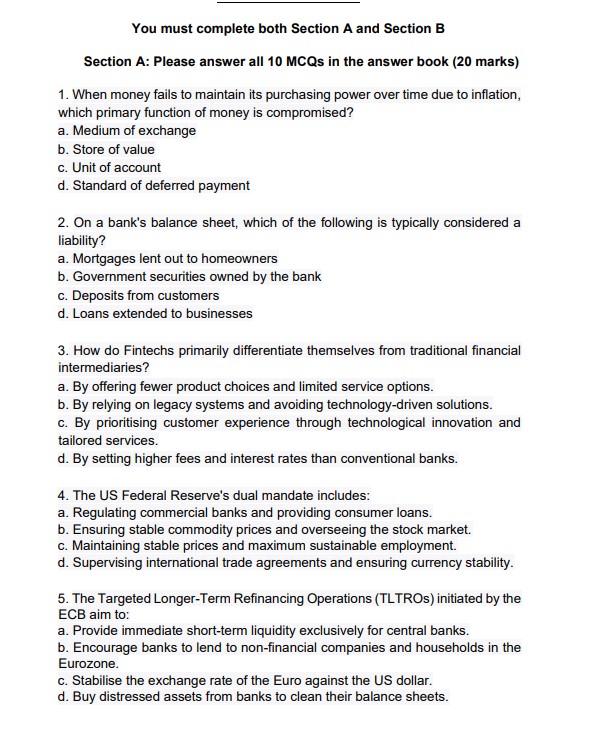
When money fails to maintain its purchasing power over time due to inflation, which primary function of money is compromised?
a Medium of exchange
b Store of value
c Unit of account
d Standard of deferred payment
On a bank's balance sheet, which of the following is typically considered a liability?
a Mortgages lent out to homeowners
b Government securities owned by the bank
c Deposits from customers
d Loans extended to businesses
How do Fintechs primarily differentiate themselves from traditional financial intermediaries?
a By offering fewer product choices and limited service options.
b By relying on legacy systems and avoiding technologydriven solutions.
c By prioritising customer experience through technological innovation and tailored services.
d By setting higher fees and interest rates than conventional banks.
The US Federal Reserve's dual mandate includes:
a Regulating commercial banks and providing consumer loans.
b Ensuring stable commodity prices and overseeing the stock market.
c Maintaining stable prices and maximum sustainable employment.
d Supervising international trade agreements and ensuring currency stability.
The Targeted LongerTerm Refinancing Operations TLTROs initiated by the ECB aim to:
a Provide immediate shortterm liquidity exclusively for central banks.
b Encourage banks to lend to nonfinancial companies and households in the Eurozone.
c Stabilise the exchange rate of the Euro against the US dollar.
d Buy distressed assets from banks to clean their balance sheets. The concept of "web in the context of finance emphasises:
a A centralised internet dominated by a few corporations.
b A return to traditional, noncrypto financial mechanisms.
c A vision for a decentralised internet where users control their data and interactions, often powered by blockchain.
d A new type of web browser focused on faster browsing speeds without blockchain integrations.
While both money and cash facilitate transactions, what distinguishes cash in most modern economies?
a Cash can earn interest, while money cannot.
b Cash is a form of digital currency used online.
c Cash represents physical tokens or notes, whereas money can also encompass digital or virtual representations.
d Cash's primary function is to serve as collateral for loans, while money is for everyday transactions.
When a central bank wants to combat inflation using Open Market Operations OMOs it will most likely:
a Purchase government securities to increase the money supply.
b Lower the reserve requirement to allow more bank lending.
c Sell government securities to absorb excess liquidity.
d Decrease the interest rate it charges banks for borrowing.
A central bank decides to decrease the reserve requirement. This would most likely result in:
a A decrease in the number of loans banks can issue.
b An increase in the interest rates on savings accounts.
c A contraction in the money supply due to lower liquidity.
d An expansion of the money supply due to increased lending capacity for banks.
The "Paradox of banknotes", often referred to as the cash paradox, is a phenomenon observed in many countries. What does this paradox primarily address?
a The decreasing use of physical cash as digital payment methods rise.
b The increasing demand for banknotes even as electronic transactions become more prevalent.
c The consistent value of banknotes across different economies.
d The correlation between the printing of banknotes and inflation rates.
Step by Step Solution
There are 3 Steps involved in it
1 Expert Approved Answer
Step: 1 Unlock

Question Has Been Solved by an Expert!
Get step-by-step solutions from verified subject matter experts
Step: 2 Unlock
Step: 3 Unlock
 Study Help