



Question: You must read the scenario and prepare a response. Read the scenario carefully and develop your position using supporting arguments from the text reading material
You must read the scenario and prepare a response. Read the scenario carefully and develop your position using supporting arguments from the text reading material and any supporting videos. You must outline your position clearly. Any questions at the end of the scenario are suggestions to prompt your thinking and do not need to be answered in sequence.
HERE'S THE SCENARIO!
Andy and Brian were talking over coffee one morning. Brian, Andy said, You know Ive been repairing clocks as a hobby for some time. Since the nearest clock shop is in Smithton and thats about 60 miles away, Ive begun doing it for friends and neighbors. Im thinking of quitting this job and opening a clock repair shop here.
Oh, Andy, Brian replied, Are you really sure you want to do that? Hardly anybody starts a business these days no one even much thinks about doing that anymore. The day of somebody just deciding to open a business and doing it is past.
Even restaurants are no longer small businesses; you gotta buy a franchise from some big corporation these days. Besides, you gotta do something different than anybody else does; youve got to come up with an idea no one else has thought of before."
Andy and Brian continued their discussion about Andys possible clock repair business. You know, its not like its a business your Dad started and you feel like you HAVE to continue, Brian spoke up. Is it because you want to be the boss and tell people what to do and stuff? Or are you trying to be a big shot, Mr. Business Owner? What makes you want to leave a good job like this and do something like that?
Andy replied, No, Brian, its not like that at all. Sure, Id like to have a decent income one where I didnt have to be worried that Id get laid off all the time and maybe itd turn out to be even better than that, and I could afford a nice house and car. What Id really like though is to be able to learn more about clocks maybe pick up watches, too. Id kind of like to see if Ive got what it takes to run my own business as well. Can I keep books and advertise and stuff like that? Also, since the kids are getting older, do you know how many of Carls Little League games Ive had to miss or how many of Denises band concerts?
Be a better friend to Andy than Brian was. Correct the errors Brian made and offer Andy some advice that will be beneficial.
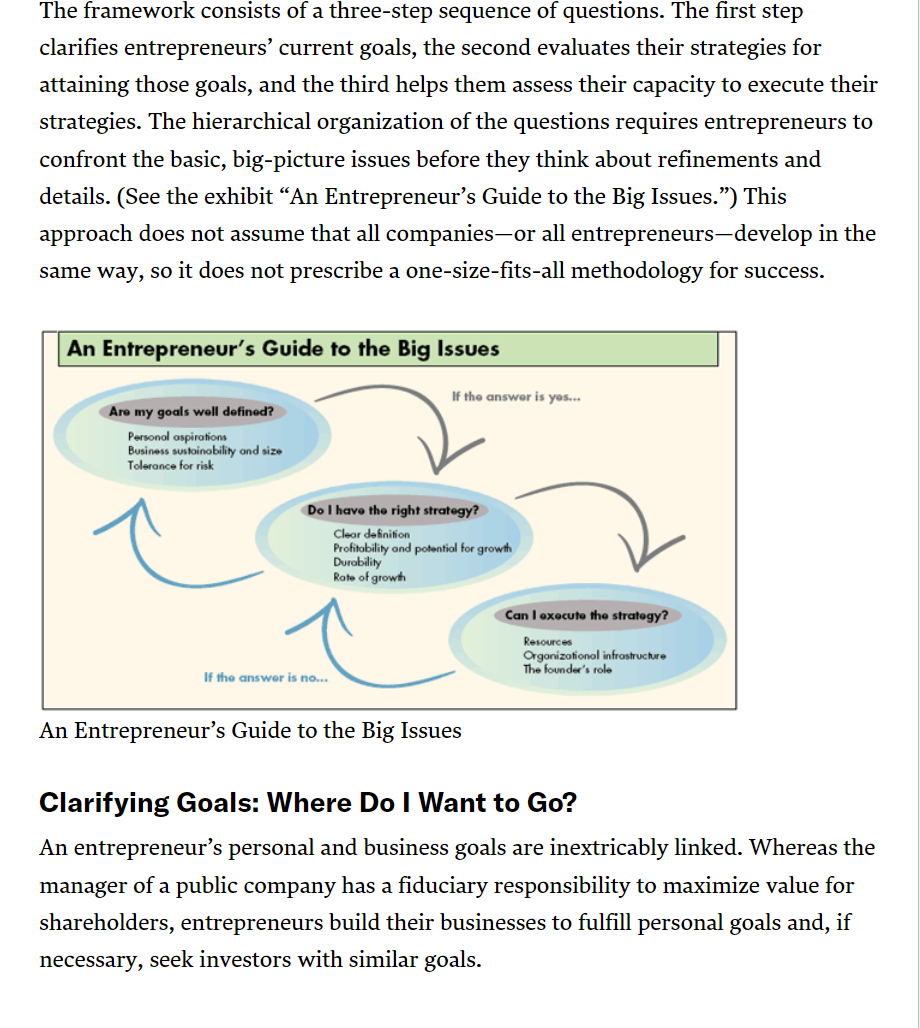
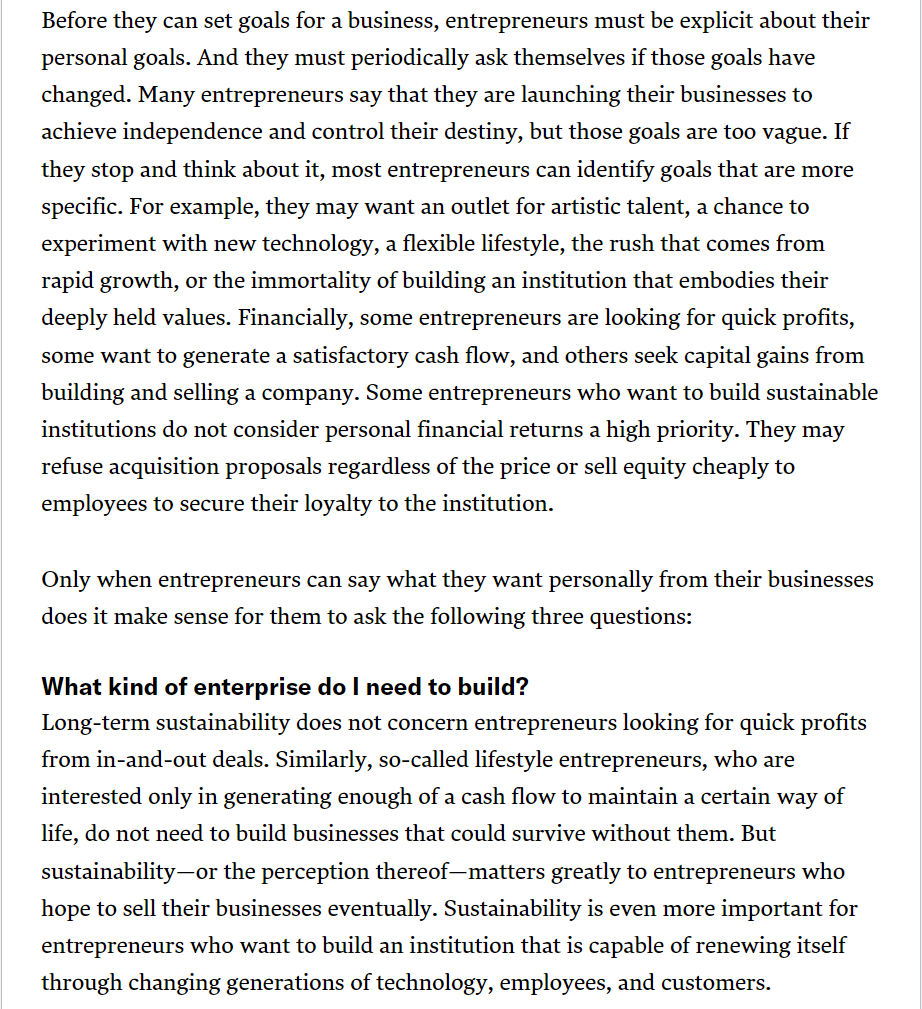
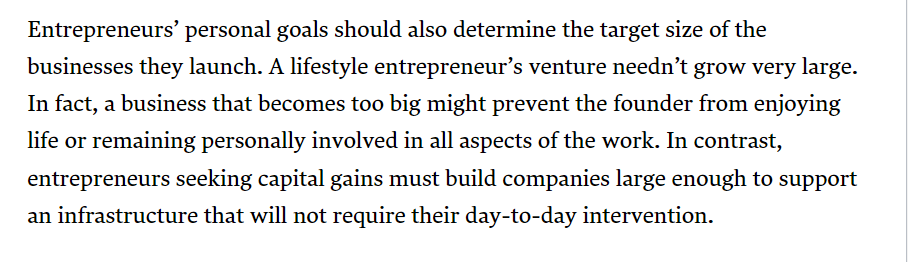
DECISION MAKING The Questions Every Entrepreneur Must Answer by Amar Bhide From the November-December 1996 Issue f the hundreds of thousands of business ventures that entrepreneurs launch every year, many never get off the ground. Others fizzle after spectacular rocket starts. A six-year-old condiment company has attracted loyal customers but has achieved less than $500,000 in sales. The company's gross margins can't cover its overhead or provide adequate incomes for the founder and the family members who participate in the business. Additional growth will require a huge capital infusion, but investors and potential buyers aren't keen on small, marginally profitable ventures, and the family has exhausted its resources. Another young company, profitable and growing rapidly, imports novelty products from the Far East and sells them to large U.S. chain stores. The founder, who has a paper net worth of several million dollars, has been nominated for entrepreneurof-the-year awards. But the company's spectacular growth has forced him to reinvest most of his profits to finance the business's growing inventories and and tempted customers to deal directly with the Asian suppliers. If the founder doesn't do something soon, the business will evaporate. Like most entrepreneurs, the condiment maker and the novelty importer get plenty of confusing counsel: Diversify your product line. Stick to your knitting. Raise capital by selling equity. Don't risk losing control just because things are bad. Delegate. Act decisively. Hire a professional manager. Watch your fixed costs. Why all the conflicting advice? Because the range of options-and problems-that founders of young businesses confront is vast. The manager of a mature company might ask, What business are we in? or How can we exploit our core competencies? Entrepreneurs must continually ask themselves what business they want to be in and what capabilities they would like to develop. Similarly, the organizational weaknesses and imperfections that entrepreneurs confront every day would cause the managers of a mature company to panic. Many young enterprises simultaneously lack coherent strategies, competitive strengths, talented employees, adequate controls, and clear reporting relationships. The problems entrepreneurs confront every day would overwhelm most managers. The entrepreneur can tackle only one or two opportunities and problems at a time. Therefore, just as a parent should focus more on a toddler's motor skills than on his or her social skills, the entrepreneur must distinguish critical issues from normal growing pains. Entrepreneurs cannot expect the sort of guidance and comfort that an authoritative child-rearing book can offer parents. Human beings pass through physiological and psychological stages in a more or less predetermined order, but companies do not share a developmental path. Microsoft, Lotus, WordPerfect, and Intuit, although competing in the same industry, did not evolve in the same way. Each of those companies has its own story to tell about the development of strategy and organizational structures and about the evolution of the founder's role in the enterprise. Every company has its own story to tell about the development of systems and strategy. The options that are appropriate for one entrepreneurial venture may be completely inappropriate for another. Entrepreneurs must make a bewildering number of decisions, and they must make the decisions that are right for them. The framework I present here and the accompanying rules of thumb will help entrepreneurs analyze the situations in which they find themselves, establish priorities among the opportunities and problems they face, and make rational decisions about the future. This framework, which is based on my observation of several hundred start-up ventures over eight years, doesn't prescribe answers. Instead, it helps entrepreneurs pose useful questions, identify important issues, and evaluate solutions. The framework applies whether the enterprise is a small printing shop trying to stay in business or a catalog retailer seeking hundreds of millions of dollars in sales. And it works at almost any point in a venture's evolution. Entrepreneurs should use the framework to evaluate their companies' position and trajectory often - not just when problems appear. The framework consists of a three-step sequence of questions. The first step clarifies entrepreneurs' current goals, the second evaluates their strategies for attaining those goals, and the third helps them assess their capacity to execute their strategies. The hierarchical organization of the questions requires entrepreneurs to confront the basic, big-picture issues before they think about refinements and details. (See the exhibit "An Entrepreneur's Guide to the Big Issues.") This approach does not assume that all companies-or all entrepreneurs-develop in the same way, so it does not prescribe a one-size-fits-all methodology for success. An Entrepreneur's Guide to the Big Issues Clarifying Goals: Where Do I Want to Go? An entrepreneur's personal and business goals are inextricably linked. Whereas the manager of a public company has a fiduciary responsibility to maximize value for shareholders, entrepreneurs build their businesses to fulfill personal goals and, if necessary, seek investors with similar goals. Before they can set goals for a business, entrepreneurs must be explicit about their personal goals. And they must periodically ask themselves if those goals have changed. Many entrepreneurs say that they are launching their businesses to achieve independence and control their destiny, but those goals are too vague. If they stop and think about it, most entrepreneurs can identify goals that are more specific. For example, they may want an outlet for artistic talent, a chance to experiment with new technology, a flexible lifestyle, the rush that comes from rapid growth, or the immortality of building an institution that embodies their deeply held values. Financially, some entrepreneurs are looking for quick profits, some want to generate a satisfactory cash flow, and others seek capital gains from building and selling a company. Some entrepreneurs who want to build sustainable institutions do not consider personal financial returns a high priority. They may refuse acquisition proposals regardless of the price or sell equity cheaply to employees to secure their loyalty to the institution. Only when entrepreneurs can say what they want personally from their businesses does it make sense for them to ask the following three questions: What kind of enterprise do I need to build? Long-term sustainability does not concern entrepreneurs looking for quick profits from in-and-out deals. Similarly, so-called lifestyle entrepreneurs, who are interested only in generating enough of a cash flow to maintain a certain way of life, do not need to build businesses that could survive without them. But sustainability-or the perception thereof-matters greatly to entrepreneurs who hope to sell their businesses eventually. Sustainability is even more important for entrepreneurs who want to build an institution that is capable of renewing itself through changing generations of technology, employees, and customers. Entrepreneurs' personal goals should also determine the target size of the businesses they launch. A lifestyle entrepreneur's venture needn't grow very large. In fact, a business that becomes too big might prevent the founder from enjoying life or remaining personally involved in all aspects of the work. In contrast, entrepreneurs seeking capital gains must build companies large enough to support an infrastructure that will not require their day-to-day intervention
Step by Step Solution
There are 3 Steps involved in it

Get step-by-step solutions from verified subject matter experts