



Question: You now want to repeat the above with the same hash function but this time to modify two documents m1 and m2 with k possible
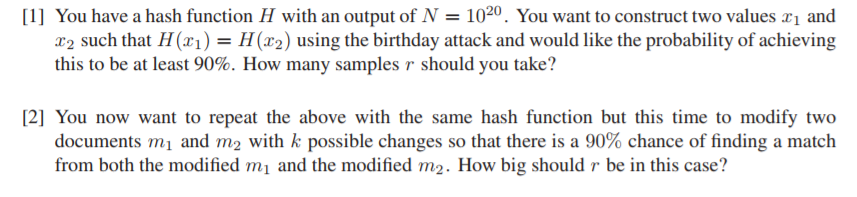 You now want to repeat the above with the same hash function but this time to modify two documents m1 and m2 with k possible changes so that there is a 90% chance of finding a match from both the modified m1 and the modified m2 . How big should r be in this case?
You have a hash function H with an output of N = 1020 You want to construct two values ri and r2 such that H(xi) -H(2) using the birthday attack and would like the probability of achieving this to be at least 90%. How many samples r should you take? [2] You now want to repeat the above with the same hash function but this time to modify two documents m, and m2 with k possible changes so that there is a 90% chance of finding a match from both the modified m and the modified m2. How big should r be in this case? You have a hash function H with an output of N = 1020 You want to construct two values ri and r2 such that H(xi) -H(2) using the birthday attack and would like the probability of achieving this to be at least 90%. How many samples r should you take? [2] You now want to repeat the above with the same hash function but this time to modify two documents m, and m2 with k possible changes so that there is a 90% chance of finding a match from both the modified m and the modified m2. How big should r be in this case
Step by Step Solution
There are 3 Steps involved in it

Get step-by-step solutions from verified subject matter experts