Question: You only need to write the Song class in Java based on the ULM. Some of the method descriptions are below for this class. Will
You only need to write the Song class in Java based on the ULM. Some of the method descriptions are below for this class. Will thumbs up
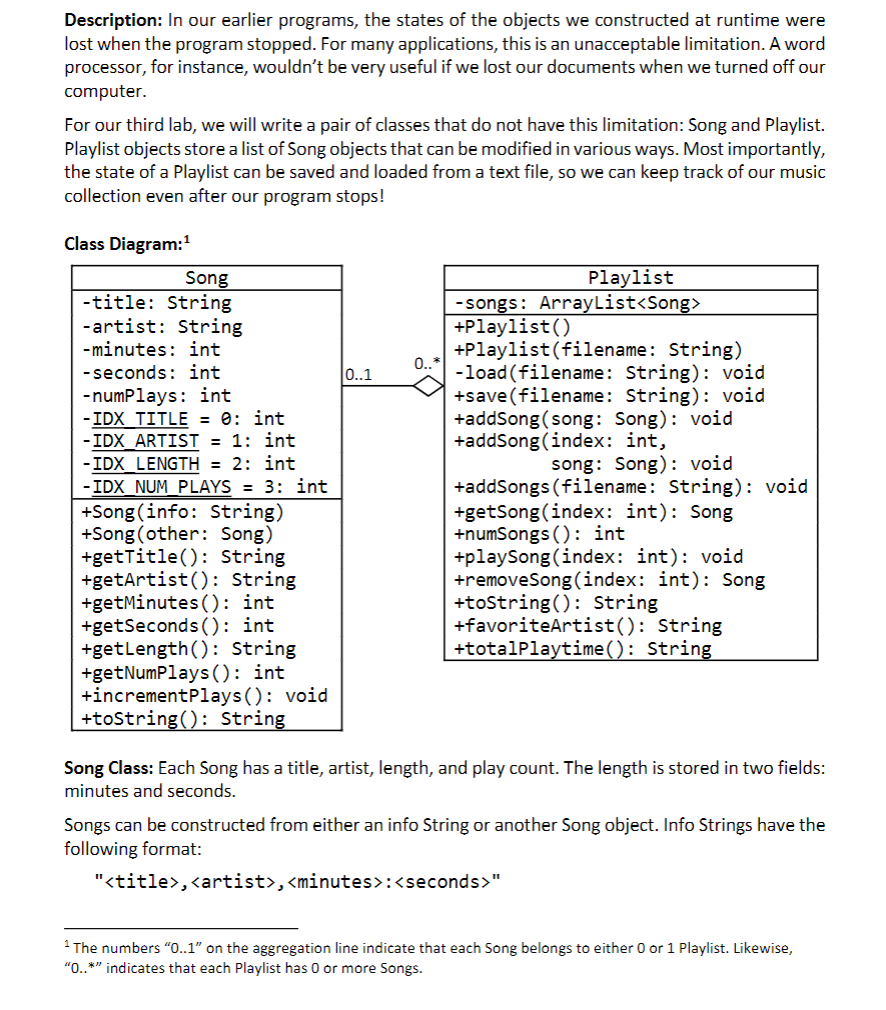
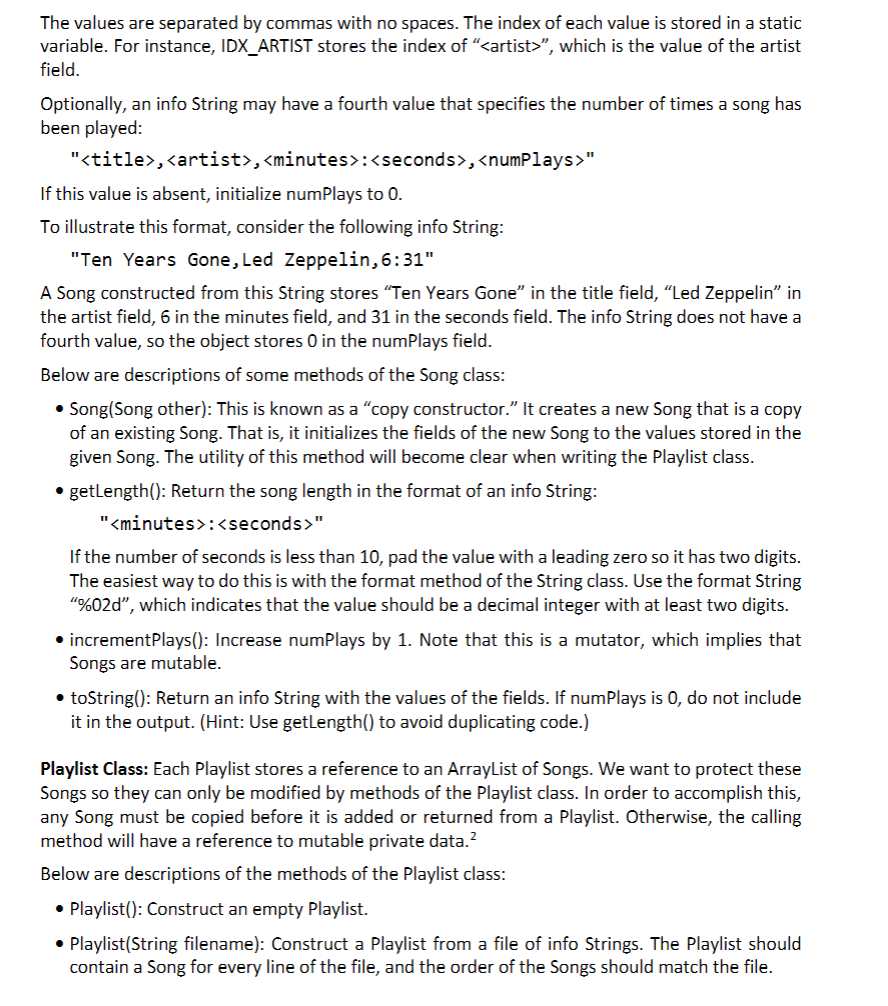
Description: In our earlier programs, the states of the objects we constructed at runtime were lost when the program stopped. For many applications, this is an unacceptable limitation. A word processor, for instance, wouldn't be very useful if we lost our documents when we turned off our computer. For our third lab, we will write a pair of classes that do not have this limitation: Song and Playlist. Playlist objects store a list of Song objects that can be modified in various ways. Most importantly, the state of a Playlist can be saved and loaded from a text file, so we can keep track of our music collection even after our program stops! 0..1 0..1 Class Diagram: Song -title: String -artist: String -minutes: int -seconds: int -numPlays: int -IDX TITLE = 0; int -IDX ARTIST = 1: int -IDX_LENGTH = 2: int - IDX_NUM PLAYS = 3: int +Song (info: String) +Song (other: Song) +getTitle(): String +getArtist(): String +getMinutes(): int +getSeconds(): int +getLength(): String +getNumPlays(): int +incrementPlays(): void +toString(): String Playlist -songs: ArrayList +Playlist) +Playlist(filename: String) - load(filename: String): void +save(filename: String): void +addSong (song: Song): void +addSong(index: int, song: Song): void +addSongs (filename: String): void +getSong(index: int): Song +numSongs(): int +playSong (index: int): void +removesong(index: int): Song +toString(): String +favoriteArtist(): String +totalPlaytime(): String tostrinsong(indi int): , Song Class: Each Song has a title, artist, length, and play count. The length is stored in two fields: minutes and seconds. Songs can be constructed from either an info String or another Song object. Info Strings have the following format: ", <artist>,<minutes>: <seconds>" The numbers "0.1" on the aggregation line indicate that each Song belongs to either 0 or 1 Playlist. Likewise, "O..*" indicates that each Playlist has 0 or more Songs. The values are separated by commas with no spaces. The index of each value is stored in a static variable. For instance, IDX_ARTIST stores the index of "<artist>", which is the value of the artist field. Optionally, an info String may have a fourth value that specifies the number of times a song has been played: "<title>, <artist>, <minutes>:<seconds>, <numplays>" If this value is absent, initialize numPlays to 0. To illustrate this format, consider the following info String: "Ten Years Gone, Led Zeppelin, 6:31" A Song constructed from this String stores "Ten Years Gone" in the title field, "Led Zeppelin" in the artist field, 6 in the minutes field, and 31 in the seconds field. The info String does not have a fourth value, so the object stores in the numPlays field. Below are descriptions of some methods of the Song class: Song(Song other): This is known as a "copy constructor." It creates a new song that is a copy of an existing song. That is, it initializes the fields of the new Song to the values stored in the given Song. The utility of this method will become clear when writing the Playlist class. .getLength(): Return the song length in the format of an info String: "<minutes>: <seconds>" If the number of seconds is less than 10, pad the value with a leading zero so it has two digits. The easiest way to do this is with the format method of the String class. Use the format String "%02d", which indicates that the value should be a decimal integer with at least two digits. incrementPlays(): Increase numPlays by 1. Note that this is a mutator, which implies that Songs are mutable. .toString(): Return an info String with the values of the fields. If numPlays is 0, do not include it in the output. (Hint: Use getLength() to avoid duplicating code.) Playlist Class: Each Playlist stores a reference to an ArrayList of Songs. We want to protect these Songs so they can only be modified by methods of the Playlist class. In order to accomplish this, any song must be copied before it is added or returned from a Playlist. Otherwise, the calling method will have a reference to mutable private data.? Below are descriptions of the methods of the Playlist class: Playlist(): Construct an empty Playlist. Playlist(String filename): Construct a Playlist from a file of info Strings. The Playlist should contain a Song for every line of the file, and the order of the Songs should match the file</seconds></minutes><umplays></umplays></numplays></seconds></minutes></artist>









 Study Help