







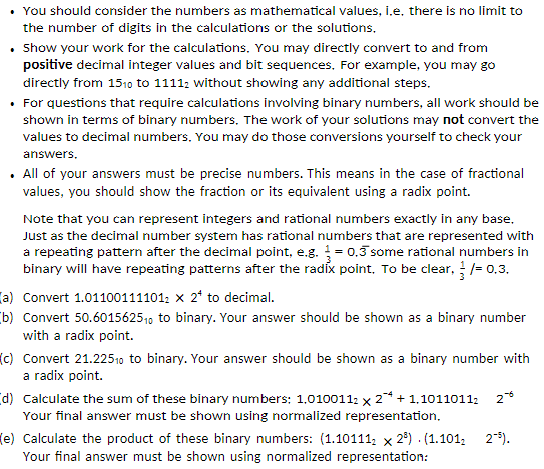
Question: You should consider the numbers as mathematical values, i . e , there is no limit to the number of digits in the calculations or
You should consider the numbers as mathematical values, ie there is no limit to the number of digits in the calculations or the solutions.
Show your work for the calculations. You may directly convert to and from positive decimal integer values and bit sequences, For example, you may go directly from to without showing any additional steps.
For questions that require calculations involving binary numbers, all work should be shown in terms of binary numbers. The work of your solutions may not convert the values to decimal numbers. You may do those conversions yourself to check your answers.
All of your answers must be precise numbers. This means in the case of fractional values, you should show the fraction or its equivalent using a radix point.
Note that you can represent integers and rational numbers exactly in any base. Just as the decimal number system has rational numbers that are represented with a repeating pattern after the decimal point, eg some rational numbers in binary will have repeating patterns after the radix point, To be clear,
a Convert to decimal.
b Convert to binary. Your answer should be shown as a binary number with a radix point.
c Convert to binary. Your answer should be shown as a binary number with a radix point.
d Calculate the sum of these binary numbers: Your final answer must be shown using normalized representation.
e Calculate the product of these binary numbers: Your final answer must be shown using normalized representation:
Step by Step Solution
There are 3 Steps involved in it
1 Expert Approved Answer
Step: 1 Unlock

Question Has Been Solved by an Expert!
Get step-by-step solutions from verified subject matter experts
Step: 2 Unlock
Step: 3 Unlock
 Study Help